
PCB Cleaning Process
The PCB cleaning process is a critical step in PCB Assembly that removes contaminants such as flux residues, dust, oils, and ionic impurities from the surface of a printed circuit board. Proper cleaning is essential after SMT Assembly and soldering to ensure long-term reliability, electrical performance, and compatibility with processes like conformal coating.
Even when using “no-clean” flux, residues can still affect sensitive electronics, especially in high-reliability applications.
Why PCB Cleaning is Important
During PCB Assembly, several contaminants can remain on the board:
- Flux residues from soldering
- Solder paste residues
- Dust and airborne particles
- Fingerprints and oils
- Ionic contamination
If not removed, these can cause:
- Corrosion
- Electrical leakage or short circuits
- Poor adhesion of conformal coating
- Reduced product lifespan
👉 Cleaning ensures the PCB meets reliability and quality standards.
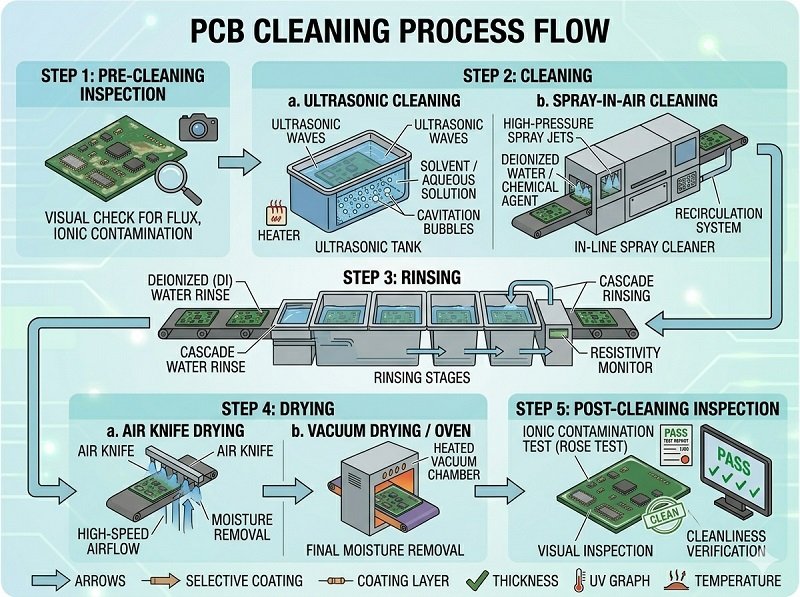
PCB Cleaning Process Steps
Pre-Clean Inspection
- Identify contamination level
- Determine cleaning method
- Check sensitive components
Cleaning Stage
The PCB is cleaned using appropriate methods (see below).
Rinsing
- Removes cleaning agents and dissolved residues
- Prevents chemical contamination
Drying
- Ensures no moisture remains
- Uses hot air or vacuum drying
Final Inspection
- Verifies cleanliness
- May include ionic contamination testing
Common PCB Cleaning Methods
Aqueous Cleaning (Water-Based)
- Uses deionized (DI) water and cleaning agents
- Environmentally friendly
- Suitable for most SMT Assembly processes
Solvent Cleaning
- Uses chemical solvents to dissolve residues
- Effective for stubborn contaminants
- Requires proper handling and ventilation
Semi-Aqueous Cleaning
- Combines solvent and water cleaning
- High efficiency for complex residues
Ultrasonic Cleaning
- Uses high-frequency sound waves
- Removes contaminants from hard-to-reach areas
- Not suitable for all components
Manual Cleaning
- Brush + solvent method
- Used for rework or small batches
Cleaning Equipment Used
- Inline cleaning machines
- Batch cleaning systems
- Spray-in-air cleaners
- Ultrasonic cleaning tanks
Modern factories integrate cleaning into automated PCB Assembly lines.
Standards for PCB Cleanliness
Cleanliness is often measured by:
- Ionic contamination testing (ROSE test)
- Visual inspection under magnification
- IPC standards (e.g., IPC-TM-650)
👉 These ensure the PCB meets industry quality requirements.
Advantages of Proper PCB Cleaning
- Improves electrical reliability
- Prevents corrosion and leakage
- Enhances conformal coating adhesion
- Reduces field failures
- Extends product lifespan
When is PCB Cleaning Required?
Cleaning is especially important for:
- High-reliability electronics (medical, aerospace)
- Fine-pitch or high-density boards
- Boards requiring conformal coating
- Harsh environment applications
Limitations and Considerations
- Adds extra cost and process time
- Incorrect cleaning can damage components
- Must match cleaning method with materials used
- Requires proper drying to avoid moisture issues
Best Practices for PCB Cleaning
- Choose the right flux and cleaning method
- Use DI water for rinsing
- Control cleaning temperature and time
- Ensure complete drying
- Test cleanliness regularly
Role in PCB Assembly Process
In a typical PCB Assembly workflow:
- Performed after soldering (SMT or through-hole)
- Before conformal coating or final testing
- Ensures the board is free from harmful residues
Conclusion
The PCB cleaning process is an essential part of SMT Assembly, ensuring that circuit boards are free from contaminants that could compromise performance and reliability. With proper cleaning methods and quality control, manufacturers can significantly improve product durability and reduce long-term failures.
Need a fast and accurate PCB assembly quotation? Submit your request in seconds.
We provide professional PCB assembly services including SMT, DIP, and full turnkey solutions.
✔ NDA Available ✔ Fast Quotation Within 24 Hours ✔ ISO Certified Factory ✔ One-stop PCB & PCBA Service
 English
  Deutsch
  Français
  Português do Brasil
  Español
  日本語
日本語  Nederlands
  Italiano
  Русский
  한국어
한국어  العربية
  Svenska
  Polski
  Türkçe
  繁體中文
繁體中文