
X-ray Inspection in PCB Assembly
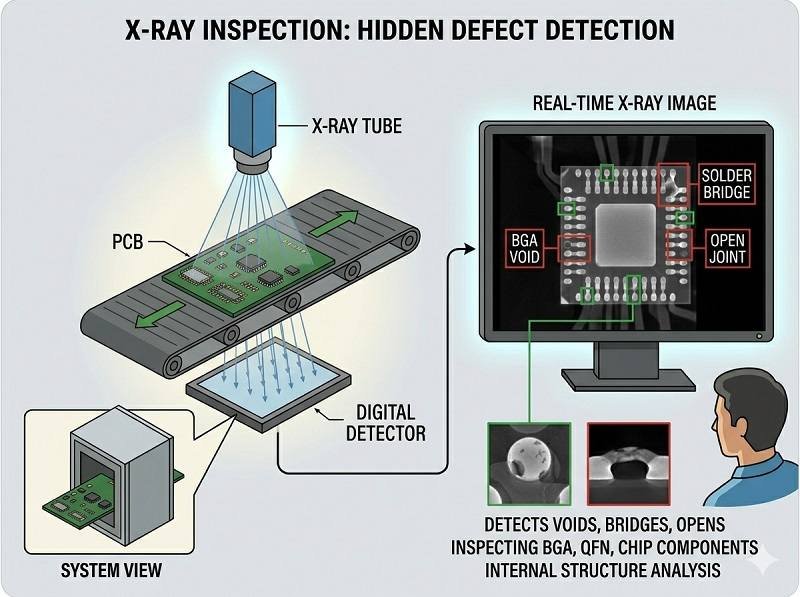
X-ray inspection is an advanced, non-destructive testing method used in PCB Assembly to examine hidden solder joints and internal structures that cannot be seen with standard optical inspection. It plays a crucial role in modern SMT Assembly, especially for complex components like BGA, QFN, and multilayer boards.
By using X-ray imaging, manufacturers can ensure the quality and reliability of solder connections inside the PCB without damaging the product.
Why X-ray Inspection is Needed
In many SMT components, solder joints are hidden underneath the package:
- BGA (Ball Grid Array) chips
- QFN (Quad Flat No-lead) packages
- LGA and other bottom-terminated components
Traditional AOI cannot inspect these areas, making X-ray inspection essential in high-reliability PCB Assembly.
How X-ray Inspection Works
X-ray inspection systems operate by:
- Emitting X-rays through the PCB
- Capturing the transmitted radiation on a detector
- Creating an image based on material density differences
- Dense materials (like solder) appear darker
- Less dense areas appear lighter
This allows engineers to analyze internal solder joints and detect hidden defects.
What Defects Can X-ray Detect?
X-ray inspection is highly effective at identifying:
- Solder voids (air gaps inside joints)
- Bridging (short circuits between pads)
- Insufficient or excess solder
- Misaligned BGA balls
- Head-in-pillow defects
- Cracked or damaged solder joints
👉 These defects are often invisible in standard SMT Assembly inspection methods.
Types of X-ray Inspection Systems
2D X-ray Inspection
- Produces flat images
- Faster and more cost-effective
- Suitable for general inspection
3D X-ray (CT – Computed Tomography)
- Creates 3D cross-sectional images
- Allows detailed internal analysis
- Ideal for complex PCB Assembly and failure analysis
Where X-ray Inspection is Used in PCB Assembly
X-ray inspection is typically performed:
- After reflow soldering
- During quality control and sampling
- In failure analysis and debugging
It is often used alongside AOI to provide complete inspection coverage.
Advantages of X-ray Inspection
- Non-destructive testing
- Ability to inspect hidden joints
- High accuracy for complex components
- Essential for BGA and fine-pitch devices
- Improves overall PCB Assembly quality
Limitations of X-ray Inspection
- Higher equipment cost
- Slower than AOI for large volumes
- Requires skilled operators for analysis
Despite these limitations, it is indispensable for advanced SMT Assembly.
X-ray vs AOI Inspection
| Feature | X-ray Inspection | AOI Inspection |
|---|---|---|
| Visibility | Internal + hidden joints | Surface only |
| Speed | Moderate | Fast |
| Cost | Higher | Lower |
| Application | BGA, QFN, complex boards | General SMT inspection |
👉 Both methods are complementary in PCB Assembly.
When Should You Use X-ray Inspection?
X-ray inspection is recommended when:
- Using BGA or bottom-mounted components
- Manufacturing high-reliability products (medical, automotive, aerospace)
- Performing failure analysis
- Ensuring strict quality standards
How to Optimize X-ray Inspection in SMT Assembly
- Use X-ray selectively for critical components
- Combine with AOI and SPI for full coverage
- Establish clear inspection criteria
- Train operators for accurate interpretation
Conclusion
X-ray inspection is a vital quality control technique in modern PCB Assembly and SMT Assembly, enabling manufacturers to detect hidden defects that cannot be seen by optical methods. It ensures the reliability of complex electronic products and is especially important for advanced PCB designs.
By integrating X-ray inspection into the production process, manufacturers can significantly improve product quality and reduce the risk of failure in the field.
From design review to delivery — we support every step. Request your PCB assembly quote.
We provide professional PCB assembly services including SMT, DIP, and full turnkey solutions.
✔ NDA Available ✔ Fast Quotation Within 24 Hours ✔ ISO Certified Factory ✔ One-stop PCB & PCBA Service
 English
  Deutsch
  Français
  Português do Brasil
  Español
  日本語
日本語  Nederlands
  Italiano
  Русский
  한국어
한국어  العربية
  Svenska
  Polski
  Türkçe
  繁體中文
繁體中文