
Conformal coating production
Scaling Conformal Coating production from small batches to high-volume manufacturing requires a structured approach across equipment, process control, and quality systems. In PCB Assembly, Prototype PCB Assembly, and SMT Assembly, successful scaling ensures consistent coating quality while improving throughput and reducing cost per unit.
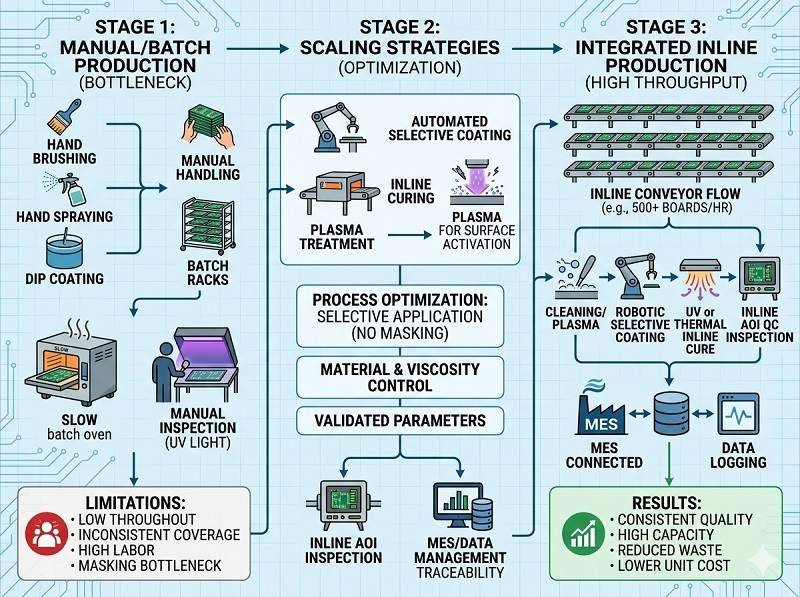
Standardize the coating process
Before scaling, validate and document all key parameters in Prototype PCB Assembly—including coating type, viscosity, thickness, curing profile, and masking strategy. A stable, repeatable process is the foundation for mass PCB Assembly.
Transition from manual to automated systems
Manual spraying or brushing works for prototypes, but scaling requires automation. Implement selective coating machines or robotic spray systems in SMT Assembly to achieve precise, repeatable application and reduce operator variability.
Optimize coating materials
Choose coatings suitable for high-speed production, such as fast-curing acrylics or UV/dual-cure systems. These materials significantly reduce cycle time in large-scale PCB Assembly.
Improve fixturing and handling
Design dedicated fixtures or pallets to hold PCBs securely during coating and curing. Efficient handling systems reduce damage risk and increase throughput in SMT Assembly lines.
Enhance curing capacity
Upgrade from air drying to thermal ovens or UV curing systems to accelerate production. Inline curing solutions are especially important for continuous SMT Assembly operations.
Implement inline production flow
Move from batch processing to inline coating lines where PCBs pass through cleaning, coating, curing, and inspection in a continuous sequence. This dramatically increases efficiency in high-volume PCB Assembly.
Strengthen quality control systems
Scaling production requires robust inspection methods, such as:
- UV inspection for coating coverage
- Thickness measurement tools
- Automated Optical Inspection (AOI)
Consistent quality control ensures that increased volume does not lead to increased defects.
Control environment and process conditions
Maintain stable temperature, humidity, and cleanliness in the coating area. Environmental control is critical to achieving consistent results in large-scale SMT Assembly.
Train personnel and define SOPs
Operators and engineers must follow standardized operating procedures (SOPs). Proper training ensures consistent execution across shifts and production lines.
Integrate with upstream and downstream processes
Coordinate coating with cleaning, masking, and testing steps in PCB Assembly. Seamless integration reduces bottlenecks and improves overall production efficiency.
Scale gradually with validation
Increase production capacity step by step. Validate each stage through pilot runs before full-scale deployment to minimize risks.
Common challenges when scaling
- Inconsistent coating thickness
- Increased defect rates (bubbles, voids)
- Bottlenecks in curing or inspection
- Equipment calibration issues
Addressing these early in Prototype PCB Assembly helps ensure smooth scaling.
Best practices summary
- Automate application and curing
- Use fast-curing, production-friendly materials
- Implement inline processes
- Strengthen inspection and quality control
- Maintain strict environmental control
In conclusion, scaling Conformal Coating production requires transitioning from manual, flexible processes to automated, standardized systems. By optimizing equipment, materials, and workflows in PCB Assembly, SMT Assembly, and Prototype PCB Assembly, manufacturers can achieve high efficiency, consistent quality, and reliable performance at scale.
Get a Conformal Coating Quote
Need fast turnaround for conformal coating projects? Submit your request today.
Send us your requirements and get a fast response from our engineering team.
✔ 24-hour response ✔ Engineering support ✔ Small & Mass Production
Shenzhen Tengxinjie Electronics Co., Ltd.
 English
  Deutsch
  Français
  Português do Brasil
  Español
  日本語
日本語  Nederlands
  Italiano
  Русский
  한국어
한국어  العربية
  Svenska
  Polski
  Türkçe
  繁體中文
繁體中文