
Bubbles in conformal coating
Bubbles in Conformal Coating are a common defect that can compromise protection, insulation, and long-term reliability. In PCB Assembly, Prototype PCB Assembly, and SMT Assembly, bubbles may create weak points where moisture, contaminants, or air can penetrate, leading to corrosion or electrical failure. Preventing bubbles requires proper material handling, surface preparation, and process control.
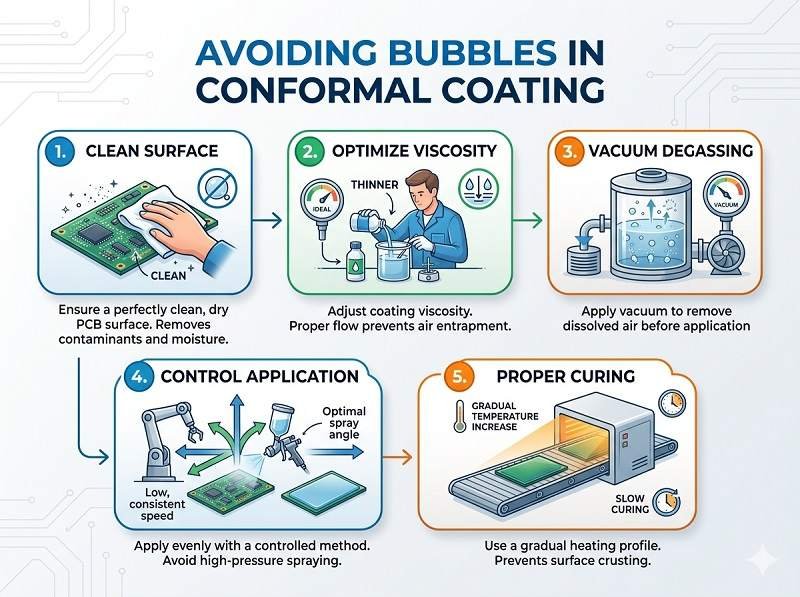
Ensure proper PCB cleaning
One of the main causes of bubbles is contamination such as flux residue, oil, or dust. Before coating in PCB Assembly, the board must be thoroughly cleaned and dried. Residual solvents or moisture can outgas during curing, forming bubbles under the coating.
Control moisture and humidity
Moisture trapped in components or the PCB can vaporize during coating or curing. In SMT Assembly, it’s important to store boards in controlled environments and, if necessary, pre-bake them to remove absorbed moisture before applying Conformal Coating.
Use correct coating viscosity
If the coating is too thick, it may trap air during application. Proper dilution (if allowed by the manufacturer) and maintaining the recommended viscosity help the coating flow smoothly and release trapped air.
Apply coating evenly and at the right speed
Application method matters. Whether spraying, dipping, or brushing, applying the coating too quickly can introduce air bubbles. In automated SMT Assembly lines, parameters such as spray pressure, nozzle distance, and flow rate should be optimized to ensure smooth, even coverage.
Avoid excessive coating thickness
Applying overly thick layers increases the risk of bubble formation and solvent entrapment. It is better to apply multiple thin layers rather than one heavy coat in PCB Assembly processes.
Degas the coating material
Before use, some coatings can be degassed (removing dissolved air) to prevent bubble formation. This is especially useful in Prototype PCB Assembly, where process optimization is being tested.
Allow proper flash-off time
After application, giving the coating time for solvents to evaporate (flash-off) before full curing helps prevent bubbles. Rushing the curing process can trap solvent vapors inside the coating.
Optimize curing conditions
Curing too quickly or at too high a temperature can cause rapid solvent evaporation, leading to bubbling. Controlled curing—whether thermal or UV—ensures a smooth, defect-free finish.
Inspect and adjust process
In Prototype PCB Assembly, visual inspection (often with UV light) helps identify bubble issues early. Process parameters can then be fine-tuned before moving to mass production.
In conclusion, avoiding bubbles in Conformal Coating requires attention to cleaning, moisture control, application technique, and curing conditions. By optimizing these factors in PCB Assembly, SMT Assembly, and Prototype PCB Assembly, manufacturers can achieve a smooth, uniform coating that delivers reliable protection.
Get a Conformal Coating Quote
From SMT assembly to conformal coating, we offer one-stop solutions. Get a quote now.
Send us your requirements and get a fast response from our engineering team.
✔ 24-hour response ✔ Engineering support ✔ Small & Mass Production
Shenzhen Tengxinjie Electronics Co., Ltd.
 English
  Deutsch
  Français
  Português do Brasil
  Español
  日本語
日本語  Nederlands
  Italiano
  Русский
  한국어
한국어  العربية
  Svenska
  Polski
  Türkçe
  繁體中文
繁體中文