
Manual vs automatic Coating
In PCB Assembly and SMT Assembly, both manual and automatic Conformal Coating methods are used, but they serve different purposes. The “better” option depends on production volume, precision requirements, and cost considerations.
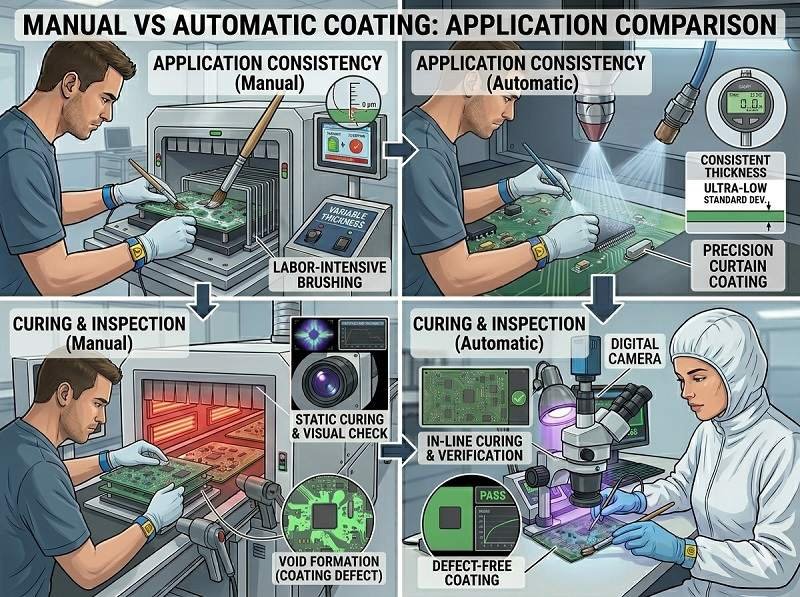
What is manual Conformal Coating
Manual coating involves applying Conformal Coating by hand using tools such as brushes or spray guns.
Advantages:
- Low initial cost (no expensive equipment)
- Flexible for prototypes and small batches
- Ideal for repair, rework, or touch-up
Disadvantages:
- Inconsistent coating thickness
- Operator-dependent quality
- Lower efficiency for large-scale PCB Assembly
- Higher risk of defects (bubbles, uneven coverage)
Manual coating is typically used in low-volume or custom SMT Assembly projects.
What is automatic Conformal Coating
Automatic coating uses machines such as selective coating systems or automated spray equipment.
Advantages:
- High precision and repeatability
- Consistent coating thickness
- Faster production speed
- Reduced material waste
- Easily integrated into inline SMT Assembly
Disadvantages:
- Higher initial investment
- Requires programming and setup
- Less flexible for one-off or prototype jobs
Automatic coating is widely used in mass production PCB Assembly.
Key comparison
Consistency
Automatic coating provides uniform and repeatable results, while manual coating varies depending on the operator.
Efficiency
Automated systems are much faster and suitable for high-volume SMT Assembly.
Cost
Manual coating has low startup cost but higher labor cost over time. Automatic coating requires higher upfront investment but lowers cost per unit.
Flexibility
Manual coating is more adaptable for small runs and rework, while automatic systems are optimized for repeat production.
Quality
Automatic coating delivers higher and more stable quality, especially for complex PCBs.
When to choose manual coating
- Prototyping and R&D
- Small batch production
- Repair and rework
- Budget-limited projects
When to choose automatic coating
- High-volume PCB Assembly
- Complex PCB designs requiring precision
- Strict quality and reliability requirements
- Automotive, industrial, and medical electronics
Final conclusion
For most modern SMT Assembly applications, automatic Conformal Coating is the better choice due to its consistency, efficiency, and scalability. However, manual coating remains valuable for prototyping, low-volume production, and repair work. The best solution often involves using both methods at different stages of PCB Assembly.
Get a Conformal Coating Quote
Want to optimize coating cost without compromising quality? Contact us now.
Send us your requirements and get a fast response from our engineering team.
✔ 24-hour response ✔ Engineering support ✔ Small & Mass Production
Shenzhen Tengxinjie Electronics Co., Ltd.
 English
  Deutsch
  Français
  Português do Brasil
  Español
  日本語
日本語  Nederlands
  Italiano
  Русский
  한국어
한국어  العربية
  Svenska
  Polski
  Türkçe
  繁體中文
繁體中文