
Solvent-based coating
Solvent-based coating is a type of Conformal Coating in which the protective material (such as acrylic, polyurethane, or silicone resin) is dissolved in an organic solvent. This solvent acts as a carrier, allowing the coating to be easily applied to the surface of a PCB. After application, the solvent evaporates, leaving behind a thin, uniform protective film.
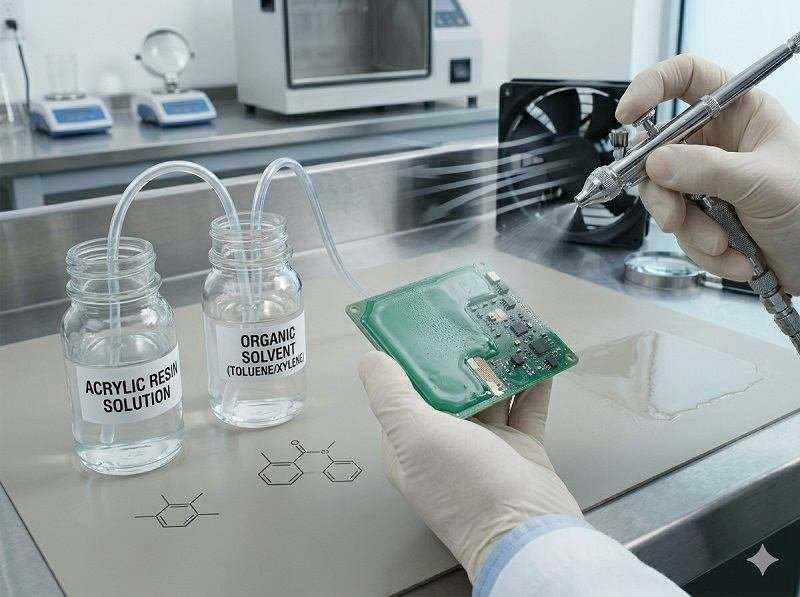
In PCB Assembly, Prototype PCB Assembly, and SMT Assembly, solvent-based coatings are widely used due to their ease of application, fast drying time, and reliable performance.
How solvent-based coating works
When applied—typically by spraying, dipping, or brushing—the liquid coating spreads evenly across the board. As the solvent evaporates under ambient conditions or mild heating, the solid resin forms a continuous insulating and պաշտպանիչ layer. This process is relatively simple and does not require complex curing equipment.
Key advantages
Solvent-based Conformal Coating offers several benefits:
- Easy application: Compatible with manual and automated processes in SMT Assembly
- Good surface coverage: Flows well into tight spaces and around components
- Fast drying: Suitable for high-throughput PCB Assembly lines
- Reworkability: Many solvent-based coatings (especially acrylic) can be removed with solvents
Common materials used
Most traditional conformal coatings fall into this category, including:
- Acrylic coatings (most common)
- Polyurethane coatings
- Some silicone-based coatings
In Prototype PCB Assembly, solvent-based coatings are often chosen for their flexibility and ease of testing different formulations.
Limitations
Despite their advantages, solvent-based coatings also have some drawbacks:
- VOC emissions: Organic solvents can release volatile organic compounds, impacting the environment and worker safety
- Flammability: Requires proper handling and ventilation
- Shrinkage: As solvent evaporates, slight thickness reduction may occur
Because of these concerns, some manufacturers are shifting toward water-based or UV-curable alternatives in modern PCB Assembly processes.
Applications
Solvent-based coatings are suitable for a wide range of electronics, including consumer devices, industrial controls, and telecommunications equipment, where reliable moisture and contamination protection is needed.
In conclusion, solvent-based coating is a traditional and widely used form of Conformal Coating that offers ease of use, fast processing, and good protective performance. It remains a practical solution in PCB Assembly, SMT Assembly, and Prototype PCB Assembly, especially where reworkability and cost-effectiveness are important.
Get a Conformal Coating Quote
Want to optimize coating cost without compromising quality? Contact us now.
Send us your requirements and get a fast response from our engineering team.
✔ 24-hour response ✔ Engineering support ✔ Small & Mass Production
Shenzhen Tengxinjie Electronics Co., Ltd.
 English
  Deutsch
  Français
  Português do Brasil
  Español
  日本語
日本語  Nederlands
  Italiano
  Русский
  한국어
한국어  العربية
  Svenska
  Polski
  Türkçe
  繁體中文
繁體中文