
Thickness of Conformal Coating
In modern electronics manufacturing, Conformal Coating plays a critical role in protecting circuit boards from environmental damage such as moisture, dust, chemicals, and temperature fluctuations. Whether in PCB Assembly, Prototype PCB Assembly, or SMT Assembly, understanding the correct coating thickness is essential to ensure reliability without compromising performance.
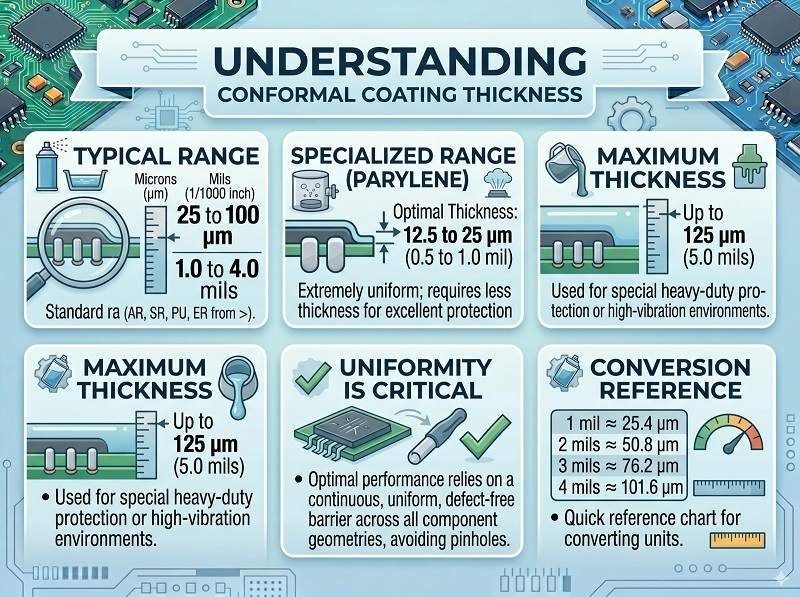
Conformal coating thickness typically ranges between 25 to 250 microns (µm), depending on the coating material, application method, and the end-use environment of the product. The most commonly used coatings include acrylic, silicone, polyurethane, and epoxy, each offering different protective properties and thickness requirements.
For example, acrylic coatings are often applied at a thickness of 25–75 µm, making them suitable for general-purpose electronics where moderate protection is sufficient. Silicone coatings, on the other hand, are usually thicker, ranging from 50–200 µm, and are preferred in high-temperature or high-humidity environments due to their flexibility and thermal stability. Polyurethane and epoxy coatings may also fall within similar or slightly higher thickness ranges, depending on the level of chemical resistance required.
In PCB Assembly processes, maintaining consistent coating thickness is crucial. If the coating is too thin, it may fail to provide adequate protection, leading to corrosion or electrical leakage. Conversely, overly thick coatings can cause issues such as difficulty in rework, added weight, and potential interference with connectors or moving parts.
During SMT Assembly, components are densely packed, making uniform coating application more challenging. Advanced techniques such as selective coating or automated spray systems are often used to ensure precise thickness control, especially in high-volume production.
For Prototype PCB Assembly, flexibility is key. Engineers may experiment with different coating thicknesses to determine the optimal balance between protection and performance. This stage is critical for validating the design before moving into full-scale production.
Measurement of conformal coating thickness can be performed using methods such as wet film gauges, dry film thickness measurement tools, or non-destructive techniques like UV inspection (for fluorescent coatings). Consistency and adherence to industry standards, such as IPC-CC-830, are important for quality assurance.
In conclusion, the thickness of Conformal Coating is not a one-size-fits-all parameter. It must be carefully selected based on the application environment, material type, and manufacturing process. Proper control during PCB Assembly, SMT Assembly, and Prototype PCB Assembly ensures long-term reliability and optimal performance of electronic products.
Get a Conformal Coating Quote
Have special coating requirements? Send us your PCB files for evaluation.
Send us your requirements and get a fast response from our engineering team.
✔ 24-hour response ✔ Engineering support ✔ Small & Mass Production
Shenzhen Tengxinjie Electronics Co., Ltd.




 English
  Deutsch
  Français
  Português do Brasil
  Español
  日本語
日本語  Nederlands
  Italiano
  Русский
  한국어
한국어  العربية
  Svenska
  Polski
  Türkçe
  繁體中文
繁體中文