
Best chemical resistance Coating
When it comes to chemical protection in electronics, selecting the right Conformal Coating is essential for ensuring long-term reliability in harsh environments. In PCB Assembly, Prototype PCB Assembly, and SMT Assembly, exposure to fuels, solvents, acids, and industrial chemicals can quickly degrade standard coatings if the wrong material is chosen.
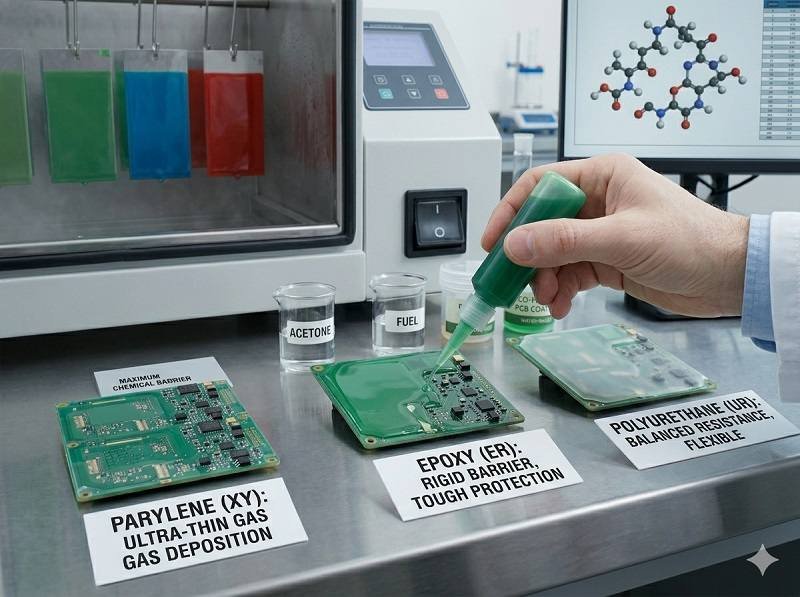
Among all conformal coating types, epoxy (ER) and polyurethane (UR) coatings generally offer the best chemical resistance, but they differ in performance and practicality.
Epoxy coatings – highest chemical resistance
Epoxy-based Conformal Coating provides the strongest protection against aggressive chemicals, including acids, alkalis, and solvents. It forms a hard, dense, and highly impermeable barrier that prevents chemical penetration. This makes epoxy the top choice for applications in heavy industry, automotive engine compartments, and chemical processing environments.
However, epoxy coatings are very rigid and difficult to remove, which limits their use in applications requiring rework or repair. In PCB Assembly, they are typically used when maximum protection outweighs flexibility and serviceability.
Polyurethane coatings – balanced performance
Polyurethane coatings also offer excellent resistance to solvents, fuels, and oils, making them a popular choice in industrial and outdoor electronics. While slightly less resistant than epoxy in extreme cases, polyurethane provides a better balance between chemical protection and flexibility.
In SMT Assembly, polyurethane is often preferred when boards may experience both chemical exposure and mechanical stress. It is also somewhat easier to rework than epoxy, though still more challenging than acrylic coatings.
Other coatings comparison
- Silicone coatings provide good moisture and temperature resistance but only moderate chemical resistance.
- Acrylic coatings offer basic protection and are easy to remove, but they are not suitable for strong chemical environments.
- Parylene coatings provide excellent barrier properties and chemical resistance, especially in thin, uniform layers, but their higher cost and specialized process limit widespread use.
Selection considerations
In Prototype PCB Assembly, engineers often evaluate epoxy and polyurethane coatings under real chemical exposure conditions to determine the best fit. Factors such as coating thickness, adhesion, and curing quality also influence overall resistance.
In conclusion, epoxy coatings provide the best chemical resistance, while polyurethane coatings offer an excellent balance of protection and practicality. Choosing the right Conformal Coating during PCB Assembly, SMT Assembly, and Prototype PCB Assembly ensures reliable performance in chemically aggressive environments.
Get a Conformal Coating Quote
Need professional support for conformal coating? Submit your requirements and get a response within 12 hours.
Send us your requirements and get a fast response from our engineering team.
✔ 24-hour response ✔ Engineering support ✔ Small & Mass Production
Shenzhen Tengxinjie Electronics Co., Ltd.

 English
  Deutsch
  Français
  Português do Brasil
  Español
  日本語
日本語  Nederlands
  Italiano
  Русский
  한국어
한국어  العربية
  Svenska
  Polski
  Türkçe
  繁體中文
繁體中文