
Best Coating for automotive PCBA
In automotive PCB Assembly and SMT Assembly, there is no single “one-size-fits-all” Conformal Coating, but silicone and parylene are generally considered the best choices, depending on the application environment.
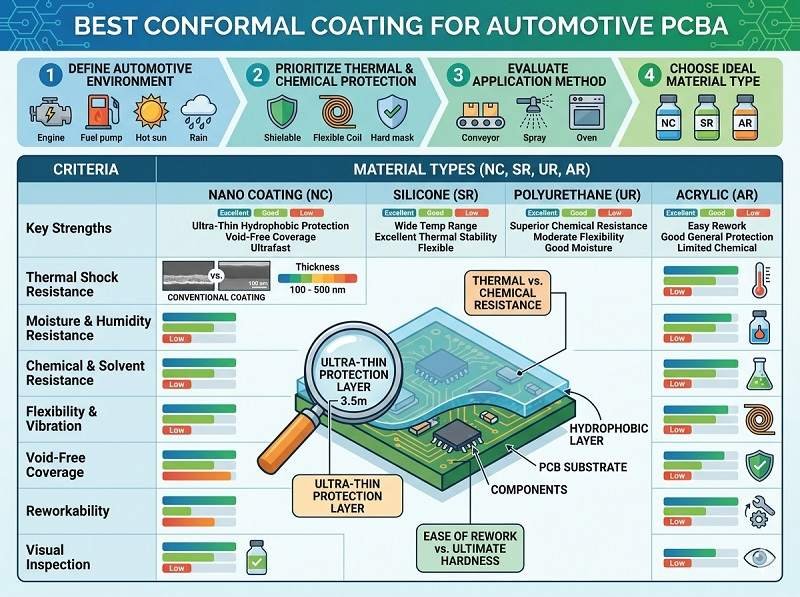
Best overall: silicone Conformal Coating
Silicone is the most widely used coating for automotive PCBA, especially in harsh environments like engine compartments.
Key advantages:
- Wide temperature range (-55°C to 200°C+)
- Excellent flexibility to handle vibration and thermal cycling
- Strong resistance to moisture, salt spray, and corrosion
- Good electrical insulation for dense circuits
Because automotive electronics face heat, vibration, and humidity simultaneously, silicone provides the best balance of performance and reliability. It is commonly used in engine control units, sensors, and power modules.
High-end option: parylene Conformal Coating
Parylene is the premium solution for critical automotive electronics.
Key advantages:
- Ultra-thin, pinhole-free coating with complete coverage
- Exceptional resistance to moisture, chemicals, fuels, and salt
- Works in extreme temperature ranges (very low to very high)
Limitations:
- Higher cost
- Requires vacuum deposition process
Parylene is typically used in safety-critical systems like ADAS, airbag controllers, and high-reliability automotive electronics.
Strong alternative: polyurethane (urethane)
Polyurethane Conformal Coating is also widely used in automotive applications.
Best for:
- Exposure to fuels, oils, and solvents
- Industrial and under-hood environments
It offers excellent chemical resistance and durability, making it suitable for harsh automotive conditions.
Other coatings in automotive PCBA
Acrylic
- Low cost and easy to apply
- Suitable for non-critical systems (e.g., infotainment)
- Limited temperature and chemical resistance
Epoxy
- Very strong and durable
- Poor flexibility → may crack under vibration and thermal stress
How to choose the right coating
For automotive PCB Assembly, selection depends on the working environment:
- High temperature + vibration → Silicone (best overall)
- Extreme reliability / safety-critical → Parylene
- Chemical exposure (fuel, oil) → Polyurethane
- Cost-sensitive, low-stress applications → Acrylic
Final conclusion
For most automotive SMT Assembly applications, silicone Conformal Coating is the best overall choice due to its ability to handle heat, vibration, and moisture simultaneously. For high-end or safety-critical systems, parylene provides the highest level of protection, while polyurethane serves as a strong option for chemically harsh environments.
Get a Conformal Coating Quote
Have questions about conformal coating for your PCB? Our engineers are ready to help.
Send us your requirements and get a fast response from our engineering team.
✔ 24-hour response ✔ Engineering support ✔ Small & Mass Production
Shenzhen Tengxinjie Electronics Co., Ltd.


 English
  Deutsch
  Français
  Português do Brasil
  Español
  日本語
日本語  Nederlands
  Italiano
  Русский
  한국어
한국어  العربية
  Svenska
  Polski
  Türkçe
  繁體中文
繁體中文