
Best coating for high voltage PCB
For high-voltage applications, the key requirement is high dielectric strength (insulation capability), along with resistance to moisture, contamination, and electrical arcing. The best Conformal Coating is not just one type—it depends on performance level—but generally:
👉 Silicone and parylene coatings are considered the best for high-voltage PCBs
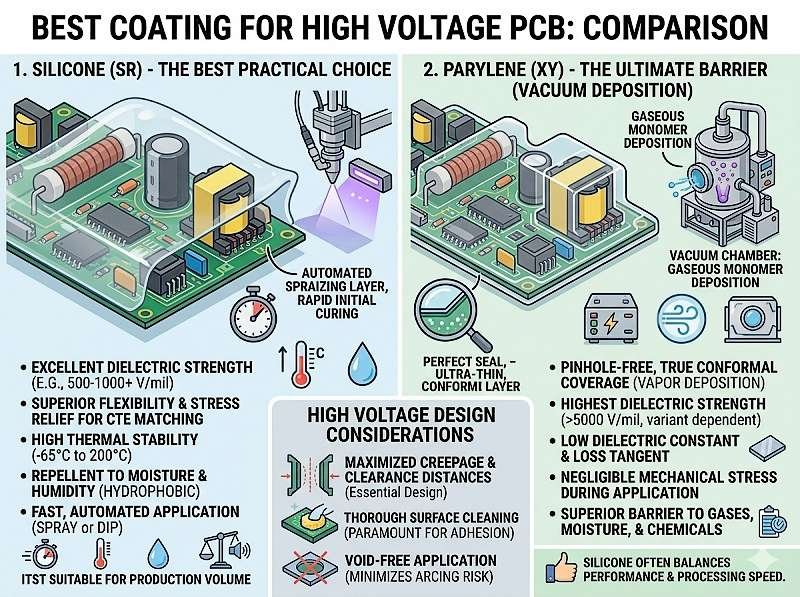
Best overall: Silicone conformal coating
Silicone Conformal Coating is widely regarded as the best balance for high-voltage PCB Assembly and SMT Assembly.
Why silicone is ideal:
- High dielectric strength (up to ~500 V/mil)
- Excellent performance under high temperature and humidity
- Flexible → reduces cracking under electrical stress
- Strong resistance to corona discharge and arcing
Silicone coatings are commonly used in power electronics, automotive systems, and industrial high-voltage designs where reliability is critical.
Best for extreme performance: Parylene coating
If you need the highest insulation performance, parylene is often the top choice in advanced Turnkey PCB Assembly.
Advantages:
- Extremely uniform, pinhole-free coating (vapor deposition)
- Very high dielectric strength and insulation reliability
- Excellent protection against moisture and contamination
- Ideal for compact, high-voltage, high-density designs
Limitation: High cost and complex processing
Other viable options
- Polyurethane coating
- Good dielectric strength (~350 V/mil)
- Strong chemical resistance
- Suitable for industrial environments
- Epoxy coating
- High insulation and durability
- Better for harsh environments but less flexible
- Acrylic coating
- Lower cost, moderate dielectric strength (~300–400 V/mil)
- Not ideal for high-voltage or harsh conditions
Why coating matters for high voltage
In high-voltage PCB Assembly, risks include:
- Electrical arcing
- Leakage currents
- Electrochemical migration
- Reduced creepage distance
Conformal Coating helps by:
- Increasing surface dielectric strength
- Preventing moisture-induced leakage
- Suppressing arcing and corona discharge
- Improving long-term insulation stability
Conclusion
- Best overall for high voltage: Silicone conformal coating
- Best for extreme/high-end applications: Parylene coating
- Budget alternative: Polyurethane
In PCB Assembly, SMT Assembly, and Turnkey PCB Assembly, the right coating choice should be based on voltage level, environment, and reliability requirements—not just cost.
Get a Conformal Coating Quote
Have a PCB project that requires conformal coating? Get a customized quote today.
Send us your requirements and get a fast response from our engineering team.
✔ 24-hour response ✔ Engineering support ✔ Small & Mass Production
Shenzhen Tengxinjie Electronics Co., Ltd.

 English
  Deutsch
  Français
  Português do Brasil
  Español
  日本語
日本語  Nederlands
  Italiano
  Русский
  한국어
한국어  العربية
  Svenska
  Polski
  Türkçe
  繁體中文
繁體中文