
Coating for industrial control boards
Industrial control boards used in PCB Assembly and SMT Assembly operate in harsh environments that often include humidity, dust, chemicals, vibration, and temperature fluctuations. Choosing the right Conformal Coating is essential to ensure long-term reliability and performance.
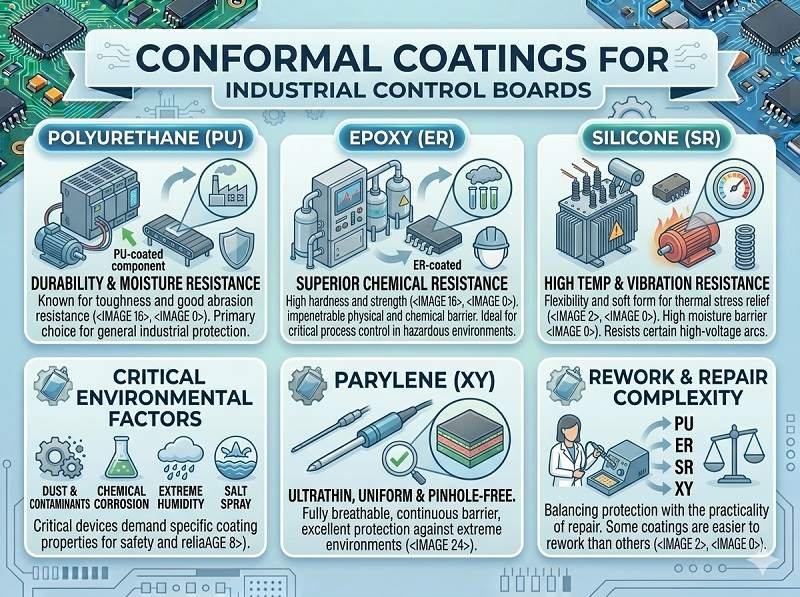
Best overall: polyurethane (urethane) Conformal Coating
Polyurethane is one of the most commonly used coatings for industrial control boards due to its strong resistance to chemicals and environmental contaminants.
Key advantages:
- Excellent chemical resistance (solvents, oils, fuels)
- Strong protection against moisture and corrosion
- Good mechanical durability
- Suitable for factory and industrial environments
This makes polyurethane ideal for control systems exposed to industrial pollutants and harsh operating conditions in PCB Assembly.
Best for temperature and flexibility: silicone Conformal Coating
Silicone is another top choice, especially when temperature variation and vibration are significant.
Key advantages:
- Wide temperature range (-55°C to 200°C+)
- High flexibility → resists cracking under vibration
- Good moisture and humidity resistance
- Performs well in outdoor or semi-industrial environments
Silicone is often used in industrial automation systems that experience both heat and mechanical stress in SMT Assembly.
High-end option: parylene Conformal Coating
For critical industrial applications, parylene provides the highest level of protection.
Key advantages:
- Pinhole-free, uniform coating
- Superior resistance to moisture, chemicals, and corrosion
- Excellent performance in extreme environments
However, due to higher cost and specialized processing, it is typically reserved for high-reliability or mission-critical control systems.
Other coatings in industrial use
Acrylic
- Cost-effective and easy to apply
- Suitable for mild industrial environments
- Limited resistance to chemicals and harsh conditions
Epoxy
- Strong and durable
- Good for mechanical protection
- Less suitable due to rigidity and poor reworkability
How to choose the right coating
- Chemical exposure (oil, solvent, factory gases) → Polyurethane (best choice)
- High temperature + vibration → Silicone
- Extreme or mission-critical environments → Parylene
- Cost-sensitive, low-risk applications → Acrylic
Final conclusion
For most industrial control boards in PCB Assembly and SMT Assembly, polyurethane Conformal Coating is the best overall choice due to its excellent chemical and environmental resistance. Silicone is ideal for high-temperature and vibration-prone environments, while parylene offers premium protection for critical systems.
Get a Conformal Coating Quote
Looking for reliable conformal coating solutions for your PCBA project? Click below to get a fast quote.
Send us your requirements and get a fast response from our engineering team.
✔ 24-hour response ✔ Engineering support ✔ Small & Mass Production
Shenzhen Tengxinjie Electronics Co., Ltd.


 English
  Deutsch
  Français
  Português do Brasil
  Español
  日本語
日本語  Nederlands
  Italiano
  Русский
  한국어
한국어  العربية
  Svenska
  Polski
  Türkçe
  繁體中文
繁體中文