
Conformal Coating process steps
In PCB Assembly and SMT Assembly, the Conformal Coating process follows a series of controlled steps to ensure reliable protection against moisture, dust, chemicals, and environmental stress. Proper execution of each step is critical for coating performance and long-term durability.
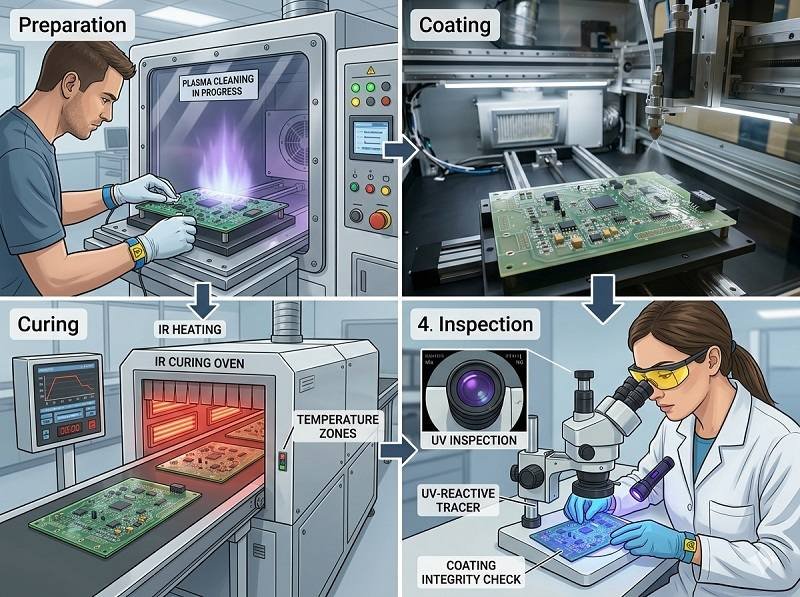
Inspection before coating
Before applying Conformal Coating, the PCB must be carefully inspected.
- Check for solder defects, contamination, or damage
- Ensure all components are properly assembled
- Verify that the board meets quality standards
Any defects left before coating can become difficult to repair later in PCB Assembly.
Cleaning the PCB
Cleaning is one of the most important steps in the Conformal Coating process.
- Remove flux residues, oils, dust, and ionic contaminants
- Use solvent cleaning, aqueous cleaning, or ultrasonic cleaning
- Ensure the surface is chemically clean for proper adhesion
Poor cleaning can lead to coating failure, delamination, or corrosion.
Drying and moisture removal
After cleaning, the PCB must be completely dry.
- Use ovens or air drying to remove residual moisture
- Prevent trapped moisture under the coating
This step is essential in SMT Assembly to avoid long-term reliability issues.
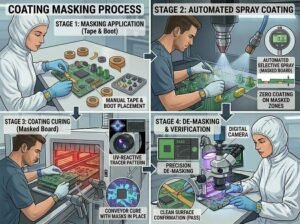
Masking
Masking protects areas that should not be coated.
- Connectors, switches, test points, and sockets
- Use tapes, boots, or removable masks
Accurate masking ensures functionality is not affected after Conformal Coating.
Coating application
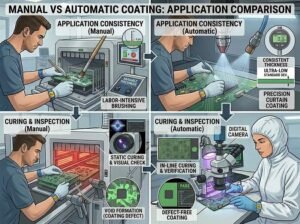
The Conformal Coating is then applied using one of several methods:
- Spray coating (manual or automated)
- Dip coating
- Brush coating (for repair or low volume)
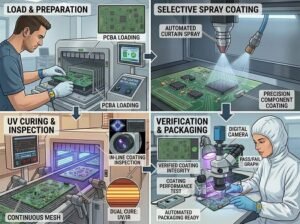
- Selective coating (automated precision)
- Vapor deposition (for parylene coatings)
The choice depends on production scale and product requirements in PCB Assembly.
Curing
After application, the coating must be cured to form a protective layer.
- Air cure (common for acrylic)
- Heat cure (epoxy, polyurethane)
- UV cure (fast and efficient)
- Moisture cure (silicone coatings)
Proper curing ensures the coating achieves its mechanical and electrical properties.
Inspection and quality control
Once cured, the coating is inspected to ensure quality.
- Visual inspection under white or UV light
- Check for coverage, thickness, bubbles, or voids
- Verify no unwanted areas are coated
Automated inspection systems are often used in advanced SMT Assembly lines.
Testing and validation
Final testing ensures the coated PCB meets performance requirements.
- Electrical testing
- Environmental testing (humidity, temperature cycling)
- Adhesion and thickness checks
This step confirms reliability in real-world operating conditions.
Final conclusion
The Conformal Coating process in PCB Assembly and SMT Assembly includes inspection, cleaning, drying, masking, coating application, curing, and final inspection. Each step plays a critical role in ensuring that the coating provides effective and long-lasting protection for electronic circuits.
Get a Conformal Coating Quote
Need fast turnaround for conformal coating projects? Submit your request today.
Send us your requirements and get a fast response from our engineering team.
✔ 24-hour response ✔ Engineering support ✔ Small & Mass Production
Shenzhen Tengxinjie Electronics Co., Ltd.

 English
  Deutsch
  Français
  Português do Brasil
  Español
  日本語
日本語  Nederlands
  Italiano
  Русский
  한국어
한국어  العربية
  Svenska
  Polski
  Türkçe
  繁體中文
繁體中文