
ICT (Teste em circuito)
ICT (Teste em circuito) is a widely used electrical testing method in Montagem de PCB that verifies the performance and integrity of individual components and circuits on a fully assembled PCB. It is commonly applied after Montagem SMT to ensure that each component is correctly placed, soldered, and functioning as intended.
ICT is one of the most effective ways to detect manufacturing defects early and ensure high product quality in mass production.
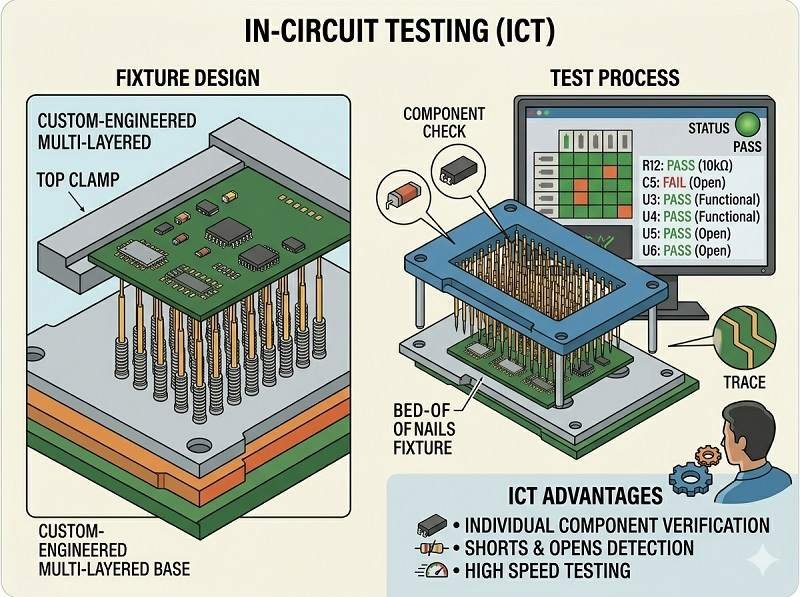
What Does ICT Test?
ICT focuses on checking the electrical behavior of each component on the board. It can detect:
- Open circuits (broken connections)
- Short circuits (unwanted connections)
- Incorrect component values (e.g., wrong resistor or capacitor)
- Componentes ausentes
- Faulty or damaged components
- Polarity errors (e.g., diodes, capacitors)
👉 ICT ensures that the PCB Assembly is electrically correct before functional testing.
How ICT Works
ICT uses a bed-of-nails fixture to make contact with test points on the PCB:
- The assembled PCB is placed on a fixture
- Spring-loaded pins contact designated test points
- Electrical signals are applied and measured
- Results are compared with expected values
This allows fast and accurate testing of each circuit node.
Types of ICT Methods
Bed-of-Nails ICT (Fixture-Based)
- Uses a custom test fixture
- High-speed testing for mass production
- High upfront cost (fixture design)
Flying Probe Testing
- Uses movable probes instead of a fixture
- No need for dedicated tooling
- Slower but more flexible
- Ideal for prototypes and small batches
👉 Flying probe is often used when ICT fixtures are not cost-effective.
Advantages of ICT
- High fault coverage (detects most electrical issues)
- Fast testing speed in production
- Accurate and repeatable results
- Reduces defective products reaching customers
- Improves overall Montagem de PCB quality
Limitations of ICT
- Requires test points in PCB design
- High initial fixture cost
- Cannot fully verify real-world functionality
- Less effective for very high-density boards without proper design
ICT vs Functional Testing (FCT)
| Recurso | ICT | Teste funcional |
|---|---|---|
| Focus | Individual components | Overall system behavior |
| Velocidade | Fast | Mais lento |
| Cobertura | Electrical faults | Functional performance |
| Setup cost | High (fixture) | Moderado |
👉 ICT and functional testing are often used together in Montagem SMT projetos.
When is ICT Used?
ICT is most suitable for:
- Medium to high-volume production
- Products requiring high reliability
- Complex PCB Assembly designs
- Industries like automotive, medical, and industrial electronics
Design Considerations for ICT
To enable effective ICT testing:
- Add sufficient test points
- Ensure proper spacing for probes
- Avoid obstructed access
- Follow DFT (Design for Testing) guidelines
Good design significantly improves ICT efficiency.
Role of ICT in PCB Assembly Process
In a typical Montagem de PCB workflow:
- Performed after SMT Assembly and soldering
- Identifies manufacturing defects early
- Reduces rework and repair costs
- Improves yield and production efficiency
Conclusão
ICT (In-Circuit Testing) is a powerful and essential testing method in Montagem de PCB, providing fast and accurate verification of electrical performance at the component level. When combined with Montagem SMT and functional testing, ICT helps ensure high-quality, reliable electronic products.
Obtenha consultoria especializada e preços precisos em uma única etapa. Solicite sua cotação hoje mesmo.
Oferecemos serviços profissionais de montagem de PCBs, incluindo SMT, DIP e soluções completas prontas para uso.
NDA disponível ✔ Cotação rápida em 24 horas ✔ Fábrica com certificação ISO ✔ Serviço completo de PCB e PCBA

 Português do Brasil
  English
  Deutsch
  Français
  Español
  日本語
日本語  Nederlands
  Italiano
  Русский
  한국어
한국어  العربية
  Svenska
  Polski
  Türkçe
  繁體中文
繁體中文