
AOI Inspection in PCB Assembly
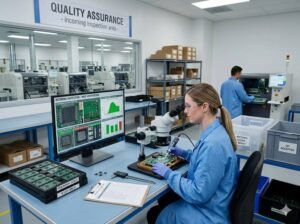
AOI (inspeção óptica automatizada) is a critical quality control process in Montagem de PCB, especially in modern Montagem SMT lines. It uses high-resolution cameras and intelligent software to automatically inspect printed circuit boards for defects after solder paste printing and component placement.
AOI helps manufacturers detect errors early, reduce rework, and ensure high product reliability.
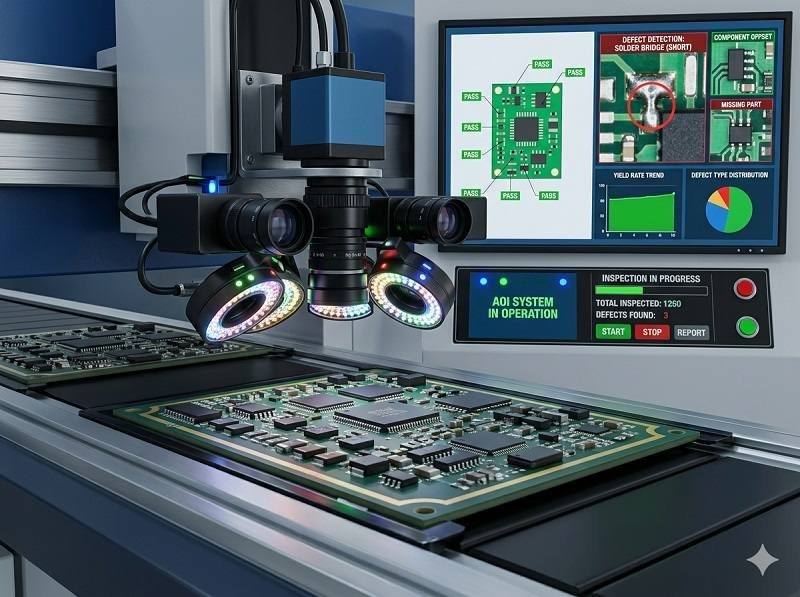
What Does AOI Inspection Do?
AOI systems scan the PCB and compare it against a reference (design data or a “golden board”) to identify defects such as:
- Componentes ausentes
- Misaligned or shifted components
- Incorrect component orientation (polarity errors)
- Solder bridges (short circuits)
- Insufficient or excessive solder
- Tombstoning (lifted components)
👉 This makes AOI an essential step in high-quality PCB Assembly.
Where AOI is Used in SMT Assembly
AOI inspection can be applied at multiple stages:
Post-Solder Paste AOI (SPI + AOI)
- Checks solder paste position and volume
- Detects printing defects early
Post-Placement AOI
- Verifies component presence and alignment
- Ensures correct placement before soldering
Post-Reflow AOI (Most Common)
- Inspects final solder joints
- Detects most assembly defects
👉 Post-reflow AOI is the most widely used stage in Montagem SMT.
How AOI Inspection Works
AOI systems operate using:
- High-resolution cameras (2D or 3D)
- Controlled lighting (LED, multi-angle illumination)
- Image processing algorithms
The system:
- Captures images of the PCB
- Compares them with reference data
- Flags any deviations or defects
Advanced AOI systems can also use AI for better defect detection.
Types of AOI Systems
2D AOI
- Uses standard imaging
- Detects basic defects
- Lower cost
AOI 3D
- Measures height and volume (e.g., solder paste)
- More accurate detection
- Ideal for complex PCB Assembly
Advantages of AOI Inspection
- High-speed automatic inspection
- Resultados consistentes e repetíveis
- Early defect detection
- Reduced manual inspection cost
- Improved SMT Assembly yield
Limitations of AOI
While powerful, AOI has some limitations:
- Cannot see hidden solder joints (e.g., under BGA)
- May produce false positives
- Requires proper programming and setup
👉 For hidden defects, X-ray inspection is often used alongside AOI.
AOI vs Manual Inspection
| Recurso | AOI Inspection | Manual Inspection |
|---|---|---|
| Velocidade | Muito rápido | Slow |
| Accuracy | Alta | Depends on operator |
| Consistência | Excelente | Variable |
| Custo | Higher initial cost | Higher long-term labor cost |
AOI is now standard in most Montagem de PCB linhas de produção.
Why AOI is Important in PCB Assembly
AOI inspection helps:
- Detect defects early in the process
- Reduce rework and scrap
- Improve product quality and reliability
- Lower overall manufacturing cost
👉 It is a key step in modern Montagem SMT controle de qualidade.
Best Practices for AOI Implementation
- Use AOI at multiple stages (pre- and post-reflow)
- Combine with SPI and X-ray inspection
- Regularly update inspection programs
- Train operators to review results effectively
Conclusão
AOI inspection is an essential part of Montagem de PCB e Montagem SMT, providing fast and accurate detection of defects throughout the manufacturing process. By automating inspection, manufacturers can ensure consistent quality, reduce errors, and deliver reliable electronic products.
Precisa de suporte com BOM e fornecimento de componentes? Comece solicitando uma cotação.
Oferecemos serviços profissionais de montagem de PCBs, incluindo SMT, DIP e soluções completas prontas para uso.
NDA disponível ✔ Cotação rápida em 24 horas ✔ Fábrica com certificação ISO ✔ Serviço completo de PCB e PCBA
 Português do Brasil
  English
  Deutsch
  Français
  Español
  日本語
日本語  Nederlands
  Italiano
  Русский
  한국어
한국어  العربية
  Svenska
  Polski
  Türkçe
  繁體中文
繁體中文