
Bprocesso de revestimento de cimento
O processo de revestimento em lote em Revestimento conformacional refere-se à aplicação de revestimento em várias PCBs ao mesmo tempo em ciclos agrupados, em vez de continuamente. Esse método é amplamente utilizado em Montagem de PCB, Montagem de protótipo de PCB, e de pequena a média escala Montagem SMT, onde a flexibilidade e o controle de custos são importantes.
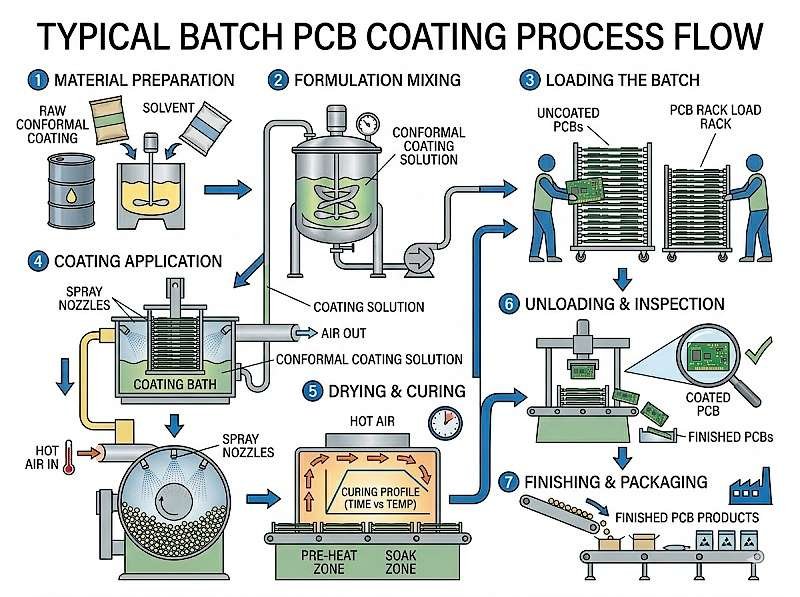
Como funciona o revestimento em lote
Em um processo em lote, um grupo de PCBs montadas é preparado, mascarado e revestido em conjunto usando métodos como imersão, pulverização ou escovação. Após o revestimento, todas as placas do lote passam por um ciclo compartilhado de secagem ou cura. Uma vez concluído, o próximo lote é processado.
Métodos comuns de revestimento em lote
Revestimento por imersão
Os PCBs são submersos em um tanque de Revestimento conformacional material e, em seguida, retirado em uma velocidade controlada. Isso garante a cobertura total, mas exige o mascaramento adequado em Montagem de PCB.
Revestimento manual ou por pulverização
Os operadores ou os sistemas de pulverização semiautomáticos aplicam o revestimento em várias placas colocadas em racks ou acessórios. Isso é comum em Montagem de protótipo de PCB devido à sua flexibilidade.
Revestimento com pincel
Usado principalmente para retrabalho ou pequenos lotes, onde a precisão é necessária, mas o volume de produção é baixo.
Principais recursos do revestimento em lote
Processamento agrupado
Várias placas são revestidas e curadas juntas, aumentando a eficiência em comparação com o manuseio de uma única placa.
Configuração flexível
Ideal para diferentes projetos de PCB ou pedidos de baixo volume, especialmente em Montagem de protótipo de PCB.
Menor custo de equipamento
Em comparação com os sistemas em linha totalmente automatizados usados em sistemas de alta velocidade Montagem SMT, Os processos em lote exigem menos investimento.
Vantagens do revestimento em lote
- Econômico para pequenas e médias séries de produção
- Fácil de alternar entre diferentes produtos
- Adequado para projetos de PCB complexos ou irregulares
- Controle de processo simplificado para prototipagem
Limitações do revestimento em lote
Menor consistência
Em comparação com o revestimento em linha automatizado em Montagem SMT, Em processos em lote, pode haver mais variação na espessura e na cobertura.
Trabalho intensivo
O manuseio manual aumenta os custos de mão de obra e o risco de erro humano em Montagem de PCB.
Taxa de transferência mais lenta
O processamento é feito em ciclos e não de forma contínua, o que pode limitar a velocidade de produção.
Risco de defeitos
O manuseio inadequado, a imersão irregular ou a pulverização inconsistente podem causar bolhas, gotejamentos ou revestimento irregular.
Revestimento em lote versus revestimento em linha
- Revestimento em lote: Flexível, de baixo custo, ideal para Montagem de protótipo de PCB e pequenos volumes
- Revestimento em linha: Automatizado, de alta consistência, melhor para grande escala Montagem SMT
Práticas recomendadas para revestimento em lote
- Use fixações consistentes para manter as PCBs no lugar
- Controle da velocidade de retirada no revestimento por imersão
- Manter a viscosidade e a temperatura do revestimento estáveis
- Assegurar a limpeza e o mascaramento adequados antes do revestimento
- Padronizar as condições de cura para cada lote
Em conclusão, o processo de revestimento em lote é uma abordagem prática e econômica para aplicar Revestimento conformacional em Montagem de PCB, especialmente para prototipagem e produção de médio volume. Embora possa não corresponder à velocidade e à precisão dos sistemas em linha, ele oferece flexibilidade e adaptabilidade para uma ampla gama de aplicações.
Obter uma cotação de revestimento isolante
Precisa de revestimento isolante para aplicações em ambientes agressivos? Envie sua consulta abaixo.
Envie-nos seus requisitos e receba uma resposta rápida de nossa equipe de engenharia.
Resposta 24 horas ✔ Suporte de engenharia ✔ Produção pequena e em massa
Shenzhen Tengxinjie Electronics Co., Ltd.



 Português do Brasil
  English
  Deutsch
  Français
  Español
  日本語
日本語  Nederlands
  Italiano
  Русский
  한국어
한국어  العربية
  Svenska
  Polski
  Türkçe
  繁體中文
繁體中文