
Cura em forno versus cura em sala
Em Revestimento conformacional, A cura é o processo que transforma um revestimento líquido em uma camada protetora sólida. Dois dos métodos mais comuns usados em Montagem de PCB, Montagem de protótipo de PCB, e Montagem SMT são cura em forno e cura em sala (secagem ao ar). Cada método tem características, vantagens e casos de uso ideais diferentes.
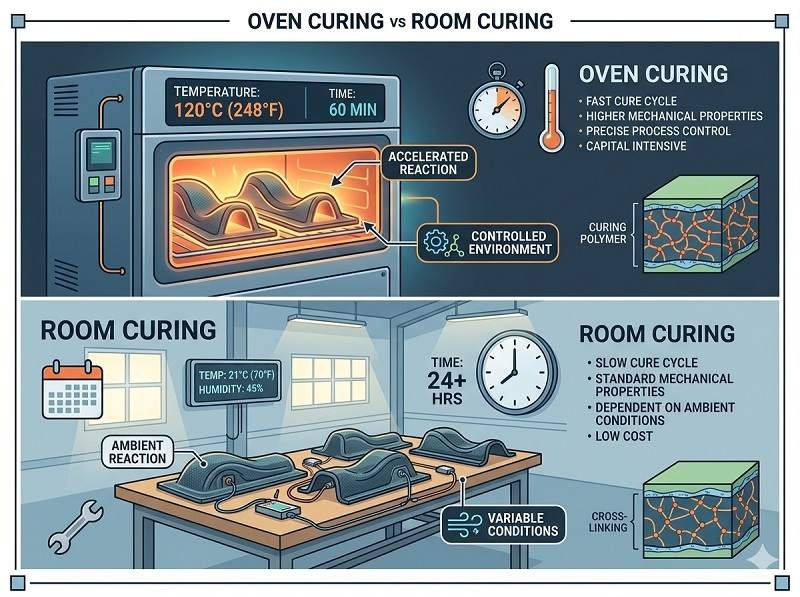
O que é cura em forno?
A cura em forno (cura térmica) utiliza calor controlado para acelerar o processo de cura. Depois de aplicar o Revestimento conformacional, As PCBs são colocadas em um forno em uma temperatura específica por um tempo definido.
Principais recursos da cura em forno
- Temperaturas típicas: 60-150°C, dependendo do tipo de revestimento
- Tempo de cura mais rápido (de minutos a algumas horas)
- Resultados mais consistentes e repetíveis
- Maior aderência e resistência mecânica
Em grandes volumes Montagem SMT, A cura em forno é amplamente utilizada porque aumenta significativamente a eficiência da produção e garante a qualidade uniforme do revestimento em todos os lotes.
O que é cura ambiente (cura ao ar)?
A cura em ambiente depende da evaporação natural do solvente ou da reação da umidade à temperatura ambiente (normalmente 20-25°C) para curar o revestimento.
Principais recursos da cura em sala
- Não é necessário equipamento de aquecimento
- Tempo de cura mais longo (12 a 48 horas)
- Menor custo de energia
- Adequado para componentes sensíveis ao calor
Esse método é comumente usado em Montagem de protótipo de PCB ou em pequena escala Montagem de PCB, onde a flexibilidade e o baixo custo de configuração são mais importantes do que a velocidade.
Principais diferenças entre a cura em forno e a cura em sala
Velocidade de cura
A cura no forno é muito mais rápida, o que a torna ideal para a produção em massa em Montagem SMT. A cura em sala é mais lenta e pode atrasar a produção.
Controle de processos
A cura em forno oferece controle preciso da temperatura e do tempo, resultando em qualidade consistente. A cura em sala é mais dependente das condições ambientais, como umidade e fluxo de ar.
Requisitos de equipamento
A cura em forno requer fornos térmicos e sistemas de monitoramento de processos. A cura em sala requer apenas um ambiente limpo e controlado.
Impacto nos componentes
A cura em sala é mais segura para componentes sensíveis à temperatura. A cura em forno deve ser cuidadosamente controlada para evitar danos térmicos durante a cura. Montagem de PCB.
Desempenho do revestimento
A cura em forno geralmente produz revestimentos mais fortes e duráveis, com melhor resistência química e mecânica.
Quando escolher cada método
A cura no forno é melhor para:
- Alto volume Montagem SMT
- Cronogramas de produção apertados
- Aplicações que exigem alta confiabilidade
A cura em sala é melhor para:
- Montagem de protótipo de PCB e pequenos lotes
- Projetos sensíveis ao calor
- Projetos sensíveis ao custo
Em conclusão, tanto a cura em forno quanto a cura em sala são amplamente utilizadas em Revestimento conformacional processos. A escolha depende do volume de produção, do material de revestimento e dos requisitos do produto. A otimização do método de cura em Montagem de PCB, Montagem SMT, e Montagem de protótipo de PCB garante o melhor equilíbrio entre eficiência, custo e desempenho do revestimento.
Obter uma cotação de revestimento isolante
Deseja terceirizar os serviços de revestimento isolante? Entre em contato com a nossa equipe.
Envie-nos seus requisitos e receba uma resposta rápida de nossa equipe de engenharia.
Resposta 24 horas ✔ Suporte de engenharia ✔ Produção pequena e em massa
Shenzhen Tengxinjie Electronics Co., Ltd.
 Português do Brasil
  English
  Deutsch
  Français
  Español
  日本語
日本語  Nederlands
  Italiano
  Русский
  한국어
한국어  العربية
  Svenska
  Polski
  Türkçe
  繁體中文
繁體中文