
Revestimento conformacional etapas do processo
Em Montagem de PCB e Montagem SMT, o Revestimento conformacional segue uma série de etapas controladas para garantir uma proteção confiável contra umidade, poeira, produtos químicos e estresse ambiental. A execução adequada de cada etapa é fundamental para o desempenho do revestimento e sua durabilidade a longo prazo.
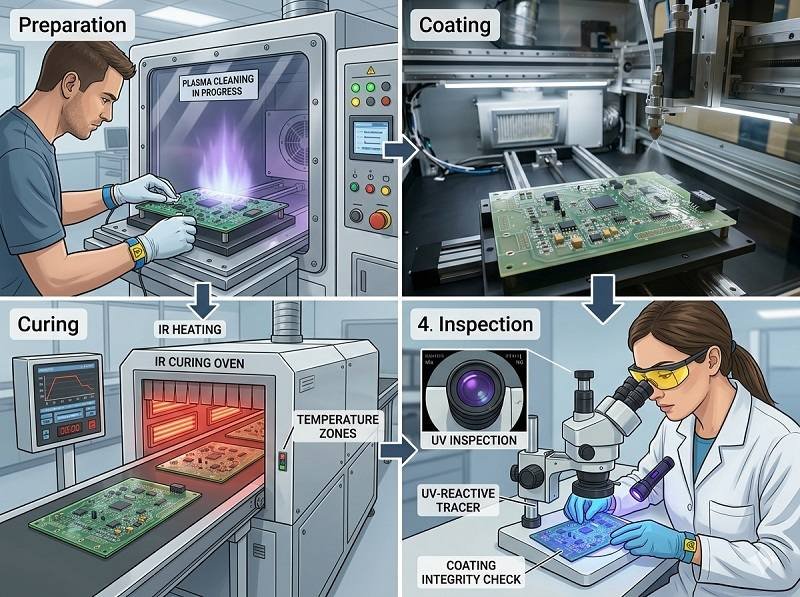
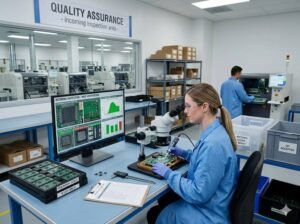
Inspeção antes do revestimento
Antes de aplicar Revestimento conformacional, A placa de circuito impresso deve ser cuidadosamente inspecionada.
- Verifique se há defeitos, contaminação ou danos na solda
- Certifique-se de que todos os componentes estejam montados corretamente
- Verificar se a placa atende aos padrões de qualidade
Qualquer defeito deixado antes do revestimento pode se tornar difícil de reparar mais tarde. Montagem de PCB.
Limpeza da placa de circuito impresso
A limpeza é uma das etapas mais importantes do processo de Revestimento conformacional processo.
- Remova resíduos de fluxo, óleos, poeira e contaminantes iônicos
- Use limpeza com solvente, limpeza aquosa ou limpeza ultrassônica
- Certifique-se de que a superfície esteja quimicamente limpa para uma adesão adequada
A limpeza inadequada pode levar a falhas no revestimento, delaminação ou corrosão.
Secagem e remoção de umidade
Após a limpeza, a placa de circuito impresso deve estar completamente seca.
- Use fornos ou secagem ao ar para remover a umidade residual
- Evite que a umidade fique presa sob o revestimento
Essa etapa é essencial para Montagem SMT para evitar problemas de confiabilidade a longo prazo.
Mascaramento
O mascaramento protege as áreas que não devem ser revestidas.
- Conectores, interruptores, pontos de teste e soquetes
- Use fitas, botas ou máscaras removíveis
O mascaramento preciso garante que a funcionalidade não seja afetada após Revestimento conformacional.
Aplicação do revestimento
O Revestimento conformacional é então aplicado usando um dos vários métodos:
- Revestimento em spray (manual ou automatizado)
- Revestimento por imersão
- Revestimento com pincel (para reparos ou baixo volume)
- Revestimento seletivo (precisão automatizada)
- Deposição de vapor (para revestimentos de parileno)
A escolha depende da escala de produção e dos requisitos do produto em Montagem de PCB.
Cura
Após a aplicação, o revestimento deve ser curado para formar uma camada protetora.
- Cura do ar (comum para acrílico)
- Cura por calor (epóxi, poliuretano)
- Cura UV (rápido e eficiente)
- Cura por umidade (revestimentos de silicone)
A cura adequada garante que o revestimento atinja suas propriedades mecânicas e elétricas.
Inspeção e controle de qualidade
Depois de curado, o revestimento é inspecionado para garantir a qualidade.
- Inspeção visual sob luz branca ou UV
- Verifique a cobertura, a espessura, as bolhas ou os vazios
- Verifique se nenhuma área indesejada foi revestida
Os sistemas de inspeção automatizados são frequentemente usados em Montagem SMT linhas.
Testes e validação
O teste final garante que a PCB revestida atenda aos requisitos de desempenho.
- Testes elétricos
- Testes ambientais (umidade, ciclo de temperatura)
- Verificações de adesão e espessura
Essa etapa confirma a confiabilidade em condições reais de operação.
Conclusão final
O Revestimento conformacional processo em Montagem de PCB e Montagem SMT inclui inspeção, limpeza, secagem, mascaramento, aplicação do revestimento, cura e inspeção final. Cada etapa desempenha um papel fundamental para garantir que o revestimento forneça proteção eficaz e duradoura para os circuitos eletrônicos.
Obter uma cotação de revestimento isolante
Precisa de um retorno rápido para projetos de revestimento isolante? Envie sua solicitação hoje mesmo.
Envie-nos seus requisitos e receba uma resposta rápida de nossa equipe de engenharia.
Resposta 24 horas ✔ Suporte de engenharia ✔ Produção pequena e em massa
Shenzhen Tengxinjie Electronics Co., Ltd.
 Português do Brasil
  English
  Deutsch
  Français
  Español
  日本語
日本語  Nederlands
  Italiano
  Русский
  한국어
한국어  العربية
  Svenska
  Polski
  Türkçe
  繁體中文
繁體中文