
High-Volume PCB Production
High-volume PCB production refers to the large-scale manufacturing of printed circuit boards in quantities typically ranging from thousands to millions of units. It is a highly optimized process designed for efficiency, consistency, and cost reduction, making it ideal for mass-market electronics such as consumer devices, automotive systems, and industrial equipment.
Unlike prototyping or low-volume runs, high-volume Produzione di PCB focuses on standardized processes, automation, and repeatability. Once a design has been fully validated, it moves into high-volume production to meet market demand at the lowest possible unit cost.
Key Features of High-Volume PCB Production
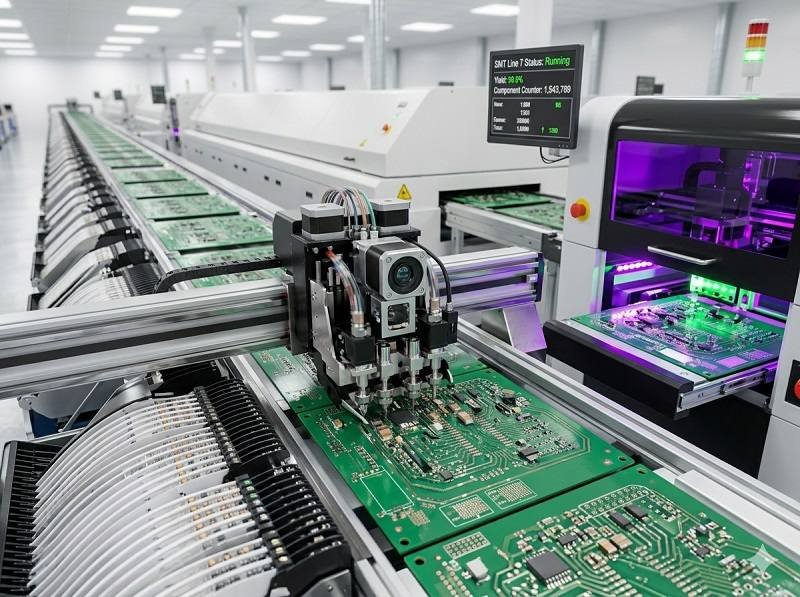
One of the most important characteristics of high-volume PCB production is automation. Advanced machinery is used throughout PCB Manufacturing and PCB Assembly to ensure precision, speed, and consistency. This includes automated optical inspection, pick-and-place machines, and reflow soldering systems.
Another key feature is economies of scale. As production volume increases, the cost per unit decreases significantly. Bulk purchasing of components, optimized production lines, and reduced setup costs all contribute to lower overall expenses.
Standardization is also critical. Design files, materials, and processes are tightly controlled to ensure that every PCB meets the same quality and performance standards.
High-Volume PCB Manufacturing Process
The process begins with finalized design files that have already been validated through prototyping and testing. These files are used to set up large-scale PCB Manufacturing operations.
Fabrication includes panelization, imaging, etching, drilling, plating, and surface finishing. For high-volume production, these processes are optimized for throughput and minimal variation.
After fabrication, the boards move to Assemblaggio di PCB, where components are mounted using automated SMT Assembly lines. High-speed pick-and-place machines can place tens of thousands of components per hour, ensuring both speed and accuracy.
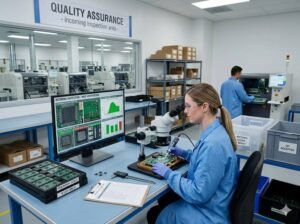
Once assembly is complete, the boards undergo rigorous inspection and testing, including automated optical inspection (AOI), in-circuit testing (ICT), and functional testing. This ensures product reliability before shipment.
Role of SMT Assembly in High-Volume Production
Assemblaggio SMT is the backbone of high-volume PCB production. It allows for fast, accurate, and repeatable component placement, which is essential for large-scale manufacturing.
Automated SMT Assembly lines reduce human error and increase efficiency. They also support high-density designs, enabling manufacturers to produce compact and complex electronic products at scale.
In high-volume environments, SMT processes are carefully optimized, including stencil design, solder paste application, and thermal profiling, to achieve consistent solder joints and minimize defects.
Turnkey PCB Assembly in High-Volume Manufacturing
Assemblaggio di PCB chiavi in mano is often used in high-volume production to streamline operations. In this model, a single provider manages PCB Manufacturing, component sourcing, and PCB Assembly.
This approach simplifies supply chain management, reduces coordination complexity, and improves overall efficiency. It also helps ensure consistency across all stages of production, which is critical for maintaining quality at scale.
Applications of High-Volume PCB Production
High-volume PCB production is widely used in industries that require large quantities of electronic products.
Consumer electronics such as smartphones, laptops, and wearable devices rely heavily on high-volume manufacturing. Automotive electronics, including control systems and sensors, also depend on consistent large-scale production.
Other applications include telecommunications equipment, medical devices, and industrial automation systems.
Advantages of High-Volume PCB Production
High-volume PCB production offers several benefits.
It significantly reduces unit costs through economies of scale. It ensures high consistency and quality due to standardized processes and automation. It also enables faster production rates, allowing companies to meet large market demands efficiently.
Additionally, integration with PCB Assembly and SMT Assembly processes ensures seamless production from fabrication to final product.
Challenges of High-Volume PCB Production
Despite its advantages, high-volume production also presents challenges.
Initial setup costs can be high, requiring investment in tooling, equipment, and process optimization. Design errors can be costly if not identified before production, as they may affect large quantities of boards.
Supply chain management is another critical factor. Ensuring the availability of components in large volumes requires careful planning and reliable sourcing strategies.
Conclusione
High-volume PCB production is essential for scaling electronic products to meet global demand. By combining advanced PCB Manufacturing, automated SMT Assembly, and efficient PCB Assembly processes, manufacturers can achieve high efficiency, consistent quality, and reduced costs.
When supported by Turnkey PCB Assembly services, high-volume production becomes even more streamlined, enabling companies to bring reliable products to market quickly and competitively.
State pianificando il vostro prossimo progetto elettronico? Iniziate con un preventivo per l'assemblaggio di PCB.
Forniamo servizi professionali di assemblaggio di PCB, tra cui SMT, DIP e soluzioni complete chiavi in mano.
✔ NDA disponibile ✔ Preventivo veloce entro 24 ore ✔ Fabbrica certificata ISO ✔ Servizio unico per PCB e PCBA
 Italiano
  English
  Deutsch
  Français
  Português do Brasil
  Español
  日本語
日本語  Nederlands
  Русский
  한국어
한국어  العربية
  Svenska
  Polski
  Türkçe
  繁體中文
繁體中文