
Controllo del processo di rivestimento
Controllo del processo di rivestimento in Rivestimento conforme si riferisce alla gestione sistematica di tutte le variabili che influenzano la qualità, la consistenza e le prestazioni del rivestimento. In Assemblaggio di PCB, Assemblaggio di prototipi di PCB, e Assemblaggio SMT, Il sistema garantisce che ogni PCB riceva un rivestimento uniforme e privo di difetti, conforme agli standard di affidabilità e di settore.
Senza un adeguato controllo, variazioni nei materiali, nell'ambiente o nei metodi di applicazione possono portare a difetti come bolle, spessore non uniforme, scarsa adesione o copertura incompleta.
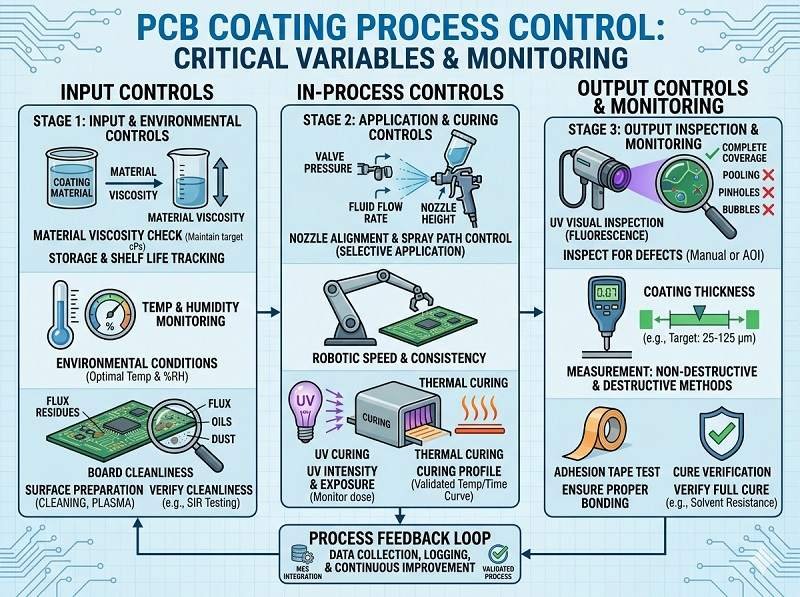
Elementi chiave del controllo del processo di rivestimento
Controllo del materiale
Le proprietà del Rivestimento conforme come la viscosità, la durata di conservazione e il rapporto di miscelazione, devono essere rigorosamente monitorati. Una viscosità errata può portare a uno spessore non uniforme del rivestimento, mentre i materiali scaduti possono provocare una mancata adesione in Assemblaggio di PCB.
Controllo della preparazione della superficie
Una pulizia e un'asciugatura adeguate dei PCB sono essenziali. Residui come il flussante o l'umidità possono interferire con l'adesione del rivestimento e causare difetti. In Assemblaggio SMT, I processi di pulizia controllata sono fondamentali prima del rivestimento.
Controllo dei parametri dell'applicazione
I metodi di rivestimento (spray, immersione, rivestimento selettivo) devono essere controllati con precisione. I parametri chiave includono:
- Pressione e portata dello spruzzo
- Distanza e velocità dell'ugello
- Spessore del rivestimento
Automazione in Assemblaggio SMT aiuta a mantenere la coerenza su grandi volumi di produzione.
Controllo ambientale
Temperatura, umidità e pulizia dell'aria influiscono direttamente sulle prestazioni del rivestimento. L'elevata umidità può causare difetti come il blush, mentre la polvere può contaminare la superficie del rivestimento durante il processo di verniciatura. Assemblaggio di PCB.
Controllo del processo di polimerizzazione
Le condizioni di polimerizzazione - tempo, temperatura o esposizione ai raggi UV - devono corrispondere alle specifiche del rivestimento. Una polimerizzazione inadeguata può causare rivestimenti morbidi, fessurazioni o una protezione incompleta.
Controllo della mascheratura e della copertura
Le aree critiche, come i connettori e i punti di test, devono essere adeguatamente mascherate. Garantire una copertura corretta, proteggendo al contempo le zone di non accesso, è una parte fondamentale del controllo dei processi in PAssemblaggio PCB rototipo.
Ispezione e controllo qualità
L'ispezione post-rivestimento verifica che il processo funzioni correttamente. I metodi più comuni includono:
- Ispezione UV per la copertura
- Misura dello spessore
- Ispezione visiva per la ricerca di difetti
In Assemblaggio di PCB, Il feedback delle ispezioni viene utilizzato per migliorare continuamente il processo.
Perché è importante il controllo del processo di rivestimento
- Assicura uno spessore e una copertura uniformi del rivestimento
- Riduce i difetti e le rilavorazioni
- Migliora l'affidabilità e la durata del prodotto
- Supporta la conformità agli standard di settore (ad esempio, IPC).
- Migliora l'efficienza dei grandi volumi Assemblaggio SMT
Controllo del processo in diverse fasi di produzione
Assemblaggio di prototipi di PCB
Si concentra sull'ottimizzazione dei parametri, sui test e sulla convalida dei processi di rivestimento.
Assemblaggio di massa di PCB / Assemblaggio SMT
Si concentra sull'automazione, sulla ripetibilità e su un rigoroso monitoraggio della qualità per mantenere la coerenza su scala.
Le migliori pratiche per un controllo efficace dei processi
- Definire procedure operative standard (SOP)
- Utilizzare sistemi di rivestimento e polimerizzazione automatizzati
- Monitoraggio dei parametri chiave in tempo reale
- Mantenere ambienti di produzione controllati
- Analizzare continuamente i difetti e migliorare i processi
In conclusione, controllo del processo di rivestimento è il fondamento di un'alta qualità Rivestimento conforme in Assemblaggio di PCB, Assemblaggio SMT, e Assemblaggio di prototipi di PCB. Gestendo i materiali, le attrezzature, l'ambiente e le ispezioni, i produttori possono ottenere prestazioni di rivestimento affidabili e ripetibili e ridurre al minimo i rischi di produzione.
Richiedete un preventivo per il rivestimento conforme
Avete bisogno di un supporto professionale per il rivestimento conformale? Inviate le vostre richieste e riceverete una risposta entro 12 ore.
Inviateci i vostri requisiti e riceverete una risposta rapida dal nostro team di ingegneri.
✔ Risposta in 24 ore ✔ Supporto ingegneristico ✔ Produzione di piccole dimensioni e di massa
Shenzhen Tengxinjie Electronics Co., Ltd.
 Italiano
  English
  Deutsch
  Français
  Português do Brasil
  Español
  日本語
日本語  Nederlands
  Русский
  한국어
한국어  العربية
  Svenska
  Polski
  Türkçe
  繁體中文
繁體中文