
Bprocesso di rivestimento dell'atch
Il processo di rivestimento in batch in Rivestimento conforme si riferisce all'applicazione del rivestimento a più PCB contemporaneamente in cicli raggruppati anziché in modo continuo. Questo metodo è ampiamente utilizzato in Assemblaggio di PCB, Assemblaggio di prototipi di PCB, e su scala medio-piccola Assemblaggio SMT, dove la flessibilità e il controllo dei costi sono importanti.
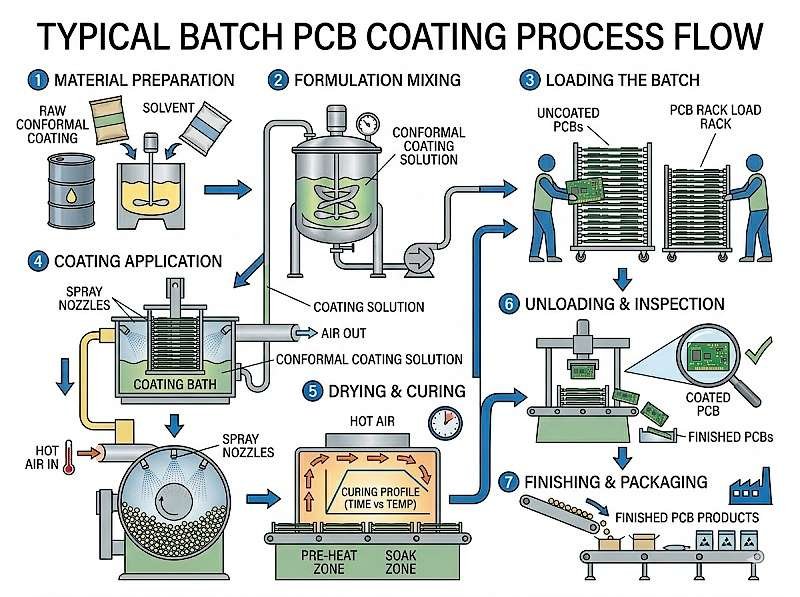
Come funziona il rivestimento in batch
In un processo a lotti, un gruppo di PCB assemblati viene preparato, mascherato e rivestito insieme con metodi quali l'immersione, la spruzzatura o la spazzolatura. Dopo il rivestimento, tutte le schede del lotto vengono sottoposte a un ciclo di essiccazione o polimerizzazione comune. Una volta completato, viene elaborato il lotto successivo.
Metodi comuni di rivestimento in batch
Rivestimento per immersione
I PCB vengono immersi in una vasca di Rivestimento conforme e poi ritirato a velocità controllata. Questo metodo garantisce una copertura completa, ma richiede una mascheratura adeguata. Assemblaggio di PCB.
Rivestimento manuale o a spruzzo
Gli operatori o i sistemi di spruzzatura semiautomatici applicano il rivestimento su più pannelli collocati in scaffalature o in impianti. Questa operazione è comune in Assemblaggio di prototipi di PCB grazie alla sua flessibilità.
Rivestimento a pennello
Utilizzato principalmente per la rilavorazione o per piccoli lotti, dove è necessaria la precisione ma il volume di produzione è basso.
Caratteristiche principali del rivestimento in batch
Elaborazione raggruppata
Più pannelli vengono rivestiti e polimerizzati insieme, migliorando l'efficienza rispetto alla gestione di un singolo pannello.
Configurazione flessibile
Ideale per progetti di PCB diversi o per ordini di bassi volumi, soprattutto in Assemblaggio di prototipi di PCB.
Costo inferiore dell'attrezzatura
Rispetto ai sistemi in linea completamente automatizzati utilizzati nei sistemi ad alta velocità. Assemblaggio SMT, I processi batch richiedono meno investimenti.
Vantaggi del rivestimento in batch
- Conveniente per le piccole e medie produzioni
- Facile passare da un prodotto all'altro
- Adatto per progetti di PCB complessi o irregolari
- Controllo del processo semplificato per la prototipazione
Limiti del rivestimento in batch
Consistenza inferiore
Rispetto alla verniciatura in linea automatizzata in Assemblaggio SMT, I processi a lotti possono presentare maggiori variazioni di spessore e copertura.
Ad alta intensità di lavoro
La movimentazione manuale aumenta i costi di manodopera e il rischio di errore umano in Assemblaggio di PCB.
Produttività più lenta
La lavorazione avviene in cicli piuttosto che in modo continuo, il che può limitare la velocità di produzione.
Rischio di difetti
Una manipolazione non corretta, un'immersione non uniforme o una spruzzatura non omogenea possono provocare bolle, gocce o un rivestimento non uniforme.
Verniciatura in batch o in linea
- Rivestimento in lotti: Flessibile, a basso costo, ideale per Assemblaggio di prototipi di PCB e piccoli volumi
- Rivestimento in linea: Automatico, ad alta consistenza, migliore per le grandi dimensioni Assemblaggio SMT
Migliori pratiche per il rivestimento in batch
- Utilizzare un fissaggio coerente per tenere in posizione i PCB
- Controllo della velocità di prelievo nella verniciatura ad immersione
- Mantenere stabili la viscosità e la temperatura del rivestimento
- Assicurare un'adeguata pulizia e mascheratura prima del rivestimento
- Standardizzare le condizioni di polimerizzazione per ogni lotto
In conclusione, il processo di rivestimento in batch è un approccio pratico ed economico per l'applicazione di Rivestimento conforme in Assemblaggio di PCB, soprattutto per la prototipazione e la produzione di medi volumi. Pur non potendo eguagliare la velocità e la precisione dei sistemi in linea, offre flessibilità e adattabilità per un'ampia gamma di applicazioni.
Richiedete un preventivo per il rivestimento conforme
Avete bisogno di un rivestimento conformale per applicazioni in ambienti difficili? Inviate la vostra richiesta qui sotto.
Inviateci i vostri requisiti e riceverete una risposta rapida dal nostro team di ingegneri.
✔ Risposta in 24 ore ✔ Supporto ingegneristico ✔ Produzione di piccole dimensioni e di massa
Shenzhen Tengxinjie Electronics Co., Ltd.
 Italiano
  English
  Deutsch
  Français
  Português do Brasil
  Español
  日本語
日本語  Nederlands
  Русский
  한국어
한국어  العربية
  Svenska
  Polski
  Türkçe
  繁體中文
繁體中文