
Bolle nel rivestimento conforme
Bolle in Rivestimento conforme sono un difetto comune che può compromettere la protezione, l'isolamento e l'affidabilità a lungo termine. In Assemblaggio di PCB, Assemblaggio di prototipi di PCB, e Assemblaggio SMT, Le bolle possono creare punti deboli in cui umidità, contaminanti o aria possono penetrare, causando corrosione o guasti elettrici. Per evitare la formazione di bolle è necessario un corretto trattamento del materiale, la preparazione della superficie e il controllo del processo.
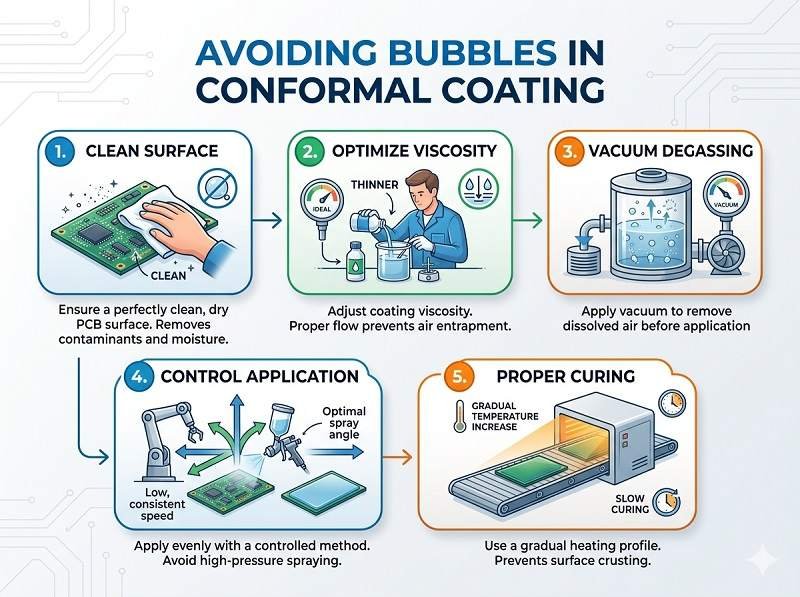
Assicurare una corretta pulizia dei PCB
Una delle cause principali delle bolle è la contaminazione, come residui di flussante, olio o polvere. Prima di rivestire in Assemblaggio di PCB, La tavola deve essere accuratamente pulita e asciugata. I solventi residui o l'umidità possono fuoriuscire durante l'indurimento, formando bolle sotto il rivestimento.
Controllo dell'umidità e dell'umidità
L'umidità intrappolata nei componenti o nel PCB può vaporizzare durante il rivestimento o l'indurimento. In Assemblaggio SMT, È importante conservare le tavole in ambienti controllati e, se necessario, precuocerle per rimuovere l'umidità assorbita prima di applicarle. Rivestimento conforme.
Utilizzare la corretta viscosità del rivestimento
Se il rivestimento è troppo denso, può intrappolare l'aria durante l'applicazione. Una corretta diluizione (se consentita dal produttore) e il mantenimento della viscosità raccomandata aiutano il rivestimento a scorrere senza problemi e a rilasciare l'aria intrappolata.
Applicare il rivestimento in modo uniforme e alla giusta velocità
Il metodo di applicazione è importante. Che si tratti di spruzzatura, immersione o spazzolatura, l'applicazione troppo rapida del rivestimento può introdurre bolle d'aria. In caso di applicazione automatizzata Assemblaggio SMT Per garantire una copertura uniforme e omogenea, è necessario ottimizzare parametri quali la pressione di spruzzo, la distanza dell'ugello e la portata.
Evitare uno spessore eccessivo del rivestimento
L'applicazione di strati troppo spessi aumenta il rischio di formazione di bolle e di intrappolamento del solvente. È preferibile applicare più strati sottili piuttosto che un'unica mano pesante in Assemblaggio di PCB processi.
Degasare il materiale di rivestimento
Prima dell'uso, alcuni rivestimenti possono essere degassati (eliminando l'aria disciolta) per evitare la formazione di bolle. Questa operazione è particolarmente utile in Assemblaggio di prototipi di PCB, dove si sta testando l'ottimizzazione del processo.
Consentire un tempo di spegnimento adeguato
Dopo l'applicazione, lasciare che i solventi evaporino (flash-off) prima dell'indurimento completo aiuta a prevenire la formazione di bolle. Affrettare il processo di indurimento può intrappolare i vapori dei solventi all'interno del rivestimento.
Ottimizzare le condizioni di polimerizzazione
Una polimerizzazione troppo rapida o ad una temperatura troppo elevata può causare una rapida evaporazione del solvente, con conseguente formazione di bolle. Una polimerizzazione controllata, termica o UV, garantisce una finitura liscia e priva di difetti.
Ispezione e regolazione del processo
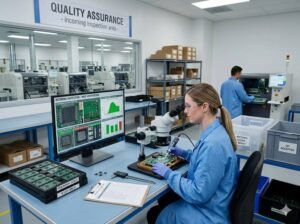
In Assemblaggio di prototipi di PCB, L'ispezione visiva (spesso con luce UV) aiuta a identificare tempestivamente i problemi relativi alle bolle. I parametri di processo possono quindi essere messi a punto prima di passare alla produzione di massa.
In conclusione, evitare le bolle in Rivestimento conforme richiede attenzione alla pulizia, al controllo dell'umidità, alla tecnica di applicazione e alle condizioni di indurimento. Ottimizzando questi fattori in Assemblaggio di PCB, Assemblaggio SMT, e Assemblaggio di prototipi di PCB, I produttori possono ottenere un rivestimento liscio e uniforme che offre una protezione affidabile.
Richiedete un preventivo per il rivestimento conforme
Dall'assemblaggio SMT al rivestimento conforme, offriamo soluzioni one-stop. Richiedete subito un preventivo.
Inviateci i vostri requisiti e riceverete una risposta rapida dal nostro team di ingegneri.
✔ Risposta in 24 ore ✔ Supporto ingegneristico ✔ Produzione di piccole dimensioni e di massa
Shenzhen Tengxinjie Electronics Co., Ltd.
 Italiano
  English
  Deutsch
  Français
  Português do Brasil
  Español
  日本語
日本語  Nederlands
  Русский
  한국어
한국어  العربية
  Svenska
  Polski
  Türkçe
  繁體中文
繁體中文