
Testing methods
Testing is a fundamental part of ensuring reliability and performance in Assemblage du circuit imprimé. Even with advanced SMT Assembly processes, defects can still occur due to component issues, soldering problems, or design limitations.
A comprehensive testing strategy ensures that faults are detected early, reducing rework costs and preventing defective products from reaching customers. In modern electronics manufacturing, multiple testing methods are combined to achieve the highest level of quality assurance.
Solder paste inspection (SPI)
Solder Paste Inspection is the first quality checkpoint in SMT Assembly. It is performed immediately after solder paste printing and before component placement.
SPI systems measure:
- Solder paste volume
- Paste height and area
- Alignment accuracy
By identifying insufficient or excessive solder early, SPI prevents defects such as tombstoning, bridging, and weak solder joints during PCB Assembly.
Inspection optique automatisée (AOI)
Automated Optical Inspection is one of the most widely used testing methods in PCB Assembly. It uses high-resolution cameras to detect visual defects after component placement and soldering.
AOI can identify:
- Composants manquants
- Misalignment or polarity errors
- Solder bridges and insufficient solder
- Surface defects
It is commonly used both before and after reflow in Assemblage SMT to ensure consistent quality.
Inspection par rayons X
X-ray inspection is essential for detecting hidden defects that cannot be seen with optical systems. It is especially important for complex components such as BGAs, QFNs, and multilayer boards.
X-ray testing helps identify:
- Void formation in solder joints
- Hidden bridges under components
- Internal connection defects
This method provides deep visibility into PCB Assembly quality and is critical for high-reliability products.
In-circuit testing (ICT)
In-Circuit Testing checks the electrical performance of individual components on a PCB after SMT Assembly is completed.
ICT verifies:
- Component values (resistance, capacitance, etc.)
- Short circuits and open circuits
- Proper component placement
This method ensures that each part of the circuit functions correctly before the board moves to functional testing.
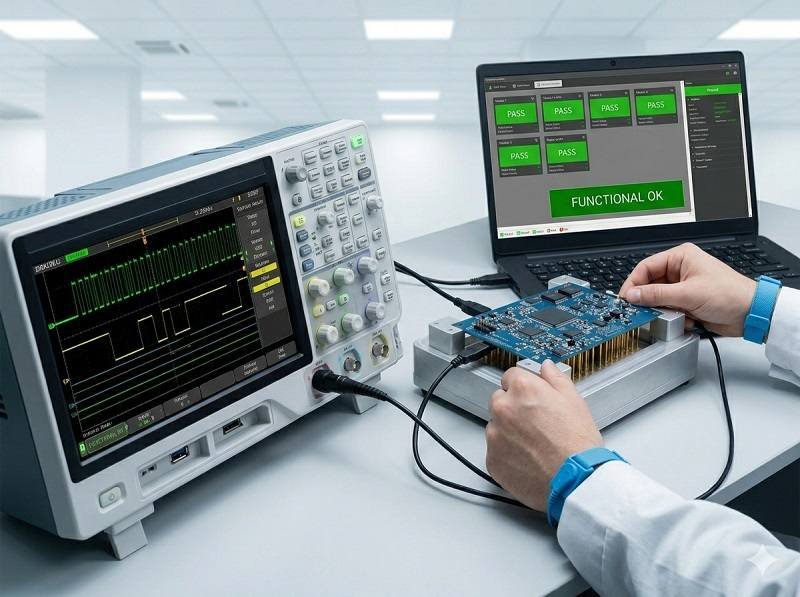
Functional testing (FCT)
Functional Testing evaluates how the fully assembled PCB performs under real operating conditions.
During FCT, the board is powered on and tested based on its intended application. This may include:
- Signal verification
- Communication testing
- Power performance checks
Functional testing ensures the PCB Assembly meets end-use requirements and behaves as expected in real-world scenarios.
Flying probe testing
Flying Probe Testing is an alternative to ICT, especially suitable for low-volume production and prototype PCB Assembly.
It uses movable probes to test electrical connections without requiring a dedicated test fixture. This makes it:
- Flexible for design changes
- Cost-effective for small batches
- Ideal for rapid prototyping
Although slower than ICT, it is highly accurate and efficient for early-stage testing.
Burn-in testing
Burn-in testing is used to identify early-life failures by running the PCB under elevated stress conditions such as high temperature or continuous operation.
This method helps detect:
- Weak components
- Thermal instability issues
- Early failure risks
Burn-in testing is often used for high-reliability industries like automotive, aerospace, and medical electronics.
Essais environnementaux et de fiabilité
For products that must operate in harsh conditions, environmental testing is essential.
This includes:
- Thermal cycling tests
- Test d'humidité
- Vibration and shock testing
These tests ensure that PCB Assembly products can withstand real-world environmental stress without failure.
Final quality inspection
Before shipment, all boards go through a final inspection process. This includes visual checks, documentation verification, and packaging inspection.
This step ensures:
- No defects are missed
- All testing requirements are completed
- Products meet customer specifications
It acts as the final safeguard in the PCB Assembly process.
Combining multiple testing methods
No single testing method can guarantee complete quality assurance. That is why professional SMT Assembly providers use a combination of testing techniques.
A typical process may include:
- SPI → AOI → X-ray → ICT → FCT
This layered approach ensures that defects are detected at different stages, improving overall product reliability and reducing failure rates.
Conclusion
PCB assembly quality depends heavily on a robust and multi-layered testing strategy. From solder paste inspection to functional testing, each method plays a unique role in ensuring product performance.
By integrating advanced testing technologies into PCB Assembly and SMT Assembly processes, manufacturers can deliver reliable, high-quality products that meet strict industry standards and customer expectations.
Besoin d'aide concernant les prix et les délais d'assemblage des circuits imprimés ? Demandez un devis dès aujourd'hui.
Nous fournissons des services professionnels d'assemblage de circuits imprimés, y compris SMT, DIP et des solutions complètes clé en main.
✔ NDA disponible ✔ Devis rapide sous 24 heures ✔ Usine certifiée ISO ✔ Service unique de PCB et PCBA
 Français
  English
  Deutsch
  Português do Brasil
  Español
  日本語
日本語  Nederlands
  Italiano
  Русский
  한국어
한국어  العربية
  Svenska
  Polski
  Türkçe
  繁體中文
繁體中文