
Traceability in PCB assembly
Traceability in Assemblage du circuit imprimé refers to the ability to track and record every component, material, and process involved in manufacturing a printed circuit board throughout its entire lifecycle. It is a critical part of quality management in Assemblage SMT, Assemblage de circuits imprimés clés en main, and overall Fabrication de circuits imprimés, ensuring that every board can be traced back to its origin, production conditions, and testing results.
In simple terms, traceability answers the question: “Where did this board and its components come from, and how was it built?”
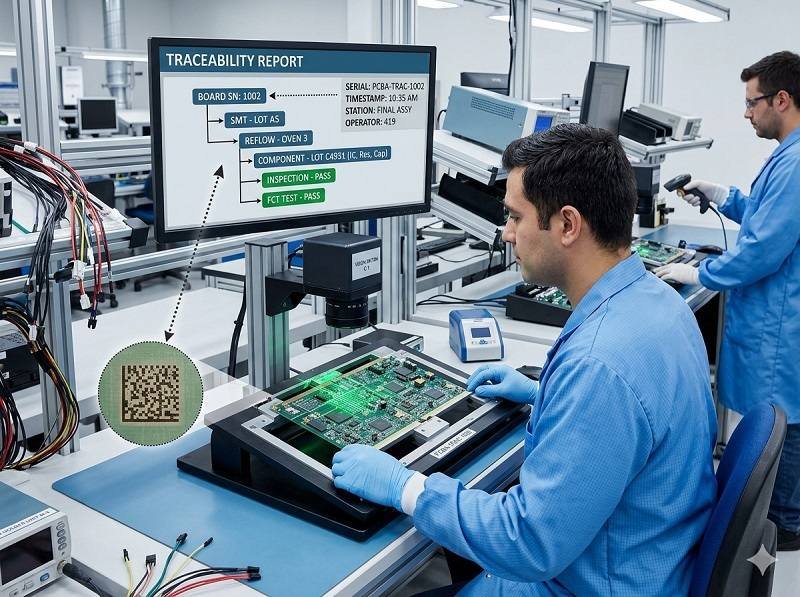
Why traceability is important
Traceability plays a key role in ensuring product quality, especially for industries that require high reliability such as automotive, medical, and industrial electronics.
With proper traceability in Assemblage du circuit imprimé, manufacturers can:
- Quickly identify defective batches
- Perform efficient root cause analysis
- Reduce recall scope and cost
- Ensure compliance with industry standards
- Improve overall production transparency
Pour Assemblage de circuits imprimés clés en main, traceability is even more critical because the manufacturer handles everything from component sourcing to final testing.
What information is tracked?
A complete traceability system in Fabrication de circuits imprimés records data at multiple levels:
Component Traceability
Each component used in Assemblage SMT is tracked by:
- Manufacturer name
- Part number
- Lot or batch number
- Supplier (authorized distributor or vendor)
- Date of purchase
PCB Traceability
Bare boards are tracked with:
- PCB batch number
- Fabrication date
- Material type
- Surface finish (e.g., ENIG, HASL)
Process Traceability
Every step in Assemblage du circuit imprimé is recorded, including:
- Solder paste printing
- Pick and place machine data
- Reflow soldering profiles
- Inspection results (AOI, X-ray, ICT)
Operator and Equipment Data
- Machine ID
- Operator ID
- Production line used
How traceability is implemented
Moderne Assemblage SMT lines use digital systems to ensure accurate traceability.
Les méthodes les plus courantes sont les suivantes :
Barcode and QR Code Systems
Each PCB is labeled with a unique barcode or QR code, allowing real-time tracking throughout the production process.
MES (Manufacturing Execution System)
An MES system integrates all production data, linking components, processes, and inspection results into one database.
ERP Integration
Traceability data is often connected with ERP systems to manage inventory, procurement, and logistics in Assemblage de circuits imprimés clés en main.
Levels of traceability
Traceability can vary depending on project requirements:
Basic Traceability
Tracks PCB batches and general production data.
Full Traceability
Tracks every individual component and process step for each board.
Advanced Traceability
Includes real-time monitoring, automated data collection, and detailed analytics.
High-reliability industries usually require full or advanced traceability in Fabrication de circuits imprimés.
Traceability in quality control
Traceability is essential for effective quality control in Assemblage du circuit imprimé:
- Helps identify the root cause of defects
- Links failures to specific components or processes
- Enables corrective and preventive actions (CAPA)
- Supports continuous improvement
When combined with testing methods like AOI, ICT, and functional testing, traceability significantly enhances product reliability.
Benefits of traceability for customers
For customers using Assemblage de circuits imprimés clés en main, traceability offers clear advantages:
Transparency
You know exactly where your components and boards come from.
Accountability
Manufacturers can provide detailed production records when needed.
Faster issue resolution
Problems can be traced and solved quickly.
Conformité réglementaire
Essential for industries with strict standards and audits.
Traceability and counterfeit prevention
Traceability also helps prevent counterfeit components in Assemblage SMT.
By tracking:
- Supplier sources
- Component lot numbers
- Procurement channels
manufacturers can ensure that only genuine parts are used in Fabrication de circuits imprimés.
Traceability documentation
A professional Assemblage du circuit imprimé provider can offer traceability reports that include:
- Component sourcing records
- Production logs
- Inspection and test results
- Batch and serial tracking details
These reports are especially valuable for high-end or regulated applications.
Conclusion
Traceability in Assemblage du circuit imprimé is a vital system that ensures every component and process can be tracked throughout the production lifecycle. It enhances quality control, improves reliability, and provides full transparency in Assemblage SMT, Assemblage de circuits imprimés clés en main, et Fabrication de circuits imprimés.
Choosing a manufacturer with strong traceability capabilities ensures better product quality, faster problem resolution, and greater confidence in your final electronic products.
Votre solution d'assemblage de circuits imprimés commence ici. Cliquez ci-dessous pour demander un devis.
Nous fournissons des services professionnels d'assemblage de circuits imprimés, y compris SMT, DIP et des solutions complètes clé en main.
✔ NDA disponible ✔ Devis rapide sous 24 heures ✔ Usine certifiée ISO ✔ Service unique de PCB et PCBA

 Français
  English
  Deutsch
  Português do Brasil
  Español
  日本語
日本語  Nederlands
  Italiano
  Русский
  한국어
한국어  العربية
  Svenska
  Polski
  Türkçe
  繁體中文
繁體中文