
Contrôle du processus de revêtement
Contrôle du processus de revêtement en Revêtement conforme se réfère à la gestion systématique de toutes les variables qui affectent la qualité, la consistance et la performance du revêtement. Dans le cadre de la Assemblage du circuit imprimé, Prototype d'assemblage de circuits imprimés, et Assemblage SMT, Il garantit que chaque circuit imprimé reçoit un revêtement uniforme et sans défaut qui répond aux normes de fiabilité et aux normes industrielles.
Sans un contrôle adéquat, des variations dans les matériaux, l'environnement ou les méthodes d'application peuvent entraîner des défauts tels que des bulles, une épaisseur inégale, une mauvaise adhérence ou une couverture incomplète.
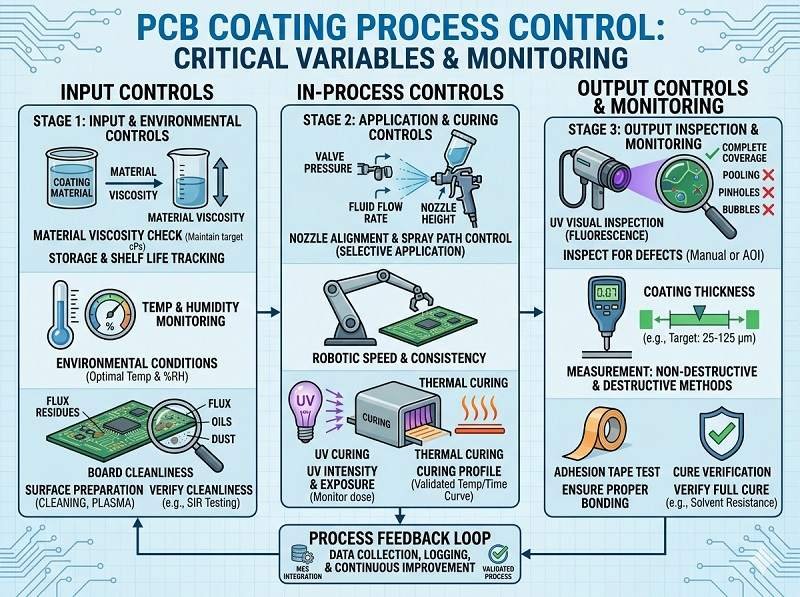
Éléments clés du contrôle du processus de revêtement
Contrôle des matériaux
Les propriétés de la Revêtement conforme Les caractéristiques du produit, telles que la viscosité, la durée de conservation et le rapport de mélange, doivent faire l'objet d'un suivi rigoureux. Une viscosité incorrecte peut entraîner une épaisseur de revêtement inégale, tandis que les matériaux périmés peuvent provoquer un défaut d'adhérence dans les Assemblage du circuit imprimé.
Contrôle de la préparation de la surface
Il est essentiel de nettoyer et de sécher correctement les PCB. Les résidus tels que le flux ou l'humidité peuvent interférer avec l'adhérence du revêtement et provoquer des défauts. En Assemblage SMT, Les processus de nettoyage contrôlés sont essentiels avant l'application du revêtement.
Contrôle des paramètres d'application
Les méthodes de revêtement (pulvérisation, immersion, revêtement sélectif) doivent être contrôlées avec précision. Les paramètres clés sont les suivants :
- Pression et débit de pulvérisation
- Distance et vitesse de la buse
- Épaisseur du revêtement
L'automatisation en Assemblage SMT permet de maintenir la cohérence dans les grands volumes de production.
Contrôle environnemental
La température, l'humidité et la propreté de l'air affectent directement les performances du revêtement. Une humidité élevée peut entraîner des défauts tels que le rougissement, tandis que la poussière peut contaminer la surface du revêtement au cours de l'application. Assemblage du circuit imprimé.
Contrôle du processus de durcissement
Les conditions de durcissement - temps, température ou exposition aux UV - doivent correspondre aux spécifications du revêtement. Un durcissement inadéquat peut entraîner des revêtements mous, des fissures ou une protection incomplète.
Contrôle du masquage et de la couverture
Les zones critiques telles que les connecteurs et les points de test doivent être correctement masquées. Assurer une couverture correcte tout en protégeant les zones d'exclusion est un élément clé du contrôle des processus dans les pays de l'UE. PAssemblage de PCB de rototype.
Inspection et contrôle de la qualité
L'inspection post-revêtement permet de vérifier que le processus fonctionne correctement. Les méthodes les plus courantes sont les suivantes :
- Inspection UV pour la couverture
- Mesure de l'épaisseur
- Inspection visuelle des défauts
En Assemblage du circuit imprimé, Le retour d'information de l'inspection est utilisé pour améliorer continuellement le processus.
Pourquoi le contrôle du processus de revêtement est-il important ?
- Garantit une épaisseur et une couverture constantes du revêtement
- Réduction des défauts et des reprises
- Améliore la fiabilité et la durée de vie des produits
- Favorise la conformité avec les normes industrielles (par exemple, IPC)
- Améliore l'efficacité dans les grands volumes Assemblage SMT
Contrôle des processus à différents stades de la production
Prototype d'assemblage de circuits imprimés
L'accent est mis sur l'optimisation des paramètres, les essais et la validation des processus de revêtement.
Assemblage de circuits imprimés en masse / Assemblage SMT
L'accent est mis sur l'automatisation, la reproductibilité et le contrôle strict de la qualité afin de maintenir la cohérence à grande échelle.
Meilleures pratiques pour un contrôle efficace des processus
- Définir des procédures opérationnelles standard (POS)
- Utiliser des systèmes automatisés de revêtement et de durcissement
- Contrôler les paramètres clés en temps réel
- Maintenir des environnements de production contrôlés
- Analyser en permanence les défauts et améliorer les processus
En conclusion, contrôle du processus de revêtement est le fondement d'une Revêtement conforme en Assemblage du circuit imprimé, Assemblage SMT, et Prototype d'assemblage de circuits imprimés. En gérant les matériaux, l'équipement, l'environnement et l'inspection, les fabricants peuvent obtenir des performances de revêtement fiables et reproductibles et minimiser les risques de production.
Obtenir un devis pour un revêtement conforme
Besoin d'une assistance professionnelle pour le revêtement conforme ? Soumettez vos besoins et obtenez une réponse dans les 12 heures.
Envoyez-nous vos exigences et obtenez une réponse rapide de notre équipe d'ingénieurs.
✔ Réponse dans les 24 heures ✔ Soutien technique ✔ Production en petite et grande série
Shenzhen Tengxinjie Electronics Co. Ltd.
 Français
  English
  Deutsch
  Português do Brasil
  Español
  日本語
日本語  Nederlands
  Italiano
  Русский
  한국어
한국어  العربية
  Svenska
  Polski
  Türkçe
  繁體中文
繁體中文