
Détecter les défauts de revêtement
Détection des défauts dans les Revêtement conforme est essentiel pour garantir la fiabilité et la performance des Assemblage du circuit imprimé et Assemblage SMT. Des problèmes de revêtement, même minimes, peuvent entraîner des infiltrations d'humidité, de la corrosion ou des défaillances électriques. Une combinaison de méthodes d'inspection est généralement utilisée dans les Assemblage de circuits imprimés clés en main d'identifier et de contrôler efficacement les défauts.
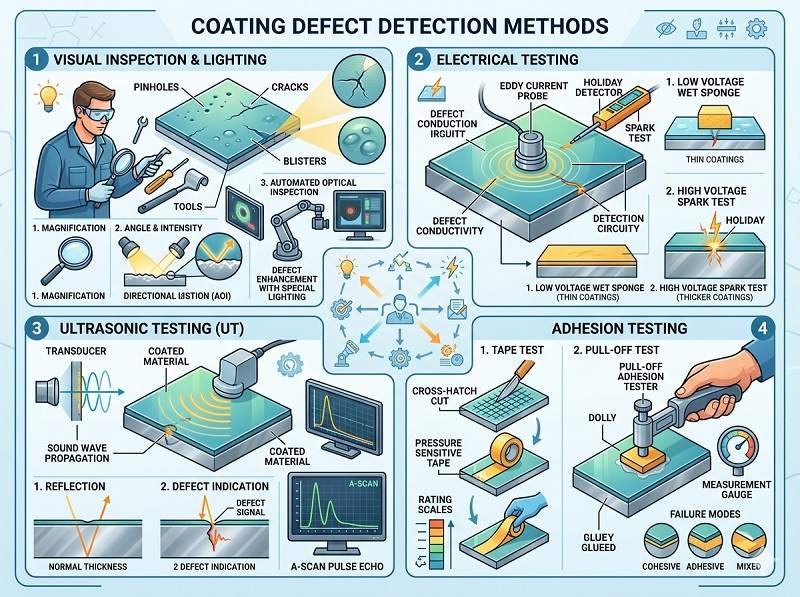
Inspection visuelle (méthode de base)
Le moyen le plus simple de détecter les défauts de revêtement est l'inspection visuelle :
- Utiliser un éclairage et un grossissement appropriés
- Vérifier que le revêtement n'est pas irrégulier, qu'il n'y a pas de bulles ou de zones manquantes.
- Identifier les surcharges sur les connecteurs ou les points d'essai
Bien que basique, cette méthode est encore largement utilisée comme première étape dans le processus d'évaluation de la qualité de l'eau. Assemblage du circuit imprimé le contrôle de la qualité.
Inspection par lumière UV (méthode la plus courante)
Nombreux Revêtement conforme comprennent des traceurs UV :
- Le revêtement brille sous la lumière UV
- Les zones manquantes ou minces apparaissent foncées
- Détection aisée des problèmes de couverture et de contamination
Il s'agit de l'une des techniques les plus efficaces pour Assemblage SMT pour une identification rapide des défauts.
AOI (Inspection optique automatisée)
Les systèmes AOI permettent une détection automatisée et très précise :
- Détecte l'insuffisance ou l'excès de revêtement
- Identifie les bulles, les vides et les incohérences
- Comparaison des résultats avec les normes programmées
L'AOI est couramment utilisée dans les Assemblage de circuits imprimés clés en main pour des résultats d'inspection cohérents.
Mesure de l'épaisseur
Les défauts ne sont pas toujours visibles - le contrôle de l'épaisseur est également important :
- Utiliser des jauges de film humide pendant l'application
- Utiliser des outils de mesure du film sec après le durcissement
- S'assurer que le revêtement se situe dans la plage typique (25-250 µm).
Une épaisseur incorrecte peut entraîner des problèmes de performance, même si la couverture semble acceptable.
Essais fonctionnels et électriques
Certains défauts du revêtement n'apparaissent qu'en cours de fonctionnement :
- Essai de résistance d'isolation
- Essais à haute tension (pour détecter les fuites ou les pannes)
- Tests de résistance à l'environnement (humidité, température)
Ces tests permettent de vérifier si Revêtement conforme fonctionne correctement en conditions réelles.
Défauts courants du revêtement à rechercher
- Bulles et vides
- Fissuration ou décollement
- Décollement
- Ombrage (zones non revêtues)
- Revêtement de pièces critiques
- Contamination sous le revêtement
La détection précoce permet de réduire les retouches et d'améliorer le rendement dans les domaines suivants Assemblage du circuit imprimé.
Meilleures pratiques pour la détection des défauts
- Combinaison de plusieurs méthodes d'inspection (UV + AOI + visuelle)
- Normaliser les critères et les procédures d'inspection
- Former les opérateurs et entretenir les équipements
- Intégrer l'inspection en ligne dans Assemblage SMT processus
Conclusion
La détection des défauts de revêtement nécessite une combinaison de méthodes d'inspection visuelle, UV, automatisée et fonctionnelle. Dans le cadre de la Assemblage du circuit imprimé, Assemblage SMT, et Assemblage de circuits imprimés clés en main, Un processus d'inspection solide permet de garantir que Revêtement conforme est appliqué correctement, ce qui permet d'éviter les défaillances et d'améliorer la fiabilité globale du produit.
Obtenir un devis pour un revêtement conforme
Prêt à démarrer votre projet de revêtement conforme ? Remplissez le formulaire ci-dessous pour commencer.
Envoyez-nous vos exigences et obtenez une réponse rapide de notre équipe d'ingénieurs.
✔ Réponse dans les 24 heures ✔ Soutien technique ✔ Production en petite et grande série
Shenzhen Tengxinjie Electronics Co. Ltd.




 Français
  English
  Deutsch
  Português do Brasil
  Español
  日本語
日本語  Nederlands
  Italiano
  Русский
  한국어
한국어  العربية
  Svenska
  Polski
  Türkçe
  繁體中文
繁體中文