
Différence entre les revêtements HumiSeal acryliques et silicones
Acrylique et revêtements en silicone HumiSeal sont deux des outils les plus couramment utilisés. Revêtement conforme types en Assemblage du circuit imprimé, Prototype d'assemblage de circuits imprimés, et Assemblage SMT. Bien qu'ils offrent tous deux une protection contre l'humidité, la poussière et les contaminants, ils diffèrent considérablement en ce qui concerne les éléments suivants la performance, la flexibilité, le coût et les scénarios d'application.
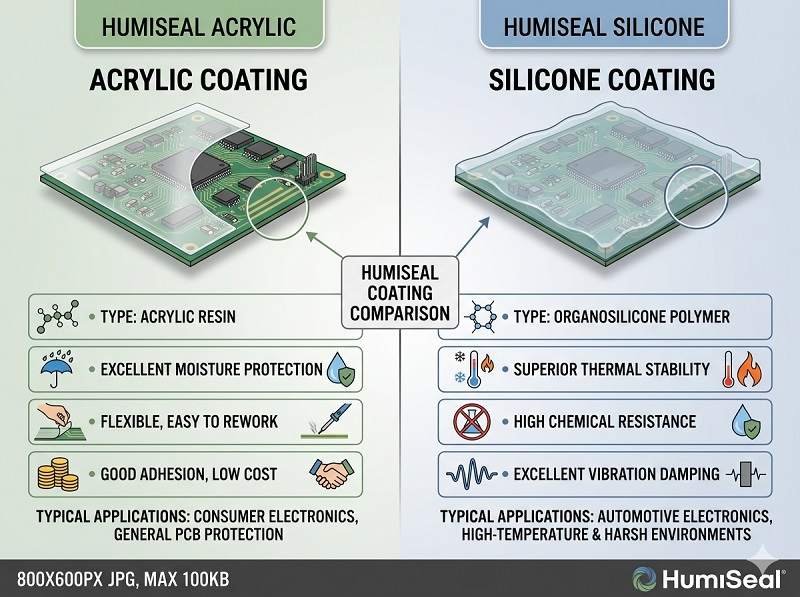
Différence essentielle : propriétés des matériaux
La principale distinction réside dans leur nature chimique :
- Revêtements acryliques (AR) → polymères durs, transparents et à séchage rapide
- Revêtements en silicone (SR) → matériaux souples, caoutchouteux et très flexibles
Les revêtements acryliques durcissent dans un couche protectrice rigide, tandis que les revêtements en silicone restent élastiques et flexibles.
Vitesse de séchage et efficacité du processus
Les revêtements acryliques sont connus pour leur séchage rapide et traitement facile, Les appareils sont donc idéaux pour les applications à grande vitesse. Assemblage SMT les lignes de production. Ils sèchent en quelques minutes et sont faciles à appliquer.
Les revêtements en silicone nécessitent généralement temps de durcissement plus long, surtout s'il s'agit d'un séchage à l'humidité, ce qui peut ralentir la cadence de production.
Flexibilité et résistance aux vibrations
C'est l'une des différences les plus importantes :
- Acrylique → relativement rigide, peut se fissurer sous l'effet de vibrations ou de cycles thermiques
- Silicone → très souple, absorbe les contraintes et résiste aux fissures
Les revêtements en silicone sont mieux adaptés aux environnements avec les contraintes mécaniques, les vibrations ou la dilatation thermique.
Résistance à la température
Les revêtements acryliques donnent de bons résultats dans plages de températures modérées (typiquement jusqu'à ~120°C).
Les revêtements en silicone offrent excellente résistance aux hautes et basses températures, opérant souvent à partir de De -55°C à 200°C ou plus, ce qui les rend idéales pour les environnements extrêmes.
Résistance aux produits chimiques et à l'environnement
- Acrylique → bonne protection contre l'humidité, mais résistance limitée aux produits chimiques agressifs
- Silicone → forte résistance aux produits chimiques, à l'humidité et aux environnements difficiles
Les revêtements en silicone sont préférés pour l'automobile, l'aérospatiale et l'électronique extérieure où la durabilité à long terme est essentielle.
Retouches et réparations
En Assemblage du circuit imprimé, La capacité de reprise est donc très importante :
- Acrylique → facile à enlever et à réparer l'utilisation de solvants courants
- Silicone → plus difficile à enlever, nécessite des procédés spéciaux
Les revêtements acryliques conviennent donc parfaitement pour Prototype d'assemblage de circuits imprimés, où des modifications fréquentes sont nécessaires.
Considérations relatives au coût et à la production
- Acrylique → coût réduit + traitement plus rapide
- Silicone → coût plus élevé + meilleure performance
Pour les gros volumes Assemblage SMT, L'acrylique est souvent choisi pour des raisons de rentabilité, tandis que le silicone est utilisé lorsque les exigences de performance justifient un coût plus élevé.
Applications typiques
Revêtements acryliques HumiSeal (par exemple, 1B31) :
- Electronique grand public
- Pilotes de LED et alimentations
- Usage général Assemblage du circuit imprimé
- Prototype d'assemblage de circuits imprimés (reprise facile)
Revêtements HumiSeal en silicone :
- Électronique automobile
- Systèmes aérospatiaux
- Environnements extérieurs et à forte humidité
- Applications à haute température
Comparaison sommaire
| Fonctionnalité | Revêtement acrylique | Revêtement de silicone |
|---|---|---|
| Vitesse de séchage | Très rapide | Plus lent |
| Flexibilité | Faible à modéré | Très élevé |
| Résistance à la température | Modéré | Excellent |
| Résistance chimique | Modéré | Haut |
| Possibilité de remaniement | Facile | Difficile |
| Coût | Plus bas | Plus élevé |
| Meilleure utilisation | Électronique standard | Environnements difficiles |
Aperçu final
Il n'y a pas de choix unique entre les revêtements acryliques et silicones HumiSeal.
- Choisir revêtements acryliques pour rentables, rapides et faciles à retravailler solutions en Assemblage du circuit imprimé et Assemblage SMT
- Choisir revêtements en silicone pour environnements extrêmes, haute fiabilité et durabilité à long terme
Dans la pratique, de nombreux fabricants valident les deux options au cours de l'année. Prototype d'assemblage de circuits imprimés avant de choisir le revêtement le mieux adapté à la production de masse.
Obtenir un devis pour un revêtement conforme
Vous n'êtes pas sûr du revêtement conforme qui convient à votre produit ? Contactez nos experts dès aujourd'hui.
Envoyez-nous vos exigences et obtenez une réponse rapide de notre équipe d'ingénieurs.
✔ Réponse dans les 24 heures ✔ Soutien technique ✔ Production en petite et grande série
Shenzhen Tengxinjie Electronics Co. Ltd.
 Français
  English
  Deutsch
  Português do Brasil
  Español
  日本語
日本語  Nederlands
  Italiano
  Русский
  한국어
한국어  العربية
  Svenska
  Polski
  Türkçe
  繁體中文
繁體中文