
Les produits chimiques éliminent Revêtement conforme
En Assemblage du circuit imprimé et Assemblage SMT, supprimant Revêtement conforme est souvent nécessaire pour la réparation, la reprise ou l'inspection. Le type de produit chimique utilisé dépend du matériau de revêtement (acrylique, silicone, polyuréthane, époxy ou parylène), chacun ayant des propriétés de résistance différentes.
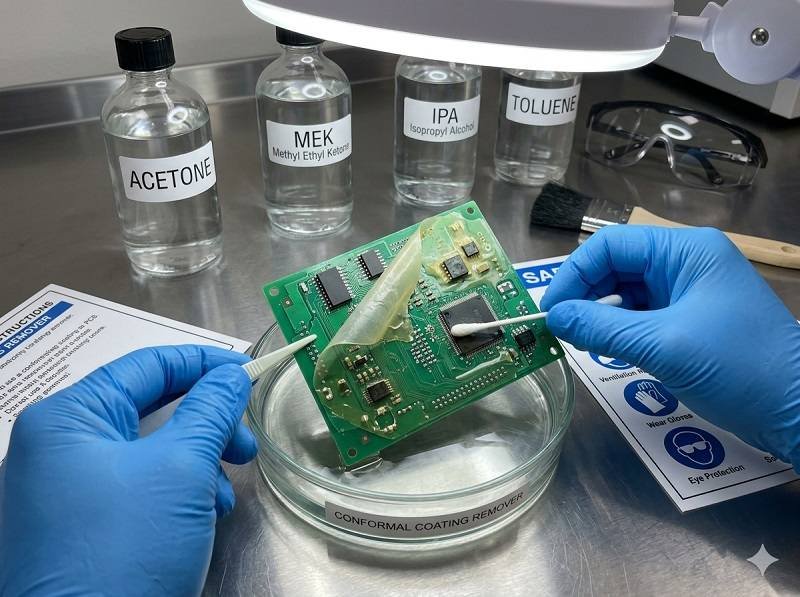
Produits chimiques courants pour l'élimination Revêtement conforme
Dissolvants à base de solvants (pour les revêtements acryliques)
Acrylique Revêtement conforme est le plus facile à enlever.
Produits chimiques courants :
- Acétone
- Alcool isopropylique (IPA)
- Dissolvants spécialisés pour l'acrylique
Caractéristiques :
- Rapide et efficace
- Dommages minimes au PCB en cas d'utilisation correcte
- Largement utilisé dans Assemblage du circuit imprimé remaniement
Mélanges de solvants (pour les revêtements en polyuréthane)
Les revêtements en polyuréthane nécessitent des produits chimiques plus puissants.
Produits chimiques courants :
- Dissolvants d'uréthane dédiés
- Mélanges de solvants (par exemple, éthers de glycol, esters)
Caractéristiques :
- Bonne efficacité en cas d'exposition contrôlée
- Peut nécessiter un brossage ou un trempage
- Courant dans l'industrie Assemblage SMT réparation
Dissolvants de silicone
Silicone Revêtement conforme est plus résistant et plus difficile à enlever.
Produits chimiques courants :
- Agents de décapage du silicone
- Solvants de gonflement (pour ramollir le revêtement avant de l'enlever)
Caractéristiques :
- Nécessite généralement une assistance mécanique (grattage)
- Processus plus lent que l'acrylique
Décapants pour époxy
Les revêtements époxy sont très difficiles à enlever chimiquement.
Produits chimiques courants :
- Décapants époxy industriels puissants
- Souvent combinée à la chaleur ou à l'élimination mécanique
Caractéristiques :
- Chronophage et agressif
- Risque d'endommagement des composants ou du circuit imprimé
- Utilisé uniquement lorsque c'est nécessaire dans Assemblage du circuit imprimé
Produits chimiques pour l'élimination du parylène
Parylène Revêtement conforme est très résistant à la plupart des produits chimiques.
Méthodes de suppression :
- Agents de décapage chimiques spécialisés
- Gravure au plasma (plus courante que les produits chimiques)
Caractéristiques :
- Processus complexe et coûteux
- Généralement utilisé dans les Assemblage SMT applications
Considérations importantes en matière de sécurité
Lors de l'utilisation de produits chimiques pour éliminer les Revêtement conforme:
- Travailler dans des zones bien ventilées
- Utiliser les EPI appropriés (gants, lunettes)
- Éviter l'exposition prolongée aux solvants
- Tester d'abord sur une petite surface pour éviter d'endommager les circuits imprimés.
Autres méthodes d'élimination
Outre les produits chimiques, d'autres méthodes peuvent être utilisées :
- Retrait mécanique (grattage, micro-outils)
- Élimination thermique (adoucissement par la chaleur)
- Ablation au laser ou au plasma (haute précision)
Ces méthodes sont souvent combinées à des méthodes chimiques dans Assemblage du circuit imprimé la refonte.
Conclusion finale
Différents Revêtement conforme Les revêtements acryliques sont plus faciles à enlever à l'aide de solvants courants. Les revêtements acryliques sont les plus faciles à enlever avec des solvants courants, tandis que le silicone, le polyuréthane, l'époxy et le parylène nécessitent des méthodes plus puissantes ou spécialisées. En Assemblage du circuit imprimé et Assemblage SMT, Le choix de la bonne méthode d'enlèvement garantit une reprise sûre et efficace sans endommager le circuit imprimé.
Obtenir un devis pour un revêtement conforme
Garantissez la fiabilité à long terme de vos circuits imprimés grâce à nos solutions de revêtement. Commencez ici.
Envoyez-nous vos exigences et obtenez une réponse rapide de notre équipe d'ingénieurs.
✔ Réponse dans les 24 heures ✔ Soutien technique ✔ Production en petite et grande série
Shenzhen Tengxinjie Electronics Co. Ltd.

 Français
  English
  Deutsch
  Português do Brasil
  Español
  日本語
日本語  Nederlands
  Italiano
  Русский
  한국어
한국어  العربية
  Svenska
  Polski
  Türkçe
  繁體中文
繁體中文