
Processus de reprise du revêtement conforme
Le processus de reprise du revêtement conforme fait référence à l'enlèvement contrôlé, à la réparation et à la réapplication du revêtement conforme. Revêtement conforme sur une carte de circuit imprimé lorsque des défauts, des modifications de conception ou des remplacements de composants sont nécessaires. Il s'agit d'une étape importante dans Assemblage du circuit imprimé et Assemblage SMT, Les cartes peuvent ainsi être corrigées sans compromettre la fiabilité.
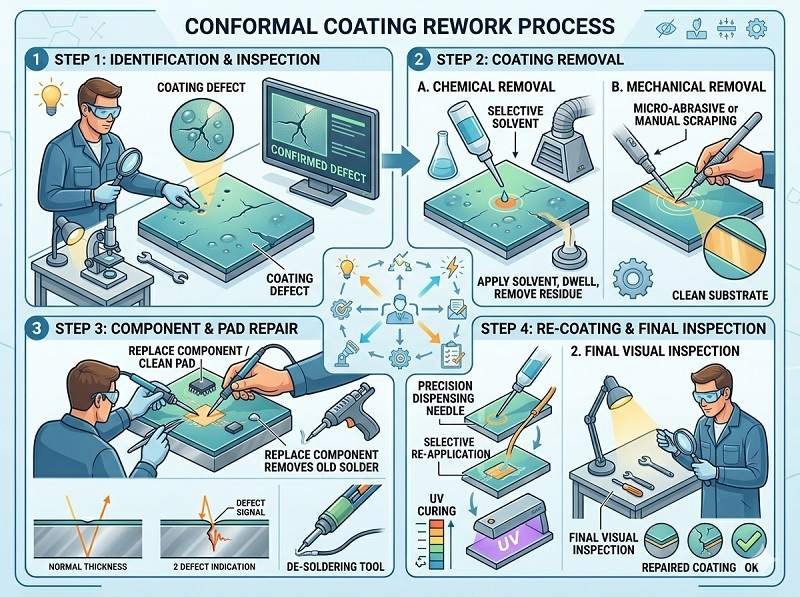
Pourquoi une reprise est-elle nécessaire ?
Des travaux de reprise peuvent être nécessaires dans les cas suivants Assemblage de circuits imprimés clés en main pour plusieurs raisons :
- Défauts de revêtement (bulles, vides, épaisseur inégale)
- Contamination piégée sous le revêtement
- Mauvais masquage ou recouvrement des connecteurs
- Réparation ou remplacement de composants
- Modifications techniques ou mises à jour de la conception
En l'absence de retouches appropriées, ces problèmes peuvent entraîner une défaillance fonctionnelle ou une réduction de la durée de vie.
Étapes de la reprise du revêtement conforme
Identification du revêtement
Tout d'abord, identifiez le type de Revêtement conforme (acrylique, silicone, uréthane, époxy ou parylène), car chacune nécessite une méthode d'enlèvement différente.
Enlèvement du revêtement
Les techniques de suppression les plus courantes sont les suivantes :
- Élimination des solvants → dissout les revêtements acryliques
- Retrait mécanique → grattage ou micro-abrasion
- Méthodes thermiques → ramollissement du revêtement par la chaleur
- Décapage chimique → utilisé pour des revêtements plus résistants comme l'époxy
La méthode doit être choisie avec soin afin d'éviter d'endommager les composants ou les traces pendant l'opération. Assemblage du circuit imprimé réparation.
Nettoyage de la carte de circuit imprimé
Après le retrait :
- Nettoyer les résidus à l'aide de solvants appropriés
- S'assurer que la surface est exempte de contaminants
- Sécher complètement la planche avant tout autre traitement
Un nettoyage adéquat est essentiel avant de procéder à un nouveau revêtement en Assemblage SMT.
Réparation ou remplacement
Effectuer les actions nécessaires, telles que
- Remplacement des composants défectueux
- Fixation des joints de soudure
- Modification des zones de circuit
Cette étape suit les procédures de réparation standard dans Assemblage de circuits imprimés clés en main.
Réapplication du revêtement
Une fois les réparations terminées :
- Renouveler la demande Revêtement conforme au moyen d'un pinceau, d'une bombe ou d'un revêtement sélectif
- Assurer un masquage correct des zones sans revêtement
- Maintenir une épaisseur et une couverture correctes
Durcissement et inspection finale
Enfin :
- Durcissement du revêtement (séchage à l'air, à la chaleur ou aux UV en fonction du matériau)
- Contrôler à l'aide de méthodes UV ou AOI
- Vérifier la couverture, l'adhérence et l'épaisseur
Les défis de la reprise
- Risque d'endommagement des composants sensibles
- Difficulté à enlever certains revêtements (par exemple, époxy ou parylène)
- Maintien d'une qualité de revêtement constante après les retouches
- Temps et coûts de main-d'œuvre
En raison de ces défis, les retouches doivent être réduites au minimum grâce à un contrôle adéquat des processus. Assemblage du circuit imprimé.
Meilleures pratiques
- Utiliser des revêtements faciles à retravailler (par exemple, acrylique) lorsque cela est possible.
- Conception pour l'accessibilité dans l'agencement des circuits imprimés
- Appliquer un masquage adéquat lors du revêtement initial
- Former les techniciens aux techniques d'enlèvement sûres
Conclusion
Le processus de reprise du revêtement conforme est essentiel pour corriger les défauts et permettre les réparations dans les domaines suivants Assemblage du circuit imprimé, Assemblage SMT, et Assemblage de circuits imprimés clés en main. En enlevant, réparant et réappliquant soigneusement le revêtement, les fabricants peuvent maintenir la qualité du produit tout en réduisant les déchets et les coûts.
Obtenir un devis pour un revêtement conforme
Réduisez les risques de défaillance des circuits imprimés grâce à un revêtement conforme professionnel. Demandez un devis maintenant.
Envoyez-nous vos exigences et obtenez une réponse rapide de notre équipe d'ingénieurs.
✔ Réponse dans les 24 heures ✔ Soutien technique ✔ Production en petite et grande série
Shenzhen Tengxinjie Electronics Co. Ltd.
 Français
  English
  Deutsch
  Português do Brasil
  Español
  日本語
日本語  Nederlands
  Italiano
  Русский
  한국어
한국어  العربية
  Svenska
  Polski
  Türkçe
  繁體中文
繁體中文