
Curado en horno frente a curado en sala
En Revestimiento conforme, El curado es el proceso que transforma un revestimiento líquido en una capa protectora sólida. Dos de los métodos más utilizados en Montaje de PCB, Montaje de prototipos de PCB, y Montaje SMT son curado en horno y curado en sala (secado al aire). Cada método tiene características, ventajas y casos de uso ideales diferentes.
¿Qué es el curado al horno?
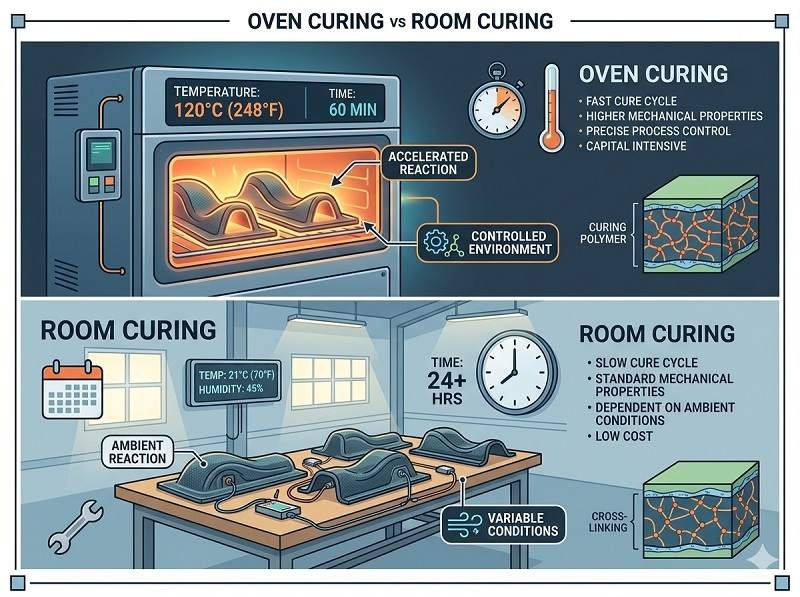
El curado en horno (curado térmico) utiliza calor controlado para acelerar el proceso de curado. Tras aplicar el Revestimiento conforme, Las placas de circuito impreso se introducen en un horno a una temperatura determinada durante un tiempo definido.
Características principales del curado en horno
- Temperaturas típicas: 60-150°C, según el tipo de revestimiento
- Tiempo de curado más rápido (de unos minutos a unas horas)
- Resultados más coherentes y repetibles
- Adherencia y resistencia mecánica mejoradas
En grandes volúmenes Montaje SMT, El curado en horno se utiliza ampliamente porque aumenta significativamente la eficiencia de la producción y garantiza una calidad uniforme del revestimiento en todos los lotes.
¿Qué es el curado en sala (curado al aire)?
El curado en sala se basa en la evaporación natural del disolvente o en la reacción de la humedad a temperatura ambiente (normalmente 20-25°C) para curar el revestimiento.
Características principales del curado en sala
- No requiere equipo de calefacción
- Mayor tiempo de curado (12-48 horas)
- Menor coste energético
- Adecuado para componentes sensibles al calor
Este método se utiliza habitualmente en Montaje de prototipos de PCB o a pequeña escala Montaje de PCB, donde la flexibilidad y el bajo coste de instalación son más importantes que la velocidad.
Principales diferencias entre el curado en horno y el curado en sala
Velocidad de curado
El curado en horno es mucho más rápido, por lo que resulta ideal para la producción en masa en Montaje SMT. El curado en sala es más lento y puede retrasar el rendimiento.
Control de procesos
El curado en horno permite un control preciso de la temperatura y el tiempo, lo que se traduce en una calidad constante. El curado en sala depende más de condiciones ambientales como la humedad y el flujo de aire.
Requisitos de equipamiento
El curado en horno requiere hornos térmicos y sistemas de control del proceso. El curado en sala solo necesita un entorno limpio y controlado.
Impacto en los componentes
El curado en sala es más seguro para los componentes sensibles a la temperatura. El curado en horno debe controlarse cuidadosamente para evitar daños térmicos durante Montaje de PCB.
Rendimiento del revestimiento
El curado en horno suele producir revestimientos más fuertes y duraderos, con mejor resistencia química y mecánica.
Cuándo elegir cada método
El curado al horno es mejor para:
- Gran volumen Montaje SMT
- Plazos de producción ajustados
- Aplicaciones que requieren alta fiabilidad
El curado en sala es mejor para:
- Montaje de prototipos de PCB y pequeños lotes
- Diseños sensibles al calor
- Proyectos sensibles a los costes
En conclusión, tanto el curado en horno como el curado en sala se utilizan ampliamente en Revestimiento conforme procesos. La elección depende del volumen de producción, el material de revestimiento y los requisitos del producto. Optimización del método de curado en Montaje de PCB, Montaje SMT, y Montaje de prototipos de PCB garantiza el mejor equilibrio entre eficacia, coste y rendimiento del revestimiento.
Obtenga un presupuesto de revestimiento de conformación
¿Desea subcontratar servicios de revestimiento de conformación? Póngase en contacto con nuestro equipo.
Envíenos sus requisitos y obtenga una respuesta rápida de nuestro equipo de ingenieros.
✔ Respuesta en 24 horas ✔ Soporte de ingeniería ✔ Producción en serie y a pequeña escala
Shenzhen Tengxinjie Electronics Co.
 Español
  English
  Deutsch
  Français
  Português do Brasil
  日本語
日本語  Nederlands
  Italiano
  Русский
  한국어
한국어  العربية
  Svenska
  Polski
  Türkçe
  繁體中文
繁體中文