
Insulation resistance in coating
Insulation resistance 於 塗層 refers to the coating’s ability to resist the flow of electrical current across its surface or through its thickness. It is a key parameter in evaluating how well a coating prevents leakage currents and maintains electrical isolation in PCB 組裝, 原型 PCB 組裝, 以及 SMT 組裝.
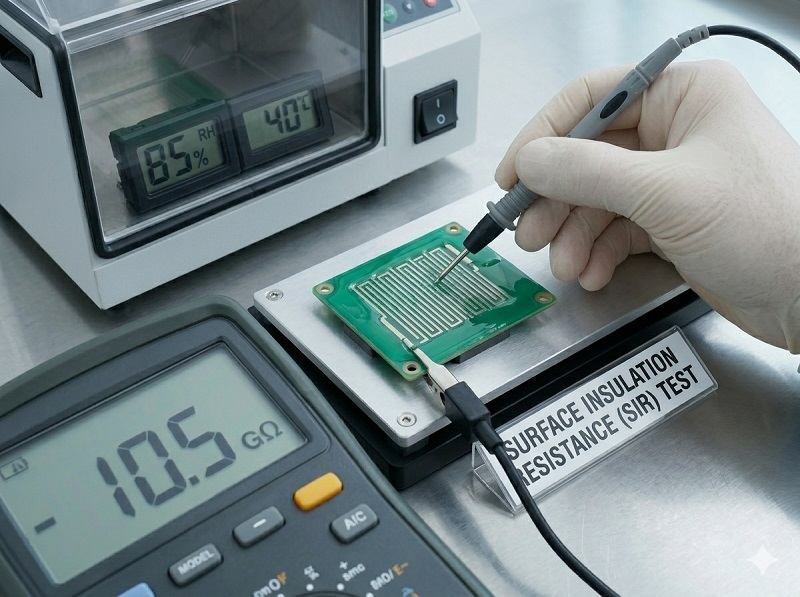
Insulation resistance is typically measured in ohms (Ω), often expressed as megaohms (MΩ) or gigaohms (GΩ). A higher insulation resistance value indicates better insulating performance, meaning the coating is more effective at preventing unintended current flow between conductive parts of a circuit.
In practical applications, when a 保形塗層 is applied to a PCB, it forms a protective insulating layer over traces, pads, and components. This layer helps reduce leakage currents, especially in environments with high humidity, dust, or contamination. Without sufficient insulation resistance, moisture or ionic residues can create conductive paths, leading to malfunction or failure.
在 SMT 組裝, where components are densely packed and spacing is minimal, high insulation resistance is especially important. Even small leakage currents can interfere with signal integrity or cause short circuits. A reliable coating ensures stable electrical performance over time.
Different coating materials offer varying insulation resistance levels:
- 丙烯酸塗料 provide good insulation resistance for general-purpose use.
- 矽膠塗層 maintain stable resistance even under high humidity and temperature variations.
- Polyurethane and epoxy coatings often deliver higher resistance and better protection in chemically aggressive environments.
- Parylene coatings are known for extremely high insulation resistance due to their uniform, pinhole-free structure.
在 PCB 組裝, achieving high insulation resistance is not only about material selection but also about process quality. Proper cleaning before coating (to remove flux residues and contaminants) is critical. Even the best coating cannot perform well if contaminants are trapped underneath.
期間 原型 PCB 組裝, insulation resistance testing is often performed under controlled conditions (such as temperature and humidity cycling) to verify long-term reliability. Standards like IPC guidelines are commonly used to define acceptable resistance levels.
It’s important to distinguish insulation resistance from dielectric strength: insulation resistance measures how much current leaks under normal conditions, while dielectric strength measures how much voltage the coating can withstand before breakdown.
總之、, insulation resistance is a fundamental property of 保形塗層 that ensures effective electrical isolation and prevents leakage currents. Proper material selection and application in PCB 組裝, SMT 組裝, 以及 原型 PCB 組裝 are essential for maintaining reliable and stable electronic performance.
取得保形塗層報價
準備好開始您的保形塗層專案了嗎?請填寫以下表格開始。.
將您的需求傳送給我們,並獲得我們工程團隊的快速回應。.
24 小時回應 ✔ 工程支援 ✔ 小型與大量生產
深圳市騰欣杰電子有限公司
 繁體中文
繁體中文  English
  Deutsch
  Français
  Português do Brasil
  Español
  日本語
日本語  Nederlands
  Italiano
  Русский
  한국어
한국어  العربية
  Svenska
  Polski
  Türkçe