
Coating defects
Defects in 保形塗層 can significantly reduce the protection and reliability of electronic products. In PCB 組裝, 原型 PCB 組裝, 以及 SMT 組裝, coating defects may lead to corrosion, electrical leakage, poor insulation, or mechanical failure. Understanding the root causes is essential for improving process quality and minimizing rework.
Poor surface cleaning
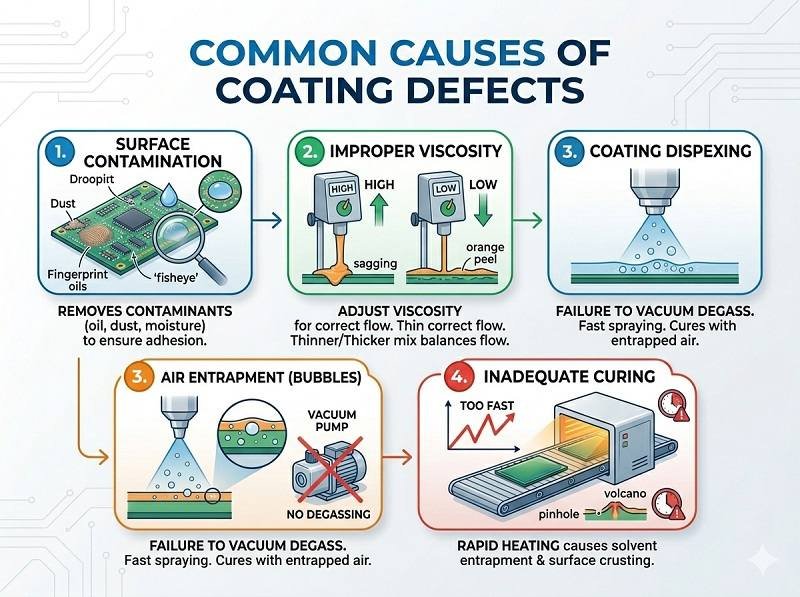
One of the most common causes of coating defects is contamination on the PCB surface. Residues such as flux, oils, dust, or fingerprints can prevent proper adhesion of the 保形塗層, leading to issues like delamination, pinholes, or uneven coverage. Proper cleaning and drying are critical steps in PCB 組裝.
Moisture and outgassing
Moisture trapped in the PCB or components can evaporate during curing, forming bubbles or voids in the coating. In SMT 組裝, improper storage or lack of pre-baking can increase moisture absorption, resulting in defects.
Incorrect coating thickness
Applying the coating too thin may result in incomplete protection, while excessive thickness can cause cracking, bubbling, or long curing times. Maintaining a consistent thickness is essential for reliable performance in PCB 組裝.
Improper application method
Spraying, dipping, or brushing parameters must be carefully controlled. Incorrect spray pressure, nozzle distance, or uneven manual application can lead to defects such as streaks, runs, or uneven coverage. Automated systems in SMT 組裝 help improve consistency but still require proper setup.
Air entrapment and bubbles
Air introduced during mixing or application can become trapped in the coating. This leads to bubbles or voids, which weaken the protective barrier and reduce insulation performance.
Inadequate curing conditions
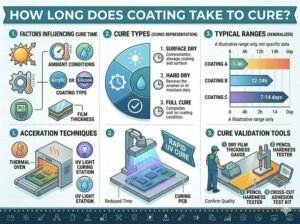
Improper curing—whether too fast, too slow, or at the wrong temperature—can result in incomplete polymerization, soft coatings, or cracking. In UV coatings, insufficient exposure can leave uncured areas, especially under components in dense SMT 組裝 設計。.
Poor adhesion or surface compatibility
Certain PCB materials or finishes may not bond well with specific coatings. Without proper surface preparation or compatibility testing in 原型 PCB 組裝, adhesion failures may occur.
Environmental factors during application
Dust, humidity, and temperature fluctuations in the production environment can affect coating quality. High humidity, for example, can cause blushing or reduced insulation performance.
Masking errors
Incorrect masking can lead to coating contamination on connectors or keep-out areas, causing functional issues or requiring additional rework.
Material quality and handling
Expired or improperly stored coating materials may degrade, leading to inconsistent performance. Proper storage and handling are essential in all PCB 組裝 流程。.
In conclusion, coating defects are usually caused by a combination of surface contamination, process control issues, environmental conditions, and material selection. By carefully managing these factors during PCB 組裝, SMT 組裝, 以及 原型 PCB 組裝, manufacturers can significantly reduce defects and ensure high-quality 保形塗層 performance.
取得保形塗層報價
立即針對您的保形塗料需求取得專家建議與定價。.
將您的需求傳送給我們,並獲得我們工程團隊的快速回應。.
24 小時回應 ✔ 工程支援 ✔ 小型與大量生產
深圳市騰欣杰電子有限公司
 繁體中文
繁體中文  English
  Deutsch
  Français
  Português do Brasil
  Español
  日本語
日本語  Nederlands
  Italiano
  Русский
  한국어
한국어  العربية
  Svenska
  Polski
  Türkçe