
Connectors before coating
Masking connectors is a critical step before applying 保形塗層 於 PCB 組裝, 原型 PCB 組裝, 以及 SMT 組裝. Connectors, test points, switches, and contact areas must remain free of coating to ensure proper electrical contact and mechanical function. Proper masking prevents defects, reduces rework, and improves overall product reliability.
Why masking is necessary
Conformal coating can insulate electrical contacts and interfere with mating surfaces if applied unintentionally. In PCB 組裝, masking ensures that connectors remain conductive and accessible after the coating process.
Common masking methods
Masking tapes
Specialized high-temperature masking tapes are widely used to cover connectors and sensitive areas. These tapes are easy to apply and remove, making them ideal for both manual and automated SMT 組裝 processes. They are especially useful for flat connector surfaces and edge contacts.
Silicone masking boots and caps
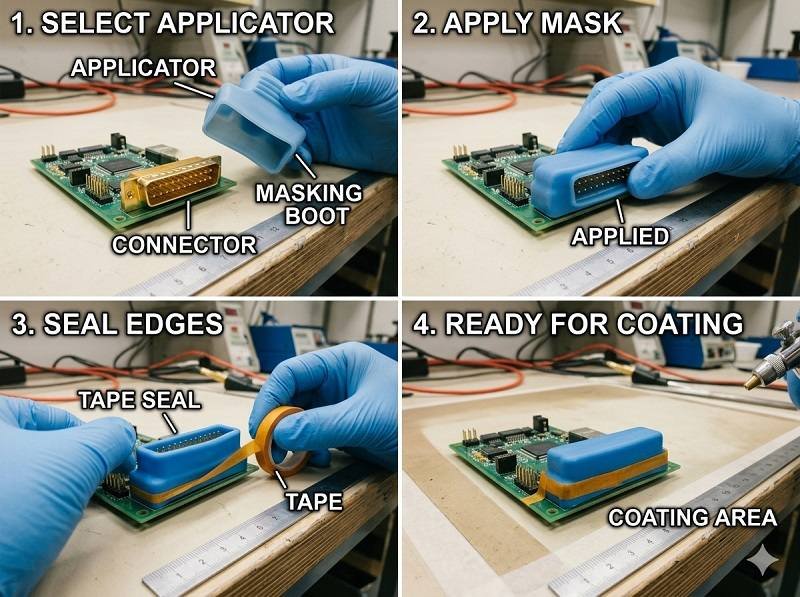
Reusable silicone boots, caps, or plugs are designed to fit over connectors and sockets. They provide precise protection and are commonly used in high-volume PCB 組裝 where consistency is required. Their flexibility allows them to fit tightly without damaging components.
Liquid masking
Liquid mask materials can be brushed or dispensed onto connectors and irregular shapes. Once dried, they form a removable barrier that peels off after coating. In 原型 PCB 組裝, liquid masking is often preferred for complex or custom geometries.
Custom masking fixtures
For large-scale production, manufacturers may use custom-designed fixtures or jigs to cover connectors during coating. These ensure repeatability and reduce labor time in automated SMT 組裝 lines.
Masking process steps
- Clean the PCB: Ensure the board is free of dust, oil, and flux residues.
- Identify areas to protect: Mark connectors, test pads, and keep-out zones.
- Apply masking materials: Use tape, boots, or liquid mask depending on the design.
- Inspect masking quality: Ensure complete coverage with no gaps.
- Apply Conformal Coating: Proceed with coating process.
- Remove masking: After curing, carefully remove all masking materials.
- Final inspection: Verify that connectors are clean and fully functional.
Best practices
- Ensure masking materials can withstand curing conditions (heat or UV).
- Avoid leaving adhesive residues on connectors.
- Use precise masking to minimize extra labor during removal.
- Combine masking with selective coating for higher accuracy.
在 原型 PCB 組裝, masking methods are often tested and optimized before moving to full production. Proper masking design can significantly improve efficiency and reduce defects in PCB 組裝 和 SMT 組裝.
In conclusion, masking connectors before applying 保形塗層 is essential to maintain functionality and reliability. By choosing the right masking method and following proper procedures, manufacturers can achieve clean, precise coating results with minimal rework.
取得保形塗層報價
使用我們的塗層解決方案,確保您的 PCB 長期可靠。從這裡開始.
將您的需求傳送給我們,並獲得我們工程團隊的快速回應。.
24 小時回應 ✔ 工程支援 ✔ 小型與大量生產
深圳市騰欣杰電子有限公司
 繁體中文
繁體中文  English
  Deutsch
  Français
  Português do Brasil
  Español
  日本語
日本語  Nederlands
  Italiano
  Русский
  한국어
한국어  العربية
  Svenska
  Polski
  Türkçe