
保形塗層 material
Selecting the right 保形塗層 material is critical for ensuring the reliability and performance of electronic products. During PCB 組裝 和 SMT 組裝, different environments and application requirements demand different coating properties. Choosing the wrong material can lead to poor protection, reduced lifespan, or unnecessary cost.
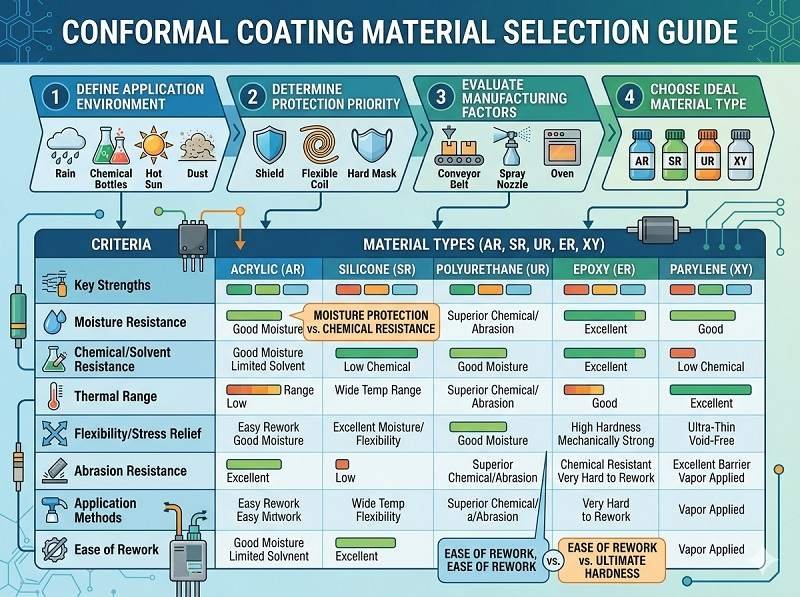
Consider the operating environment
The first step in selecting a 保形塗層 is understanding where the product will be used.
- High humidity or water exposure → Choose coatings with strong moisture resistance (e.g., silicone, acrylic)
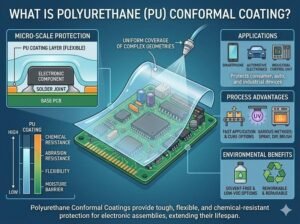
- Chemical exposure → Polyurethane or epoxy coatings offer better chemical resistance
- Extreme temperatures → Silicone coatings perform well under thermal stress
- Outdoor or harsh environments → Consider high-performance options like parylene
在 PCB 組裝, matching the coating to environmental conditions is essential for long-term reliability.
Evaluate protection requirements
Different applications require different levels of protection.
- For basic protection against dust and humidity, acrylic 保形塗層 is often sufficient
- For heavy-duty protection, such as industrial or automotive SMT 組裝, polyurethane or epoxy may be more suitable
- For critical applications (medical, aerospace), parylene provides superior performance
Understanding the level of protection needed helps avoid over-specifying or under-protecting your design.
Consider rework and repair needs
Some coatings are easier to remove than others.
- Easy to rework → Acrylic coatings
- Moderate difficulty → Silicone coatings
- Difficult to remove → Polyurethane and epoxy coatings
If your PCB 組裝 process requires frequent modifications or repairs, choosing a rework-friendly 保形塗層 is important.
Assess application method
The coating method used in SMT 組裝 can influence material selection.
- Spray coating → Works well with acrylic and silicone
- Dip coating → Suitable for uniform coverage with various materials
- Brush coating → Best for repair or small-scale applications
- Parylene deposition → Requires specialized vacuum equipment
Compatibility with your production process ensures efficiency and consistent results.
Thermal and mechanical considerations
Electronic assemblies often face temperature changes and mechanical stress.
- Flexible coatings (like silicone) handle vibration and thermal expansion better
- Rigid coatings (like epoxy) provide stronger mechanical protection but may crack under stress
Balancing flexibility and strength is key in PCB 組裝 design.
Cost and production factors
Budget and manufacturing scale also play a role.
- Acrylic coatings are cost-effective for large-scale SMT 組裝
- Parylene offers top performance but at a higher cost
- Epoxy and polyurethane fall in the mid-to-high range depending on requirements
Choosing the right material means balancing performance with cost efficiency.
取得保形塗層報價
Have questions about conformal coating for your PCB? Our engineers are ready to help.
Send us your requirements and get a fast response from our engineering team.
✔ 24-hour response ✔ Engineering support ✔ Small & Mass Production
深圳市騰欣杰電子有限公司
 繁體中文
繁體中文  English
  Deutsch
  Français
  Português do Brasil
  Español
  日本語
日本語  Nederlands
  Italiano
  Русский
  한국어
한국어  العربية
  Svenska
  Polski
  Türkçe