
Revestimento conformacional applied
Em Montagem de PCB e Montagem SMT, Revestimento conformacional is applied to protect electronic circuits from moisture, dust, chemicals, and environmental stress. The application method depends on production volume, board complexity, and performance requirements.
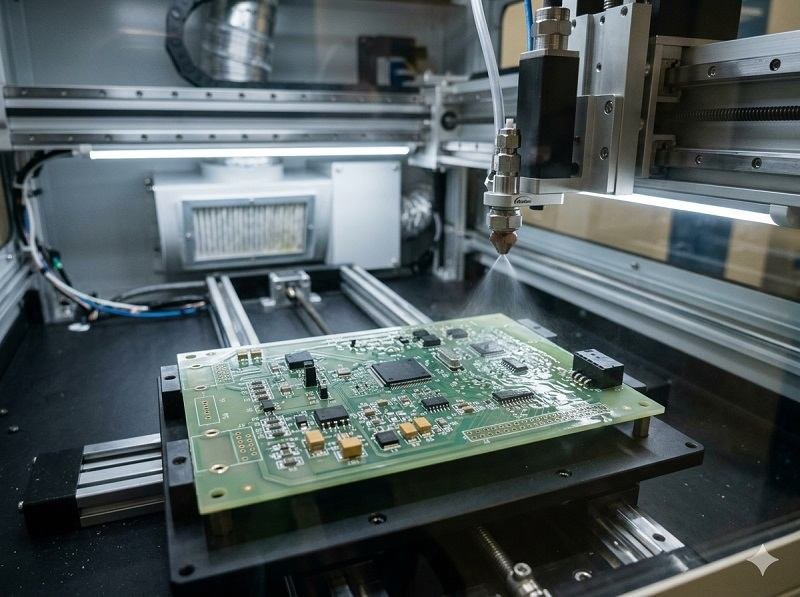
Surface preparation before coating
Before applying Revestimento conformacional, proper preparation is critical:
- Limpeza: Remove flux residues, dust, and oils
- Drying: Ensure no moisture remains on the PCB
- Masking: Protect connectors, test points, and components that must not be coated
Good preparation ensures strong adhesion and reliable performance in Montagem de PCB.
Main application methods
Revestimento em spray
Spray coating is the most widely used method em Montagem SMT, especially for medium to high-volume production.
Features:
- Can be manual (spray gun) or automated (selective coating machines)
- Fornece uniform coverage
- Suitable for complex PCB designs
Selective spray systems are commonly used in automated Montagem de PCB lines for precision coating.
Revestimento por imersão
Dip coating involves immersing the entire PCB into the coating material.
Features:
- Ensures complete coverage, including hard-to-reach areas
- Ideal for simple board designs
- High efficiency for batch production
However, masking is essential to prevent unwanted areas from being coated.
Revestimento com pincel
Brush coating is a manual method used for small-scale production or rework.
Features:
- Low cost and simple
- Suitable for repair or touch-up
- Not ideal for large-scale Montagem SMT
It depends heavily on operator skill and may result in uneven thickness.
Selective coating (automated)
Selective coating is an advanced automated process widely used in modern Montagem de PCB.
Features:
- High precision → only coats required areas
- Reduces masking requirements
- Improves consistency and repeatability
- Ideal for high-volume manufacturing
This method is commonly used in automotive and industrial electronics.
Vapor deposition (parylene coating)
Used specifically for parylene Revestimento conformacional, this process deposits coating in a vacuum chamber.
Features:
- Creates a uniform, pinhole-free layer
- Excellent coverage under components
- High reliability for critical applications
It is typically used in aerospace, medical, and high-end electronics.
Curing process
After application, Revestimento conformacional must be cured to achieve its final properties:
- Air drying (common for acrylic)
- Heat curing (epoxy, polyurethane)
- UV curing (fast production in SMT lines)
- Moisture curing (some silicone coatings)
The curing method affects production speed and coating performance.
Key factors affecting application
- Viscosity of coating material
- Board complexity and component density
- Required thickness and coverage
- Production volume and automation level
Selecting the right method ensures consistent quality in Montagem de PCB.
Conclusão final
Revestimento conformacional can be applied using spray, dip, brush, selective coating, or vapor deposition methods. In modern Montagem SMT, selective spray coating is the most common approach, offering a balance of precision, efficiency, and scalability. Proper preparation and curing are essential to ensure long-term protection and reliability of electronic product
Obter uma cotação de revestimento isolante
Precisa de revestimento isolante para aplicações em ambientes agressivos? Envie sua consulta abaixo.
Envie-nos seus requisitos e receba uma resposta rápida de nossa equipe de engenharia.
Resposta 24 horas ✔ Suporte de engenharia ✔ Produção pequena e em massa
Shenzhen Tengxinjie Electronics Co., Ltd.

 Português do Brasil
  English
  Deutsch
  Français
  Español
  日本語
日本語  Nederlands
  Italiano
  Русский
  한국어
한국어  العربية
  Svenska
  Polski
  Türkçe
  繁體中文
繁體中文