
Conformal coating affect heat dissipation
In electronics manufacturing, thermal management is a critical factor in ensuring reliability and performance. When applying Revestimento conformacional in Montagem de PCB ou Montagem SMT, many engineers wonder whether this protective layer impacts heat dissipation. The answer is yes—but usually only to a limited extent.
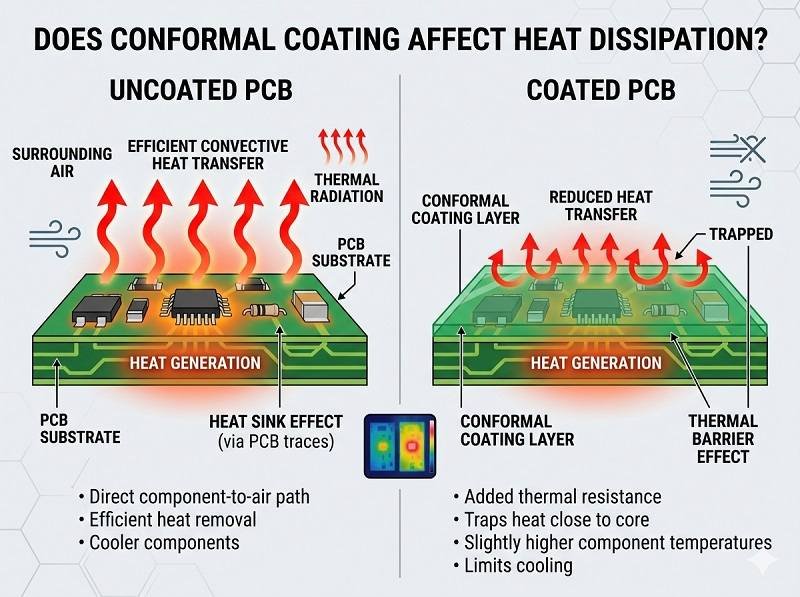
How conformal coating influences heat transfer
Revestimento conformacional materials such as acrylic, silicone, urethane, and epoxy are generally not designed to be thermally conductive. Most coatings act as thermal insulators rather than heat conductors. When applied over components and traces, they can slightly reduce the efficiency of heat transfer from the PCB surface to the surrounding air.
However, because the coating layer is extremely thin (typically 25–250 microns), its impact on overall heat dissipation is usually minimal in standard applications.
When heat impact becomes significant
In most Montagem de PCB projects, the effect of Revestimento conformacional on heat dissipation is negligible. But in certain situations, it can become more important:
- High-power components generating significant heat
- Dense Montagem SMT layouts with limited airflow
- Designs without proper heat sinks or thermal vias
- Enclosures with poor ventilation
In these cases, even a thin insulating layer can contribute to higher operating temperatures if not properly accounted for during design.
Material selection matters
Different types of Revestimento conformacional have varying thermal properties:
- Silicone coatings offer better thermal stability and flexibility
- Acrylic coatings are easier to apply and remove but have lower heat resistance
- Epoxy coatings provide strong protection but can trap heat more than others
In advanced Montagem de PCB pronta para uso, manufacturers may recommend specific coating materials or selective coating techniques to minimize thermal impact.
Best practices to manage heat
To balance protection and thermal performance, consider the following:
- Use heat sinks or thermal pads on high-power components
- Design with proper thermal vias and copper planes
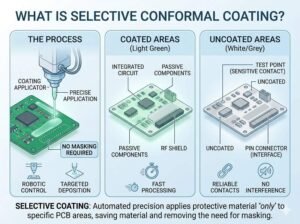
- Apply selective Revestimento conformacional (avoid coating heat-critical areas)
- Choose coatings with better thermal characteristics when needed
By integrating these strategies into Montagem de PCB design, manufacturers can maintain effective heat dissipation while still benefiting from environmental protection.
Conclusão
Revestimento conformacional does affect heat dissipation, but in most cases, the impact is minimal due to its thin application. For high-power or thermally sensitive designs, careful material selection and design optimization are essential. In professional Montagem SMT e Montagem de PCB pronta para uso, coating decisions are typically made alongside thermal analysis to ensure both protection and performance are achieved.
Obter uma cotação de revestimento isolante
Ready to start your conformal coating project? Fill out the form below to get started.
Send us your requirements and get a fast response from our engineering team.
✔ 24-hour response ✔ Engineering support ✔ Small & Mass Production
Shenzhen Tengxinjie Electronics Co., Ltd.
 Português do Brasil
  English
  Deutsch
  Français
  Español
  日本語
日本語  Nederlands
  Italiano
  Русский
  한국어
한국어  العربية
  Svenska
  Polski
  Türkçe
  繁體中文
繁體中文