
Oven curing vs room curing
W Powłoka konformalna, curing is the process that transforms a liquid coating into a solid protective layer. Two of the most common methods used in Montaż PCB, Montaż prototypów PCB, oraz Montaż SMT are oven curing oraz room curing (air drying). Each method has different characteristics, advantages, and ideal use cases.
What is oven curing?
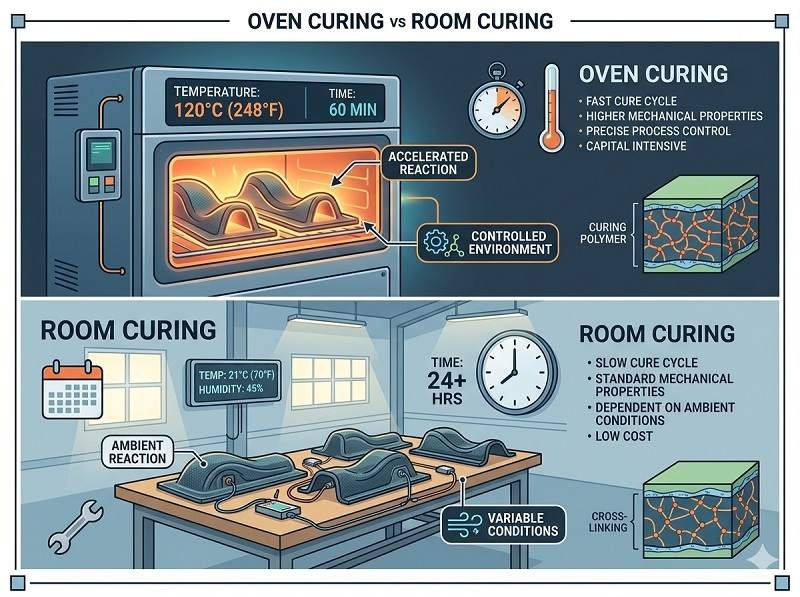
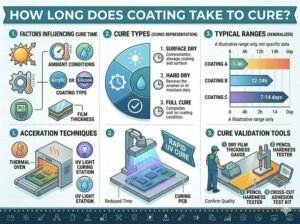
Oven curing (thermal curing) uses controlled heat to accelerate the curing process. After applying the Powłoka konformalna, PCBs are placed in an oven at a specified temperature for a defined time.
Key features of oven curing
- Typical temperatures: 60–150°C, depending on coating type
- Faster curing time (minutes to a few hours)
- More consistent and repeatable results
- Improved adhesion and mechanical strength
In high-volume Montaż SMT, oven curing is widely used because it significantly increases production efficiency and ensures uniform coating quality across batches.
What is room curing (air curing)?
Room curing relies on natural solvent evaporation or moisture reaction at ambient temperature (typically 20–25°C) to cure the coating.
Key features of room curing
- No heating equipment required
- Longer curing time (12–48 hours)
- Lower energy cost
- Suitable for heat-sensitive components
This method is commonly used in Montaż prototypów PCB or small-scale Montaż PCB, where flexibility and low setup cost are more important than speed.
Key differences between oven curing and room curing
Curing speed
Oven curing is much faster, making it ideal for mass production in Montaż SMT. Room curing is slower and may delay throughput.
Process control
Oven curing provides precise control over temperature and time, resulting in consistent quality. Room curing is more dependent on environmental conditions like humidity and airflow.
Equipment requirements
Oven curing requires thermal ovens and process monitoring systems. Room curing only needs a clean, controlled environment.
Impact on components
Room curing is safer for temperature-sensitive components. Oven curing must be carefully controlled to avoid thermal damage during Montaż PCB.
Coating performance
Oven curing often produces stronger, more durable coatings with better chemical and mechanical resistance.
When to choose each method
Oven curing is best for:
- High-volume Montaż SMT
- Tight production schedules
- Applications requiring high reliability
Room curing is best for:
- Montaż prototypów PCB and small batches
- Heat-sensitive designs
- Projekty wrażliwe na koszty
In conclusion, both oven curing and room curing are widely used in Powłoka konformalna processes. The choice depends on production volume, coating material, and product requirements. Optimizing the curing method in Montaż PCB, Montaż SMT, oraz Montaż prototypów PCB ensures the best balance between efficiency, cost, and coating performance.
Uzyskaj wycenę powłoki konformalnej
Chcesz zlecić usługi powlekania konforemnego? Skontaktuj się z naszym zespołem.
Prześlij nam swoje wymagania i uzyskaj szybką odpowiedź od naszego zespołu inżynierów.
24-godzinna reakcja ✔ Wsparcie inżynieryjne ✔ Mała i masowa produkcja
Shenzhen Tengxinjie Electronics Co., Ltd.
 Polski
  English
  Deutsch
  Français
  Português do Brasil
  Español
  日本語
日本語  Nederlands
  Italiano
  Русский
  한국어
한국어  العربية
  Svenska
  Türkçe
  繁體中文
繁體中文