
Coating for salt spray resistance
Wybór właściwego Powłoka konformalna for salt spray resistance is critical in applications exposed to marine environments, coastal climates, or industrial pollution. In Montaż PCB, Montaż prototypów PCB, oraz Montaż SMT, improper coating selection can lead to corrosion, electrical leakage, and premature failure under salt-laden conditions.

Salt spray (salt fog) environments are highly aggressive because salt accelerates electrochemical corrosion. Therefore, the coating must provide strong moisture sealing, chemical resistance, and long-term durability.
Choose high-resistance coating materials
Not all coatings perform equally in salt spray conditions. Silicone and polyurethane coatings are typically the best choices. Silicone offers excellent moisture resistance and flexibility, preventing cracking under thermal stress. Polyurethane provides superior chemical and salt resistance, making it highly suitable for harsh industrial or marine applications. Acrylic coatings, while cost-effective, generally offer lower resistance and are better suited for mild environments.
Ensure sufficient coating thickness
For salt spray environments, a slightly thicker coating (often 50–150 µm or more) is recommended to improve barrier performance. In Montaż PCB, maintaining uniform thickness is essential—thin or uneven areas can become entry points for salt and moisture.
Focus on complete coverage
Gaps, bubbles, or poor edge coverage can compromise protection. During Montaż SMT, densely packed components make uniform coating more challenging, so techniques such as selective coating or automated spray systems are often used to ensure full and consistent coverage.
Consider adhesion and surface preparation
Good adhesion between the coating and PCB surface is crucial. Proper cleaning (removal of flux residues, oils, and contaminants) before coating in Montaż PCB ensures that the coating forms a reliable barrier against salt intrusion.
Evaluate standards and testing
Salt spray resistance should be validated using industry tests such as salt fog testing (e.g., ASTM B117). W Montaż prototypów PCB, engineers often perform these tests to compare coating performance and confirm long-term reliability before mass production.
Balance protection and reworkability
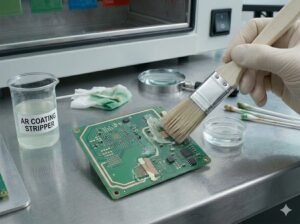
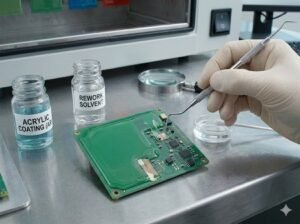
While thicker and more durable coatings offer better protection, they may reduce reworkability. For applications where maintenance is required, silicone coatings may provide a better balance compared to more rigid and difficult-to-remove materials.
Use sealing strategies when necessary
In extremely harsh environments, conformal coating alone may not be sufficient. Combining coating with design strategies—such as sealing connectors or using enclosures—can further enhance protection.
In conclusion, selecting a Powłoka konformalna for salt spray resistance requires careful consideration of material type, thickness, application quality, and testing standards. By optimizing these factors during Montaż PCB, Montaż SMT, oraz Montaż prototypów PCB, manufacturers can significantly improve corrosion resistance and extend the lifespan of electronic products in harsh environments.
Uzyskaj wycenę powłoki konformalnej
Potrzebujesz szybkiej realizacji projektów powlekania konforemnego? Złóż wniosek już dziś.
Prześlij nam swoje wymagania i uzyskaj szybką odpowiedź od naszego zespołu inżynierów.
24-godzinna reakcja ✔ Wsparcie inżynieryjne ✔ Mała i masowa produkcja
Shenzhen Tengxinjie Electronics Co., Ltd.


 Polski
  English
  Deutsch
  Français
  Português do Brasil
  Español
  日本語
日本語  Nederlands
  Italiano
  Русский
  한국어
한국어  العربية
  Svenska
  Türkçe
  繁體中文
繁體中文