
Temperature is needed for curing
The curing temperature of Conforme coating varies depending on the coating chemistry and curing method. In PCB-assemblage, Prototype PCB-assemblage, en SMT-assemblage, selecting the correct temperature is essential to ensure proper film formation, adhesion, and long-term reliability without damaging sensitive electronic components.
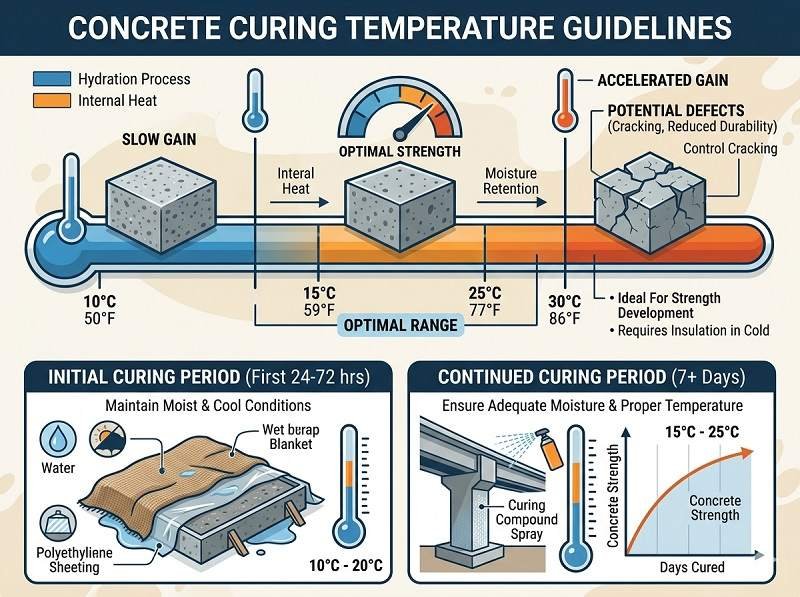
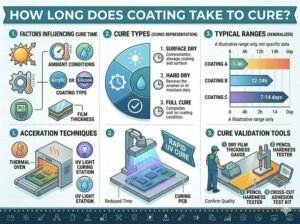
Typical curing temperature ranges
Room temperature curing (air drying)
Many acrylic coatings cure at 20–25°C (68–77°F). While they may become tack-free quickly, full curing can take up to 24 hours. This method is commonly used in Prototype PCB-assemblage due to its simplicity and low equipment requirements.
Thermal curing (oven curing)
Heat curing is widely used in SMT-assemblage to accelerate the process. Typical temperature ranges include:
- Acrylic coatings: 60–80°C
- Polyurethane coatings: 80–120°C
- Epoxy coatings: 100–150°C
- Silicone coatings: 80–120°C
These temperatures significantly reduce curing time and improve coating performance in mass PCB-assemblage.
UV curing
UV-curable Conforme coating does not rely on temperature but instead uses ultraviolet light to initiate curing. However, ambient temperatures of 20–30°C are still recommended for stable processing. In dense SMT-assemblage, dual-cure systems may use mild heat (e.g., 60–80°C) to cure shadowed areas.
Moisture curing
Some silicone and polyurethane coatings cure by reacting with moisture in the air. These typically operate at room temperature, but optimal humidity (40–70% RH) is required. Temperature still affects reaction speed in PCB-assemblage omgevingen.
Factors influencing curing temperature
Component sensitivity
Electronic components may have maximum temperature limits. Excessive heat during curing can damage parts, especially in high-density SMT-assemblage.
Coating thickness
Thicker coatings may require higher temperatures or longer curing times to fully cure.
Production speed
Higher temperatures can accelerate curing, improving throughput in large-scale PCB-assemblage, but must be carefully controlled.
Material specifications
Each coating has a recommended curing profile provided by the manufacturer. Deviating from these guidelines can lead to incomplete curing or defects.
Best practices for curing temperature control
- Always follow supplier-recommended temperature profiles
- Use calibrated ovens with uniform heat distribution
- Avoid rapid temperature increases that may cause bubbles or stress
- Validate curing results in Prototype PCB-assemblage before mass production
- Monitor both temperature and time for consistent quality
In conclusion, curing temperatures for Conforme coating typically range from room temperature up to 150°C, depending on the coating type and process. Proper temperature control in PCB-assemblage, SMT-assemblage, en Prototype PCB-assemblage ensures optimal coating performance, durability, and product reliability.
Vraag een offerte aan voor conforme coating
Op zoek naar een betrouwbare PCBA-partner die conformal coating kan toepassen? Laten we eens praten.
Stuur ons je vereisten en krijg snel antwoord van ons engineeringteam.
✔ 24-uurs respons ✔ Engineering-ondersteuning ✔ Kleine & massaproductie
Shenzhen Tengxinjie Electronics Co, Ltd.
 Nederlands
  English
  Deutsch
  Français
  Português do Brasil
  Español
  日本語
日本語  Italiano
  Русский
  한국어
한국어  العربية
  Svenska
  Polski
  Türkçe
  繁體中文
繁體中文