
Dielectric strength in coating
Dielectric strength in Coating refers to the material’s ability to withstand high electrical voltage without breaking down or allowing current to pass through. It is a critical property in PCB-assemblage, Prototype PCB-assemblage, en SMT-assemblage, where coatings are used not only for environmental protection but also for electrical insulation.

Dielectric strength is typically measured in volts per unit thickness (e.g., volts per mil or kV/mm). It indicates how much voltage the coating can resist before electrical failure occurs. A higher dielectric strength means better insulating performance, which helps prevent short circuits, arcing, and leakage currents between conductive elements on a PCB.
In practical terms, when a Conforme coating with high dielectric strength is applied to a circuit board, it creates a reliable insulating barrier over traces, solder joints, and components. This is especially important in high-voltage or high-density designs commonly seen in SMT-assemblage, where spacing between conductors is minimal.
Different coating materials offer varying dielectric strengths:
- Acrylcoatings provide good ընդհանուր insulation and are suitable for general-purpose electronics.
- Siliconencoatings offer stable dielectric properties across a wide temperature range, making them ideal for harsh environments.
- Polyurethane and epoxy coatings often provide higher dielectric strength and better resistance to electrical stress.
- Parylene coatings are known for extremely high dielectric strength even at very thin thicknesses.
In PCB-assemblage, selecting a coating with appropriate dielectric strength ensures that the board can operate safely under its intended voltage conditions. If the dielectric strength is too low, electrical breakdown may occur, leading to failures or safety hazards.
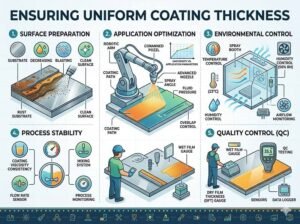
Tijdens Prototype PCB-assemblage, engineers often evaluate dielectric performance under real operating voltages to ensure the coating meets design requirements. Factors such as coating thickness, uniformity, and curing quality also influence the effective dielectric strength.
It’s important to note that dielectric strength is not the only consideration—environmental resistance, flexibility, and reworkability must also be balanced when selecting a coating.
Concluderend, dielectric strength is a key electrical property of Conforme coating that determines its ability to act as an insulator. Proper selection and application during PCB-assemblage, SMT-assemblage, en Prototype PCB-assemblage ensure safe operation and long-term reliability of electronic products.
Vraag een offerte aan voor conforme coating
Plan je een nieuw PCBA-project met coatingvereisten? Vraag hieronder snel een offerte aan.
Stuur ons je vereisten en krijg snel antwoord van ons engineeringteam.
✔ 24-uurs respons ✔ Engineering-ondersteuning ✔ Kleine & massaproductie
Shenzhen Tengxinjie Electronics Co, Ltd.
 Nederlands
  English
  Deutsch
  Français
  Português do Brasil
  Español
  日本語
日本語  Italiano
  Русский
  한국어
한국어  العربية
  Svenska
  Polski
  Türkçe
  繁體中文
繁體中文