
Coating and Encapsulation
In electronics protection, both コンフォーマル・コーティング and encapsulation (also known as potting) are used to safeguard circuit boards. However, they differ significantly in structure, application, and performance. Understanding these differences is essential in PCBアセンブリ, プロトタイプPCBアセンブリ, そして SMTアセンブリ to choose the right protection method.
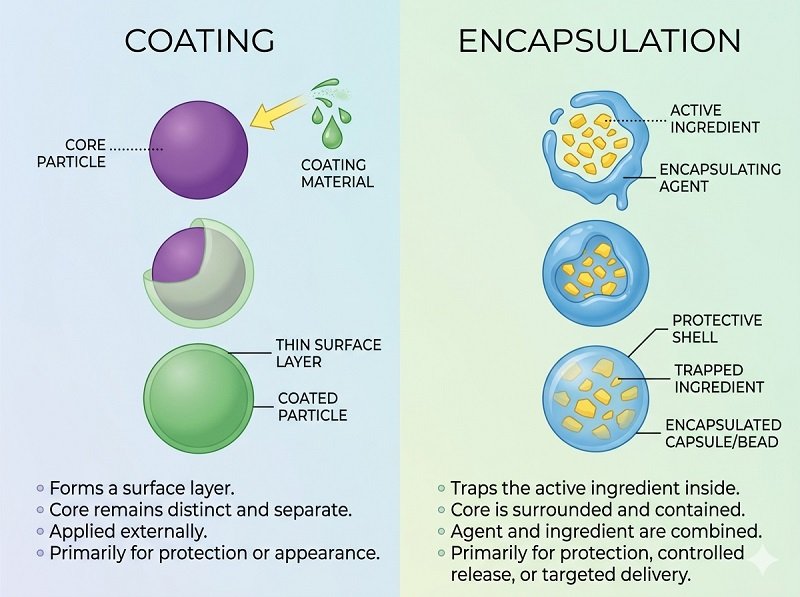
コンフォーマル・コーティング is a thin protective layer (typically 25–250 µm) applied directly onto the surface of a PCB. It “conforms” to the contours of components, providing protection against moisture, dust, chemicals, and temperature variations. Because it is thin and lightweight, it does not significantly affect the size or weight of the board. This makes it a preferred choice in PCBアセンブリ where space and reworkability are important.
Encapsulation, on the other hand, involves completely covering or embedding the PCB in a thick resin or gel (such as epoxy, silicone, or polyurethane). The material forms a solid or semi-solid block around the electronics, creating a robust barrier against water, shock, vibration, and harsh chemicals. This method is commonly used in extremely demanding environments where maximum protection is required.
One of the biggest differences lies in thickness and coverage. While コンフォーマル・コーティング is a thin film that allows visibility and access to components, encapsulation is much thicker and fully seals the board, making inspection and repair nearly impossible. In SMTアセンブリ, conformal coating is often preferred because it allows for easier rework and maintenance of densely populated boards.
Another key difference is repairability. Conformal coatings can usually be removed or reworked if a component fails, which is especially valuable during プロトタイプPCBアセンブリ and product development stages. Encapsulation, however, is generally permanent—once the board is potted, accessing internal components is extremely difficult without damaging the assembly.
In terms of protection level, encapsulation provides superior resistance to water (including full immersion), mechanical stress, and environmental hazards. Conformal coating offers excellent protection against humidity and contaminants but is not fully waterproof or mechanically robust compared to encapsulation.
Cost and processing also differ. Conformal coating is typically faster, more cost-effective, and easier to integrate into standard PCBアセンブリ processes. Encapsulation requires more material, longer curing times, and specialized handling, which increases production cost and complexity.
In summary, コンフォーマル・コーティング is ideal for applications requiring lightweight, cost-effective, and repairable protection, while encapsulation is suited for extreme environments where maximum durability and sealing are necessary. The choice between the two depends on the product’s operating conditions, reliability requirements, and manufacturing priorities.
コンフォーマルコーティングのお見積もり
Need professional support for conformal coating? Submit your requirements and get a response within 12 hours.
Send us your requirements and get a fast response from our engineering team.
✔ 24-hour response ✔ Engineering support ✔ Small & Mass Production
深セン天心傑電子有限公司.
 日本語
日本語  English
  Deutsch
  Français
  Português do Brasil
  Español
  Nederlands
  Italiano
  Русский
  한국어
한국어  العربية
  Svenska
  Polski
  Türkçe
  繁體中文
繁體中文