
Reflow Oven Profile
A reflow oven profile (or temperature profile) is the carefully controlled temperature curve that a PCB follows as it passes through a reflow oven during Assemblaggio SMT. It defines how the solder paste is heated, melted, and cooled to form reliable solder joints in the Assemblaggio di PCB processo.
A properly optimized reflow profile is critical for ensuring strong connections, preventing defects, and maintaining component integrity.
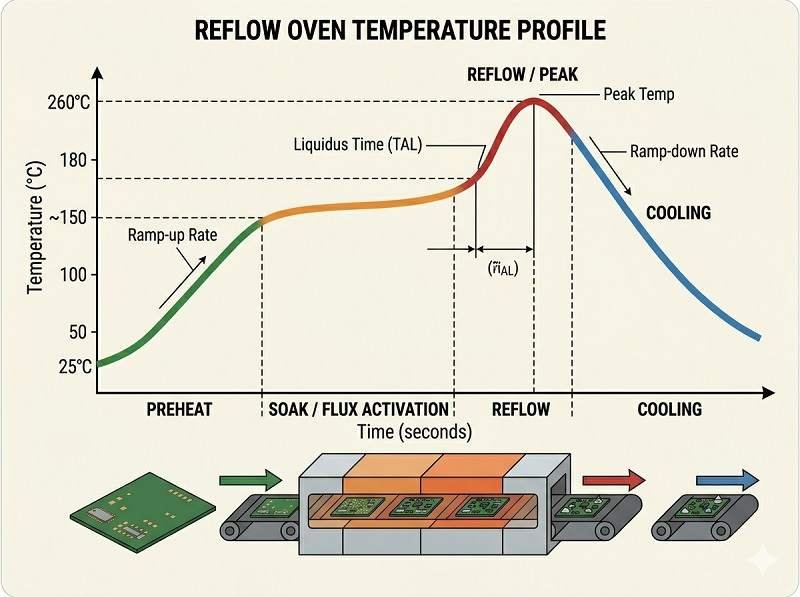
What is a Reflow Profile?
A reflow profile is a graph of temperature vs. time, typically divided into four main stages:
- Preheat
- Soak (thermal equilibrium)
- Reflow (peak temperature)
- Raffreddamento
Each stage must be precisely controlled based on the solder paste type and component requirements.
Why Reflow Profile is Important
The reflow oven profile directly affects:
- Solder joint strength
- Component reliability
- PCB Assembly yield
- Defect rate (bridging, tombstoning, voiding)
👉 A poor profile can lead to serious failures in Assemblaggio SMT.
Stages of a Reflow Oven Profile
Preheat Stage
- Temperature gradually increases (typically 1–3°C per second)
- Removes moisture and activates flux
- Prevents thermal shock to components
Typical range: Room temperature to ~120–160°C
Soak Stage (Thermal Soak)
- Temperature stabilizes and equalizes across the PCB
- Flux continues to activate
- Reduces temperature differences between components
Typical range: ~150–180°C for 60–120 seconds
Reflow Stage (Peak Temperature)
- Temperature rises above solder melting point
- Solder paste melts and forms joints
- Surface tension aligns components
Typical peak temperature:
- Lead-free: ~235–250°C
- Leaded: ~200–220°C
Time above liquidus (TAL): usually 30–90 seconds
Cooling Stage
- Controlled cooling solidifies solder joints
- Prevents grain structure defects
- Ensures mechanical strength
Cooling rate: typically 3–5°C per second
Types of Reflow Profiles
Ramp-to-Peak (RTP)
- Continuous temperature increase to peak
- Shorter process time
- Suitable for simple boards
Ramp-Soak-Spike (RSS)
- Includes soak stage before peak
- More stable and widely used
- Ideal for complex PCB Assembly
Key Parameters in Reflow Profile
Important factors to control:
- Ramp rate (heating speed)
- Soak time and temperature
- Peak temperature
- Time above liquidus (TAL)
- Cooling rate
These parameters must match the solder paste specifications.
Common Reflow Defects Caused by Poor Profile
- Tombstoning: uneven heating causes components to lift
- Solder bridging: excessive solder flow
- Cold joints: insufficient heat
- Voiding: trapped gases in solder
- Component damage: overheating
Most of these issues originate from incorrect reflow settings.
How to Optimize Reflow Oven Profile
To achieve high-quality Assemblaggio SMT:
- Follow solder paste manufacturer guidelines
- Use thermocouples to measure real PCB temperature
- Adjust profile for different board designs
- Ensure uniform heating across the PCB
- Regularly calibrate reflow ovens
Factors Affecting Reflow Profile
- PCB thickness and layer count
- Component size and density
- Solder paste type (lead-free vs leaded)
- Oven type and zone configuration
Each PCB Assembly project may require a customized profile.
Conclusione
A reflow oven profile is a critical part of Assemblaggio di PCB e Assemblaggio SMT, controlling how solder paste transforms into reliable electrical connections. By carefully managing each stage—preheat, soak, reflow, and cooling—manufacturers can ensure high-quality solder joints and minimize defects.
Understanding and optimizing the reflow profile is essential for achieving consistent, high-reliability PCB Assembly results.
Fast, reliable, and cost-effective PCB assembly solutions. Request your quote now.
Forniamo servizi professionali di assemblaggio di PCB, tra cui SMT, DIP e soluzioni complete chiavi in mano.
✔ NDA disponibile ✔ Preventivo veloce entro 24 ore ✔ Fabbrica certificata ISO ✔ Servizio unico per PCB e PCBA




 Italiano
  English
  Deutsch
  Français
  Português do Brasil
  Español
  日本語
日本語  Nederlands
  Русский
  한국어
한국어  العربية
  Svenska
  Polski
  Türkçe
  繁體中文
繁體中文