
Coating for vibration resistance
In environments where electronic assemblies are exposed to constant movement, shock, or mechanical stress, selecting the right Revêtement conforme is critical. In Assemblage du circuit imprimé, Prototype d'assemblage de circuits imprimés, et Assemblage SMT, vibration can lead to solder joint fatigue, micro-cracks, and component failure if the coating cannot absorb mechanical stress effectively.
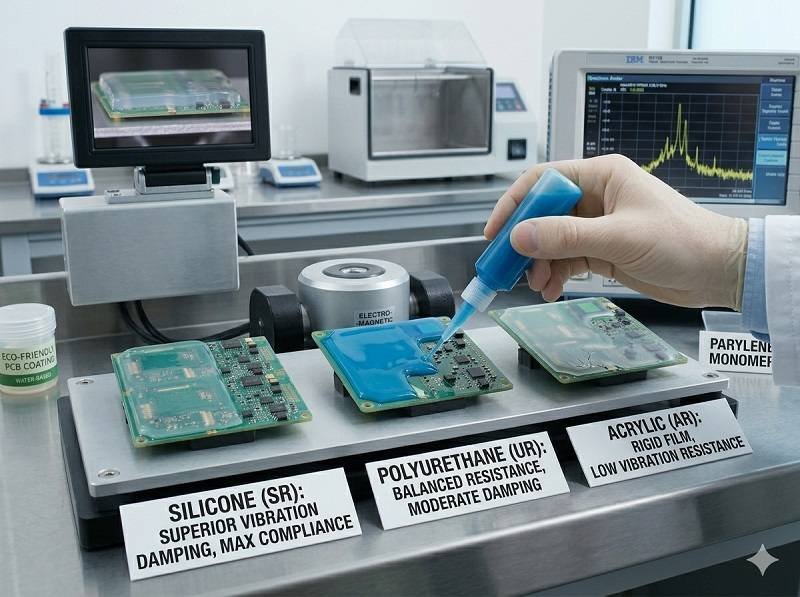
Les best coating for vibration resistance is silicone conformal coating.
Silicone coatings – top choice for vibration resistance
Silicone-based Revêtement conforme is highly flexible and elastic even after curing. This flexibility allows it to absorb and dampen vibrations, reducing the mechanical stress transmitted to components and solder joints. Unlike rigid coatings, silicone can expand and contract with temperature changes and mechanical movement without cracking.
Because of these properties, silicone coatings are widely used in applications such as automotive electronics, aerospace systems, industrial machinery, and outdoor equipment—where vibration and thermal cycling often occur together. In Assemblage SMT, where components are tightly packed, silicone helps protect delicate connections from fatigue over time.
Why flexibility matters
Vibration resistance is directly linked to a coating’s ability to deform without breaking. Rigid coatings like epoxy provide strong mechanical protection but can crack under repeated vibration, potentially exposing the PCB to environmental damage. Silicone, by contrast, acts as a shock absorber, maintaining continuous protection.
Alternative options
- Polyurethane coatings offer moderate flexibility and can handle some vibration, making them a secondary choice in less demanding conditions.
- Revêtements acryliques provide limited vibration resistance and are better suited for stable environments.
- Revêtements époxy are generally not recommended for high-vibration applications due to their rigidity.
Application considerations
En Assemblage du circuit imprimé, achieving the correct coating thickness (typically 50-200 µm for silicone) ensures optimal vibration damping without interfering with connectors or moving parts. Proper adhesion and uniform coverage are also essential to prevent weak points.
Pendant Prototype d'assemblage de circuits imprimés, vibration testing is often conducted to validate coating performance under real operating conditions. This helps engineers fine-tune material selection before full-scale production.
Combine coating with design strategies
While silicone Revêtement conforme significantly improves vibration resistance, it is most effective when combined with good mechanical design—such as proper component support, secure mounting, and the use of vibration-damping materials.
En conclusion, silicone conformal coating is the best choice for vibration resistance due to its superior flexibility and stress absorption. When properly applied in Assemblage du circuit imprimé, Assemblage SMT, et Prototype d'assemblage de circuits imprimés, it greatly enhances the durability and reliability of electronic products in high-vibration environments.
Obtenir un devis pour un revêtement conforme
Vous n'êtes pas sûr du revêtement conforme qui convient à votre produit ? Contactez nos experts dès aujourd'hui.
Envoyez-nous vos exigences et obtenez une réponse rapide de notre équipe d'ingénieurs.
✔ Réponse dans les 24 heures ✔ Soutien technique ✔ Production en petite et grande série
Shenzhen Tengxinjie Electronics Co. Ltd.


 Français
  English
  Deutsch
  Português do Brasil
  Español
  日本語
日本語  Nederlands
  Italiano
  Русский
  한국어
한국어  العربية
  Svenska
  Polski
  Türkçe
  繁體中文
繁體中文