
Conformal Coating Flexible
Revêtement conforme can be flexible, but its flexibility largely depends on the type of material used. In Assemblage du circuit imprimé, Prototype d'assemblage de circuits imprimés, et Assemblage SMT, flexibility is an important factor because electronic components and substrates may expand, contract, or vibrate during operation.
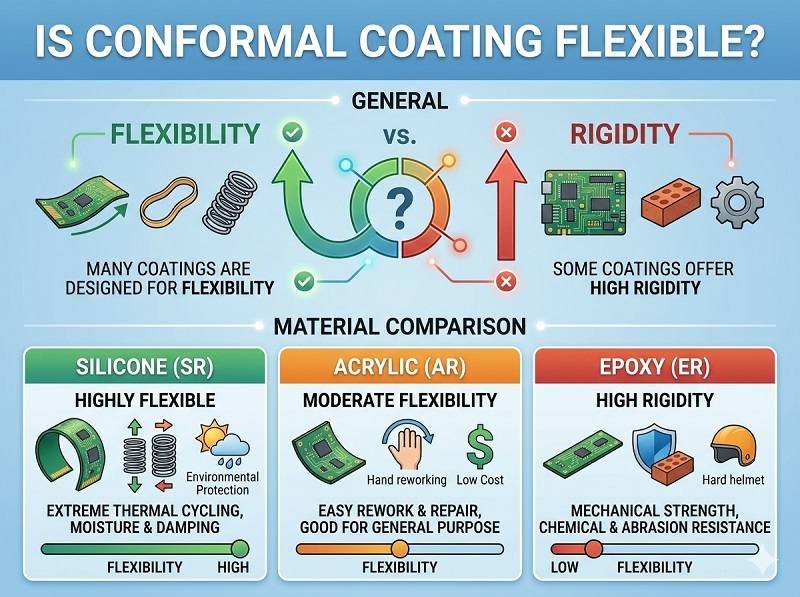
Some conformal coating materials are specifically designed to be highly flexible. For example, silicone-based coatings are known for their excellent elasticity. They can withstand repeated thermal cycling and mechanical stress without cracking, making them ideal for applications exposed to temperature extremes or vibration, such as automotive and industrial electronics.
Acrylic coatings offer moderate flexibility. They can handle minor mechanical stress and are suitable for general-purpose Assemblage du circuit imprimé where environmental conditions are relatively stable. Their ease of removal also makes them popular in Prototype d'assemblage de circuits imprimés, where rework and adjustments are common.
On the other hand, epoxy coatings are generally rigid rather than flexible. They provide strong mechanical protection and chemical resistance but may crack under stress or temperature changes. Polyurethane coatings fall somewhere in between, offering a balance of flexibility and durability, though they are tougher to remove once cured.
Flexibility is especially important in Assemblage SMT, where densely populated components and fine solder joints can be sensitive to stress. A flexible Revêtement conforme helps absorb mechanical strain and reduces the risk of micro-cracks or solder joint failure over time.
Another factor influencing flexibility is coating thickness. Thinner coatings tend to be more flexible, while thicker layers may become more rigid, regardless of the material. Proper application ensures that the coating maintains its protective qualities without restricting movement or causing stress.
In conclusion, Revêtement conforme can range from flexible to rigid depending on the material choice. Silicone coatings offer the highest flexibility, acrylics provide moderate performance, and epoxies are more rigid. Selecting the appropriate coating during Assemblage du circuit imprimé, Assemblage SMT, et Prototype d'assemblage de circuits imprimés ensures both protection and mechanical reliability in the final product.
Obtenir un devis pour un revêtement conforme
Planning a new PCBA project with coating requirements? Request a quick quote below.
Send us your requirements and get a fast response from our engineering team.
✔ 24-hour response ✔ Engineering support ✔ Small & Mass Production
Shenzhen Tengxinjie Electronics Co. Ltd.
 Français
  English
  Deutsch
  Português do Brasil
  Español
  日本語
日本語  Nederlands
  Italiano
  Русский
  한국어
한국어  العربية
  Svenska
  Polski
  Türkçe
  繁體中文
繁體中文