
Coating thickness
Achieving consistent thickness in Revêtement conforme is essential for reliable protection and electrical performance. In Assemblage du circuit imprimé, Prototype d'assemblage de circuits imprimés, et Assemblage SMT, uneven coating can lead to weak protection in thin areas or defects such as bubbles and cracking in overly thick regions. Ensuring uniformity requires control over materials, equipment, and process parameters.
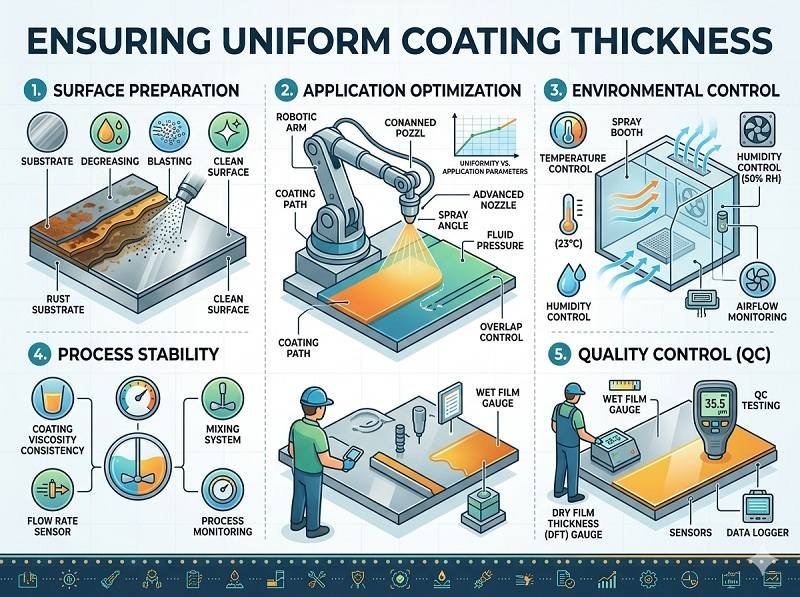
Use controlled application methods
Automated techniques such as selective coating machines or precision spray systems provide the best consistency. Compared to manual brushing or dipping, automation ensures repeatable results in high-volume Assemblage SMT and reduces human error.
Optimize coating parameters
Key variables such as spray pressure, nozzle size, flow rate, and distance from the PCB must be carefully calibrated. Incorrect settings can result in uneven distribution, overspray, or insufficient coverage during Assemblage du circuit imprimé.
Maintain proper viscosity
The viscosity of the Revêtement conforme directly affects how it flows and levels on the PCB surface. If the coating is too thick, it may not spread evenly; if too thin, it may run off edges. Following manufacturer guidelines and controlling temperature helps maintain stable viscosity.
Apply multiple thin layers
Instead of applying one thick coat, it is better to apply several thin, uniform layers. This improves coverage, reduces the risk of defects, and ensures consistent thickness across complex geometries in Assemblage SMT.
Ensure proper PCB preparation
A clean and dry surface allows the coating to spread evenly. Contaminants or moisture can disrupt flow and cause irregular thickness. In Prototype d'assemblage de circuits imprimés, surface preparation is often optimized through testing.
Control environmental conditions
Temperature and humidity affect coating behavior. Stable environmental conditions help maintain consistent drying and leveling, especially in large-scale Assemblage du circuit imprimé operations.
Use masking and keep-out control
Proper masking prevents coating buildup at edges or near connectors, which can lead to uneven thickness distribution. Selective coating also helps define precise coating boundaries.
Measure thickness during and after application
Using tools such as wet film gauges, dry film thickness meters, or UV inspection systems allows manufacturers to monitor coating consistency. In Prototype d'assemblage de circuits imprimés, these measurements are critical for process validation.
Train operators and standardize processes
Consistent results depend on clear process guidelines and skilled operators. Documented procedures ensure repeatability across different production batches in Assemblage SMT.
In conclusion, ensuring uniform thickness in Revêtement conforme requires a combination of automated application, proper material control, environmental stability, and accurate measurement. By optimizing these factors in Assemblage du circuit imprimé, Assemblage SMT, et Prototype d'assemblage de circuits imprimés, manufacturers can achieve high-quality, reliable coating performance.
Obtenir un devis pour un revêtement conforme
Vous avez un projet de circuit imprimé qui nécessite un revêtement conforme ? Obtenez un devis personnalisé dès aujourd'hui.
Envoyez-nous vos exigences et obtenez une réponse rapide de notre équipe d'ingénieurs.
✔ Réponse dans les 24 heures ✔ Soutien technique ✔ Production en petite et grande série
Shenzhen Tengxinjie Electronics Co. Ltd.

 Français
  English
  Deutsch
  Português do Brasil
  Español
  日本語
日本語  Nederlands
  Italiano
  Русский
  한국어
한국어  العربية
  Svenska
  Polski
  Türkçe
  繁體中文
繁體中文