
Coating take to cure
The curing time of Revêtement conforme depends on the coating material, application thickness, and curing method used. In Assemblage du circuit imprimé, Prototype d'assemblage de circuits imprimés, et Assemblage SMT, curing time is a critical factor that affects production speed, coating performance, and overall product reliability.

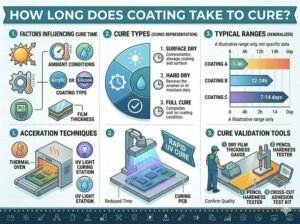
Typical curing times by coating type
Revêtements acryliques
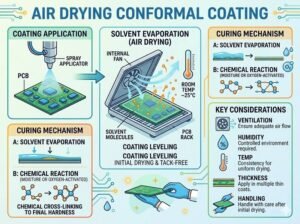
Acrylique Revêtement conforme usually dries quickly to the touch within 10–30 minutes, but full curing may take 12–24 hours at room temperature. These coatings are widely used in Prototype d'assemblage de circuits imprimés due to their ease of use and fast processing.
Revêtements en silicone
Silicone coatings often require several hours to 24 hours to fully cure, depending on humidity and thickness. They are commonly used in Assemblage SMT for high-temperature and flexible applications.
Polyurethane coatings
Polyurethane coatings typically cure within 24–48 hours at room temperature. They offer excellent chemical resistance but have longer curing times, making process control important in Assemblage du circuit imprimé.
Revêtements époxy
Epoxy-based coatings may take 24 hours or more to cure fully. They provide strong mechanical protection but are less flexible and harder to rework.
UV-curable coatings
UV Revêtement conforme can cure in seconds to a few minutes under proper UV exposure. This makes them ideal for high-speed Assemblage SMT lines. However, shadowed areas may require secondary curing (dual-cure systems).
Factors affecting curing time
Coating thickness
Thicker coatings take longer to cure. Applying multiple thin layers helps achieve faster and more consistent curing in Assemblage du circuit imprimé.
Temperature
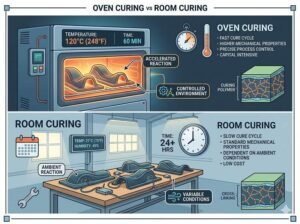
Higher temperatures (within safe limits) accelerate curing. Thermal curing ovens are often used in Assemblage SMT to reduce cycle time.
Humidity
Moisture-curing coatings depend on ambient humidity. Low humidity can slow down curing, while controlled environments improve consistency.
Ventilation
Proper airflow helps remove solvents during curing, especially for solvent-based coatings.
Production considerations
En Prototype d'assemblage de circuits imprimés, longer curing times are acceptable for testing and validation. However, in mass Assemblage SMT, faster curing methods such as UV or thermal curing are preferred to increase efficiency and throughput.
How to ensure proper curing time
- Follow manufacturer-recommended curing profiles
- Monitor temperature and humidity conditions
- Verify curing with inspection (e.g., tack-free surface, hardness testing)
- Avoid rushing the process, which can lead to defects
In summary, curing time for Revêtement conforme can range from seconds (UV curing) to 24–48 hours (room temperature curing). Selecting the right coating and curing method in Assemblage du circuit imprimé, Assemblage SMT, et Prototype d'assemblage de circuits imprimés ensures both efficiency and long-term reliability.
Obtenir un devis pour un revêtement conforme
Vous avez des exigences particulières en matière de revêtement ? Envoyez-nous vos fichiers PCB pour évaluation.
Envoyez-nous vos exigences et obtenez une réponse rapide de notre équipe d'ingénieurs.
✔ Réponse dans les 24 heures ✔ Soutien technique ✔ Production en petite et grande série
Shenzhen Tengxinjie Electronics Co. Ltd.
 Français
  English
  Deutsch
  Português do Brasil
  Español
  日本語
日本語  Nederlands
  Italiano
  Русский
  한국어
한국어  العربية
  Svenska
  Polski
  Türkçe
  繁體中文
繁體中文