
Is Reliability testing
Reliability testing is a critical process in Assemblage du circuit imprimé, Assemblage SMT, et Assemblage de circuits imprimés clés en main that evaluates how well a product performs under real-world and extreme conditions over time.
Unlike basic functional testing, which checks whether a board works at a given moment, reliability testing ensures that the product will continue to operate consistently, safely, and durably throughout its expected lifespan. It is a key part of advanced Fabrication de circuits imprimés quality assurance.
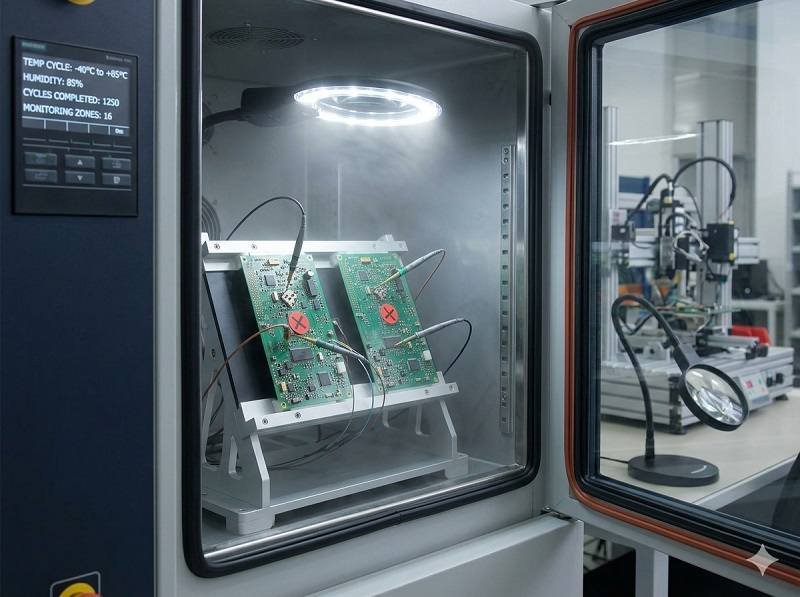
Why reliability testing is important
In modern electronics, products are often exposed to harsh environments such as temperature fluctuations, humidity, vibration, and electrical stress.
Reliability testing helps:
- Identify potential failure points early
- Ensure long-term product stability
- Reduce field failures and warranty claims
- Meet industry and regulatory requirements
For high-end Assemblage de circuits imprimés clés en main, reliability testing is essential to guarantee performance in demanding applications.
Common types of reliability testing
Different testing methods are used depending on the product and application.
Thermal Cycling Test
Boards are exposed to repeated temperature changes to simulate expansion and contraction of materials. This helps detect solder joint fatigue in Assemblage SMT.
High Temperature Operating Life (HTOL)
The PCB operates continuously at elevated temperatures to evaluate long-term performance and component stability.
Humidity Testing
High humidity environments are used to check resistance to moisture, corrosion, and insulation failure in Assemblage du circuit imprimé.
Vibration and Mechanical Shock Testing
Simulates transportation and real-world mechanical stress to ensure structural integrity.
Burn-in Testing
Boards run continuously under load for extended periods to identify early-life failures (infant mortality).
Salt Spray Test (if required)
Used for products exposed to corrosive environments, such as marine or industrial applications.
Reliability testing vs functional testing
It is important to distinguish between these two:
- Essais fonctionnels (FCT): Verifies that the board works as designed at a specific point in time
- Reliability Testing: Verifies that the board continues to work over time under stress
Both are essential in Fabrication de circuits imprimés, but reliability testing provides deeper insight into long-term performance.
When is reliability testing required?
Reliability testing is especially important for:
- Électronique automobile
- Dispositifs médicaux
- Systèmes de contrôle industriel
- Aerospace and defense products
- High-value or mission-critical equipment
In these cases, Assemblage SMT quality alone is not enough—long-term durability must be proven.
How reliability testing is integrated into turnkey PCB assembly
En Assemblage de circuits imprimés clés en main, reliability testing can be integrated into the full production process:
- Design review for reliability (DFR)
- Selection of high-quality components
- Controlled Assemblage du circuit imprimé processus
- Post-assembly stress testing
- Data collection and analysis
This end-to-end approach ensures that reliability is built into the product, not just tested afterward.
Benefits for customers
Reliability testing provides several key advantages:
Longer Product Lifespan
Ensures stable operation over time.
Reduced Failure Rates
Minimizes costly field returns and repairs.
Improved Brand Reputation
Delivers consistent product performance.
Compliance Support
Helps meet industry standards and certifications.
Limitations and considerations
While reliability testing is highly valuable, it requires:
- Additional time in the production schedule
- Higher testing costs
- Customized test setups depending on the product
However, for many applications, the benefits far outweigh the cost in Fabrication de circuits imprimés.
Conclusion
Reliability testing is a vital process that ensures long-term performance and durability in Assemblage du circuit imprimé, Assemblage SMT, et Assemblage de circuits imprimés clés en main.
By simulating real-world and extreme conditions, it helps identify potential failures before products reach the market, ensuring higher quality, lower risk, and greater customer satisfaction.
Besoin d'aide pour la nomenclature et l'approvisionnement en composants ? Commencez par demander un devis.
Nous fournissons des services professionnels d'assemblage de circuits imprimés, y compris SMT, DIP et des solutions complètes clé en main.
✔ NDA disponible ✔ Devis rapide sous 24 heures ✔ Usine certifiée ISO ✔ Service unique de PCB et PCBA
 Français
  English
  Deutsch
  Português do Brasil
  Español
  日本語
日本語  Nederlands
  Italiano
  Русский
  한국어
한국어  العربية
  Svenska
  Polski
  Türkçe
  繁體中文
繁體中文