
Components are out of stock
Component shortages are one of the most common and challenging issues in today’s electronics industry. Whether you are working on Assemblage du circuit imprimé, Assemblage SMT, or a full Assemblage de circuits imprimés clés en main project, out-of-stock components can directly affect production schedules, increase costs, and delay product launches.
A professional Fabrication de circuits imprimés partner does not passively wait for components to become available. Instead, they apply a combination of sourcing strategies, engineering support, and supply chain management to ensure your project continues moving forward with minimal disruption.
Why do electronic components go out of stock?
Understanding the root causes of shortages helps you better prepare for them. In most cases, component shortages are driven by multiple global factors rather than a single issue.
One major reason is global supply chain instability. Events such as pandemics, geopolitical tensions, or transportation delays can interrupt production and distribution. Another common factor is sudden spikes in demand, especially for chips used in automotive electronics, IoT devices, and consumer products.
Component lifecycle also plays a role. Many older components become obsolete as manufacturers discontinue production, forcing companies to search for remaining inventory. In addition, long lead times—sometimes extending beyond 30 or even 50 weeks—can make even commonly used parts temporarily unavailable.
What happens when components are unavailable?
When components are out of stock, the impact on Assemblage du circuit imprimé projects can vary depending on the severity of the shortage.
In minor cases, production may only be delayed by a few days while alternative stock is secured. However, in more serious situations, entire production schedules may need to be adjusted, especially in Assemblage de circuits imprimés clés en main where the manufacturer is responsible for all materials.
Shortages can also lead to increased costs, as scarce components are often sold at higher market prices. For high-volume Assemblage SMT, this can significantly affect the overall project budget.
How we handle component shortages
Une fiabilité Fabrication de circuits imprimés partner will always have a structured strategy in place to deal with out-of-stock situations.
One of the most effective approaches is component substitution. Engineers evaluate alternative parts that match electrical specifications, package size, and performance requirements. Once verified, these alternatives are submitted to the customer for approval before being used in production.
Another key strategy is multi-channel sourcing. Instead of relying on a single distributor, sourcing teams work with authorized distributors, original manufacturers, and trusted global partners. This increases the chances of finding available stock and reduces dependency on any one supplier.
Inventory planning also plays an important role. For frequently used components, manufacturers may maintain safety stock or pre-purchase materials based on forecast demand. This helps stabilize Assemblage du circuit imprimé production and avoid repeated delays.
Can production continue without all components?
In many cases, production does not need to stop completely. A flexible approach can be used to minimize delays.
For example, partial assembly can be performed using available components. Boards can go through Assemblage SMT for all in-stock parts, while missing components are added later once they arrive. This staged production method helps maintain efficiency and reduces overall lead time.
This approach is especially useful in large-scale Assemblage de circuits imprimés clés en main projects where time-to-market is critical.
BOM optimization to prevent shortages
One of the most effective ways to avoid stock issues is to address them during the design phase. BOM (Bill of Materials) optimization helps reduce dependency on high-risk components.
Engineers may recommend using widely available components, selecting multiple approved alternatives, or avoiding single-source parts. These adjustments improve supply chain flexibility and make Fabrication de circuits imprimés more resilient.
Designing with substitution in mind is now considered a best practice in modern electronics manufacturing.
How shortages affect cost and lead time
Component shortages almost always influence both pricing and delivery schedules.
When supply is limited, component prices tend to rise due to market demand. This can increase the total cost of Assemblage du circuit imprimé, especially for complex boards with many ICs.
Lead times may also be extended, particularly if critical components are unavailable worldwide. In such cases, transparent communication between the manufacturer and customer is essential to adjust expectations and explore alternatives.
What you can do to reduce risk
Customers also play an important role in minimizing the impact of component shortages.
Planning ahead is one of the most effective strategies. Providing demand forecasts or long-term project plans allows manufacturers to secure components earlier. Faster approval of alternative components can also significantly reduce delays.
If you have sourcing experience, a hybrid approach—combining customer-supplied components with Assemblage de circuits imprimés clés en main—can offer a balance between control and efficiency.
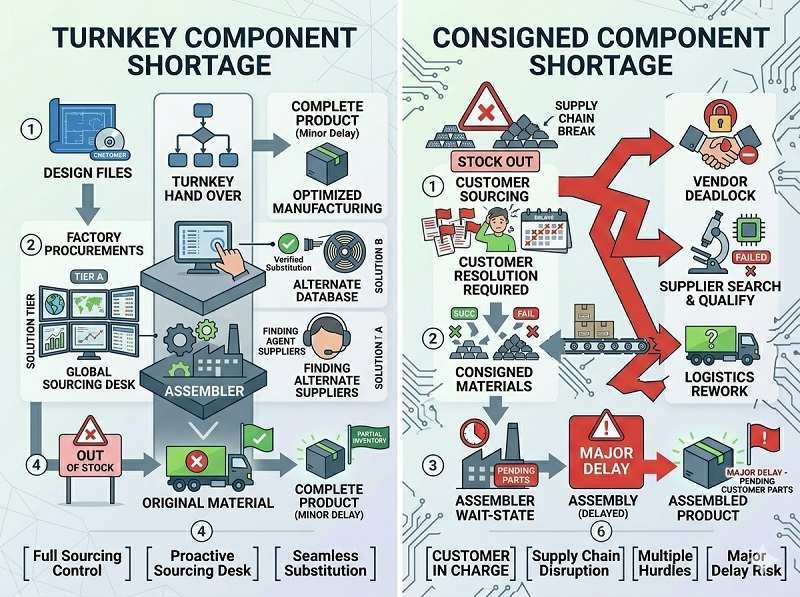
Why turnkey assembly handles shortages better
Compared to consigned assembly, Assemblage de circuits imprimés clés en main is generally more resilient when facing supply chain disruptions.
Manufacturers have dedicated sourcing teams, established supplier networks, and real-time market insights. This allows them to react quickly to shortages and find solutions that individual customers may not have access to.
Because sourcing, Fabrication de circuits imprimés, et Assemblage SMT are all managed under one system, problems can be resolved faster and more efficiently.
Conclusion
Component shortages are an unavoidable part of the modern electronics supply chain, but they do not have to stop your project. With the right strategies—such as alternative sourcing, BOM optimization, and flexible production planning—most shortages can be managed effectively.
By working with an experienced provider in Assemblage du circuit imprimé, Assemblage SMT, et Assemblage de circuits imprimés clés en main, you can reduce risks, control costs, and keep your production on schedule even in challenging market conditions.
Obtenez un devis professionnel d'assemblage de circuits imprimés adapté à vos besoins. Commencez ici.
Nous fournissons des services professionnels d'assemblage de circuits imprimés, y compris SMT, DIP et des solutions complètes clé en main.
✔ NDA disponible ✔ Devis rapide sous 24 heures ✔ Usine certifiée ISO ✔ Service unique de PCB et PCBA

 Français
  English
  Deutsch
  Português do Brasil
  Español
  日本語
日本語  Nederlands
  Italiano
  Русский
  한국어
한국어  العربية
  Svenska
  Polski
  Türkçe
  繁體中文
繁體中文