
Reflow Oven Profile
A reflow oven profile (or temperature profile) is the carefully controlled temperature curve that a PCB follows as it passes through a reflow oven during Assemblage SMT. It defines how the solder paste is heated, melted, and cooled to form reliable solder joints in the Assemblage du circuit imprimé processus.
A properly optimized reflow profile is critical for ensuring strong connections, preventing defects, and maintaining component integrity.
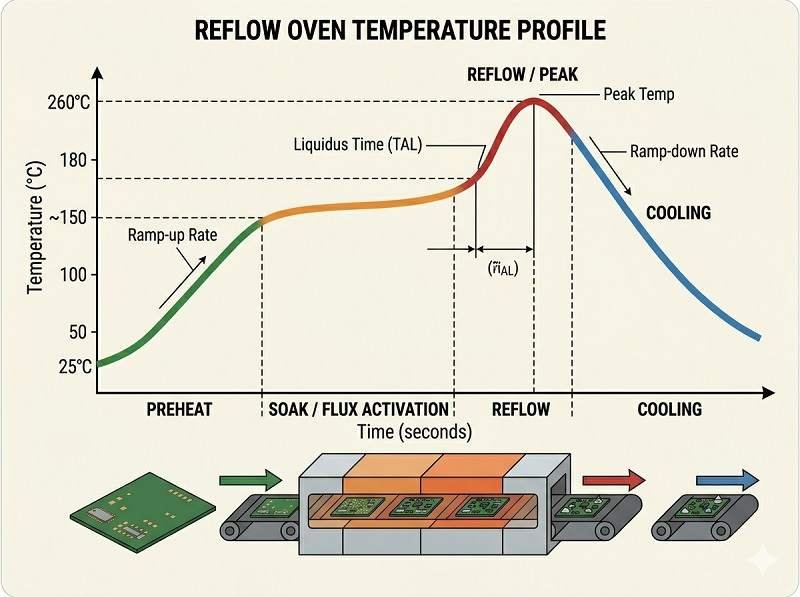
What is a Reflow Profile?
A reflow profile is a graph of temperature vs. time, typically divided into four main stages:
- Preheat
- Soak (thermal equilibrium)
- Reflow (peak temperature)
- Refroidissement
Each stage must be precisely controlled based on the solder paste type and component requirements.
Why Reflow Profile is Important
The reflow oven profile directly affects:
- Solder joint strength
- Component reliability
- PCB Assembly yield
- Defect rate (bridging, tombstoning, voiding)
👉 A poor profile can lead to serious failures in Assemblage SMT.
Stages of a Reflow Oven Profile
Preheat Stage
- Temperature gradually increases (typically 1–3°C per second)
- Removes moisture and activates flux
- Prevents thermal shock to components
Typical range: Room temperature to ~120–160°C
Soak Stage (Thermal Soak)
- Temperature stabilizes and equalizes across the PCB
- Flux continues to activate
- Reduces temperature differences between components
Typical range: ~150–180°C for 60–120 seconds
Reflow Stage (Peak Temperature)
- Temperature rises above solder melting point
- Solder paste melts and forms joints
- Surface tension aligns components
Typical peak temperature:
- Lead-free: ~235–250°C
- Leaded: ~200–220°C
Time above liquidus (TAL): usually 30–90 seconds
Cooling Stage
- Controlled cooling solidifies solder joints
- Prevents grain structure defects
- Ensures mechanical strength
Cooling rate: typically 3–5°C per second
Types of Reflow Profiles
Ramp-to-Peak (RTP)
- Continuous temperature increase to peak
- Shorter process time
- Suitable for simple boards
Ramp-Soak-Spike (RSS)
- Includes soak stage before peak
- More stable and widely used
- Ideal for complex PCB Assembly
Key Parameters in Reflow Profile
Important factors to control:
- Ramp rate (heating speed)
- Soak time and temperature
- Peak temperature
- Time above liquidus (TAL)
- Cooling rate
These parameters must match the solder paste specifications.
Common Reflow Defects Caused by Poor Profile
- Tombstoning: uneven heating causes components to lift
- Solder bridging: excessive solder flow
- Cold joints: insufficient heat
- Voiding: trapped gases in solder
- Component damage: overheating
Most of these issues originate from incorrect reflow settings.
How to Optimize Reflow Oven Profile
To achieve high-quality Assemblage SMT:
- Follow solder paste manufacturer guidelines
- Use thermocouples to measure real PCB temperature
- Adjust profile for different board designs
- Ensure uniform heating across the PCB
- Regularly calibrate reflow ovens
Factors Affecting Reflow Profile
- PCB thickness and layer count
- Component size and density
- Solder paste type (lead-free vs leaded)
- Oven type and zone configuration
Each PCB Assembly project may require a customized profile.
Conclusion
A reflow oven profile is a critical part of Assemblage du circuit imprimé et Assemblage SMT, controlling how solder paste transforms into reliable electrical connections. By carefully managing each stage—preheat, soak, reflow, and cooling—manufacturers can ensure high-quality solder joints and minimize defects.
Understanding and optimizing the reflow profile is essential for achieving consistent, high-reliability PCB Assembly results.
Fast, reliable, and cost-effective PCB assembly solutions. Request your quote now.
Nous fournissons des services professionnels d'assemblage de circuits imprimés, y compris SMT, DIP et des solutions complètes clé en main.
✔ NDA disponible ✔ Devis rapide sous 24 heures ✔ Usine certifiée ISO ✔ Service unique de PCB et PCBA


 Français
  English
  Deutsch
  Português do Brasil
  Español
  日本語
日本語  Nederlands
  Italiano
  Русский
  한국어
한국어  العربية
  Svenska
  Polski
  Türkçe
  繁體中文
繁體中文