
BProcessus d'enrobage de l'atch
Les procédé de revêtement par lots en Revêtement conforme se réfère à l'application d'un revêtement sur plusieurs circuits imprimés en même temps, par cycles groupés plutôt qu'en continu. Cette méthode est largement utilisée dans Assemblage du circuit imprimé, Prototype d'assemblage de circuits imprimés, et à petite et moyenne échelle Assemblage SMT, où la flexibilité et le contrôle des coûts sont importants.
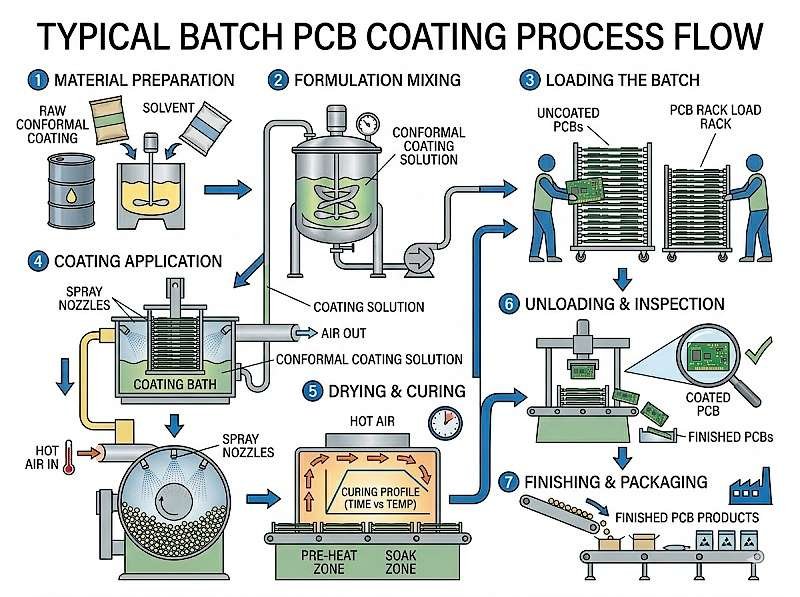
Comment fonctionne le revêtement par lots ?
Dans un processus par lots, un groupe de circuits imprimés assemblés est préparé, masqué et revêtu ensemble à l'aide de méthodes telles que le trempage, la pulvérisation ou le brossage. Après l'enduction, toutes les cartes du lot sont soumises à un cycle commun de séchage ou de durcissement. Une fois ce processus achevé, le lot suivant est traité.
Méthodes courantes de revêtement par lots
Revêtement par immersion
Les PCB sont immergés dans un réservoir de Revêtement conforme puis retiré à une vitesse contrôlée. Cette méthode assure une couverture complète, mais nécessite un masquage adéquat. Assemblage du circuit imprimé.
Revêtement manuel ou par pulvérisation
Des opérateurs ou des systèmes de pulvérisation semi-automatiques appliquent le revêtement sur plusieurs planches placées dans des racks ou des supports. Cette pratique est courante dans les Prototype d'assemblage de circuits imprimés en raison de sa flexibilité.
Revêtement au pinceau
Utilisé principalement pour les retouches ou les petits lots, lorsque la précision est nécessaire mais que le volume de production est faible.
Principales caractéristiques du revêtement par lots
Traitement groupé
Plusieurs panneaux sont revêtus et durcis ensemble, ce qui améliore l'efficacité par rapport à la manipulation d'un seul panneau.
Une configuration flexible
Idéal pour les différentes conceptions de circuits imprimés ou les commandes de faible volume, en particulier dans les domaines suivants Prototype d'assemblage de circuits imprimés.
Coût inférieur de l'équipement
Par rapport aux systèmes en ligne entièrement automatisés utilisés dans les usines de production à grande vitesse, les systèmes de production à grande échelle sont plus efficaces. Assemblage SMT, Les processus par lots nécessitent moins d'investissements.
Avantages du revêtement par lots
- Rentabilité pour les petites et moyennes séries
- Facile de passer d'un produit à l'autre
- Convient aux conceptions de circuits imprimés complexes ou irrégulières
- Contrôle simplifié du processus pour le prototypage
Limites du revêtement par lots
Moins de cohérence
Par rapport à l'enrobage automatisé en ligne dans les Assemblage SMT, Les procédés par lots peuvent présenter des variations plus importantes en termes d'épaisseur et de couverture.
à forte intensité de main-d'œuvre
La manutention manuelle augmente les coûts de main-d'œuvre et le risque d'erreur humaine dans les domaines suivants Assemblage du circuit imprimé.
Débit plus faible
Le traitement est effectué par cycles plutôt qu'en continu, ce qui peut limiter la vitesse de production.
Risque de défauts
Une mauvaise manipulation, un trempage irrégulier ou une pulvérisation incohérente peuvent entraîner la formation de bulles, de gouttes ou d'un revêtement irrégulier.
Revêtement par lots ou en ligne
- Enrobage par lots : Flexible, moins coûteux, idéal pour Prototype d'assemblage de circuits imprimés et les petits volumes
- Revêtement en ligne : Automatisé, très cohérent, idéal pour les projets à grande échelle Assemblage SMT
Meilleures pratiques pour le revêtement par lots
- Utiliser une fixation cohérente pour maintenir les circuits imprimés en place
- Contrôle de la vitesse d'extraction dans le revêtement par immersion
- Maintien d'une viscosité et d'une température de revêtement stables
- Assurer un nettoyage et un masquage adéquats avant l'application du revêtement
- Normaliser les conditions de durcissement pour chaque lot
En conclusion, le procédé de revêtement par lots est une approche pratique et rentable de l'application de la Revêtement conforme en Assemblage du circuit imprimé, Il s'agit d'un système d'usinage en ligne, spécialement conçu pour le prototypage et la production de volumes moyens. Bien qu'il n'atteigne pas la vitesse et la précision des systèmes en ligne, il offre flexibilité et adaptabilité pour une large gamme d'applications.
Obtenir un devis pour un revêtement conforme
Besoin d'un revêtement conforme pour des applications dans des environnements difficiles ? Soumettez votre demande ci-dessous.
Envoyez-nous vos exigences et obtenez une réponse rapide de notre équipe d'ingénieurs.
✔ Réponse dans les 24 heures ✔ Soutien technique ✔ Production en petite et grande série
Shenzhen Tengxinjie Electronics Co. Ltd.
 Français
  English
  Deutsch
  Português do Brasil
  Español
  日本語
日本語  Nederlands
  Italiano
  Русский
  한국어
한국어  العربية
  Svenska
  Polski
  Türkçe
  繁體中文
繁體中文