
Durcissement à l'étuve ou à l'air libre
En Revêtement conforme, La polymérisation est le processus qui transforme un revêtement liquide en une couche protectrice solide. Deux des méthodes les plus courantes utilisées en Assemblage du circuit imprimé, Prototype d'assemblage de circuits imprimés, et Assemblage SMT sont séchage au four et séchage en chambre (séchage à l'air). Chaque méthode présente des caractéristiques, des avantages et des cas d'utilisation idéaux différents.
Qu'est-ce que la cuisson au four ?
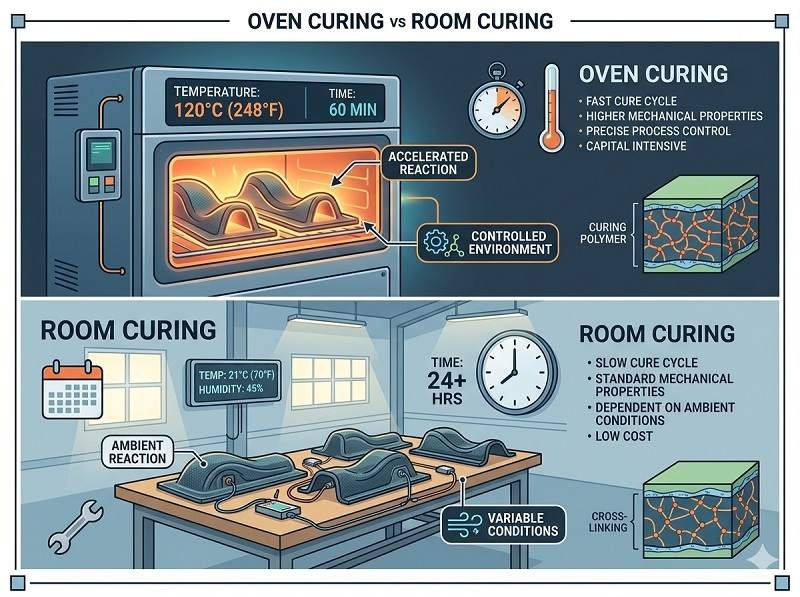
Le durcissement au four (durcissement thermique) utilise une chaleur contrôlée pour accélérer le processus de durcissement. Après l'application du Revêtement conforme, Les PCB sont placés dans un four à une température donnée pendant une durée déterminée.
Principales caractéristiques de la cuisson au four
- Températures typiques : 60-150°C, selon le type de revêtement
- Temps de durcissement plus rapide (quelques minutes à quelques heures)
- Des résultats plus cohérents et reproductibles
- Amélioration de l'adhérence et de la résistance mécanique
En cas de volume important Assemblage SMT, Le séchage au four est largement utilisé car il augmente considérablement l'efficacité de la production et garantit une qualité de revêtement uniforme pour tous les lots.
Qu'est-ce que le durcissement en chambre (durcissement à l'air) ?
Le durcissement à l'air libre repose sur l'évaporation naturelle du solvant ou la réaction de l'humidité à la température ambiante (typiquement 20-25°C) pour durcir le revêtement.
Principales caractéristiques de la polymérisation en chambre
- Aucun équipement de chauffage n'est nécessaire
- Temps de durcissement plus long (12-48 heures)
- Coût de l'énergie moins élevé
- Convient aux composants sensibles à la chaleur
Cette méthode est couramment utilisée dans les Prototype d'assemblage de circuits imprimés ou à petite échelle Assemblage du circuit imprimé, où la flexibilité et le faible coût d'installation sont plus importants que la vitesse.
Principales différences entre le séchage en étuve et le séchage en chambre
Vitesse de polymérisation
Le durcissement au four est beaucoup plus rapide, ce qui le rend idéal pour la production de masse dans les pays en développement. Assemblage SMT. Le durcissement en chambre est plus lent et peut retarder la production.
Contrôle des processus
Le séchage en étuve permet un contrôle précis de la température et de la durée, ce qui se traduit par une qualité constante. Le durcissement en chambre dépend davantage des conditions environnementales telles que l'humidité et la circulation de l'air.
Exigences en matière d'équipement
Le durcissement au four nécessite des fours thermiques et des systèmes de contrôle du processus. Le durcissement en chambre ne nécessite qu'un environnement propre et contrôlé.
Impact sur les composants
Le durcissement en chambre est plus sûr pour les composants sensibles à la température. Le durcissement en étuve doit être soigneusement contrôlé afin d'éviter tout dommage thermique pendant la cuisson. Assemblage du circuit imprimé.
Performance du revêtement
Le durcissement au four permet souvent d'obtenir des revêtements plus résistants et plus durables, avec une meilleure résistance chimique et mécanique.
Quand choisir chaque méthode
La salaison au four est la meilleure solution :
- Volume élevé Assemblage SMT
- Des calendriers de production serrés
- Applications nécessitant une grande fiabilité
Le durcissement à l'air libre est la meilleure solution :
- Prototype d'assemblage de circuits imprimés et de petits lots
- Modèles sensibles à la chaleur
- Projets sensibles aux coûts
En conclusion, la cuisson au four et la cuisson à l'air libre sont toutes deux largement utilisées dans l'industrie de la viande. Revêtement conforme processus. Le choix dépend du volume de production, du matériau de revêtement et des exigences du produit. L'optimisation de la méthode de durcissement en Assemblage du circuit imprimé, Assemblage SMT, et Prototype d'assemblage de circuits imprimés assure le meilleur équilibre entre l'efficacité, le coût et la performance du revêtement.
Obtenir un devis pour un revêtement conforme
Vous cherchez à externaliser les services de revêtement conforme ? Contactez notre équipe.
Envoyez-nous vos exigences et obtenez une réponse rapide de notre équipe d'ingénieurs.
✔ Réponse dans les 24 heures ✔ Soutien technique ✔ Production en petite et grande série
Shenzhen Tengxinjie Electronics Co. Ltd.
 Français
  English
  Deutsch
  Português do Brasil
  Español
  日本語
日本語  Nederlands
  Italiano
  Русский
  한국어
한국어  العربية
  Svenska
  Polski
  Türkçe
  繁體中文
繁體中文